Home › Plants that start with S › Swiss Cheese Vine
Indoor plant care
Swiss Cheese Vine
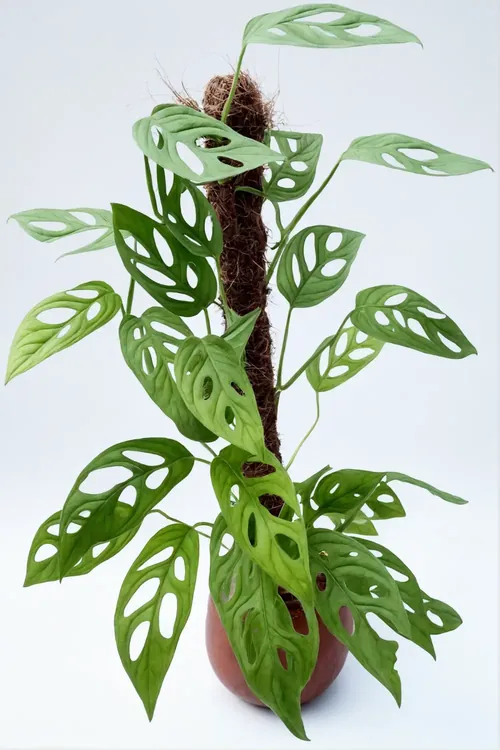
Monstera adansonii
Light requirements
Swiss Cheese Vine grows well under bright, indirect light measuring 150 to 250 μmol·m⁻²·s⁻¹. Balanced light keeps its vine leafy and supports attractive fenestrations.
- Set the pot 5 ft / 1.5m from a south, west or east-facing window.
- Avoid a position with a direct view of the sky. Soften unavoidable direct sun with a sheer curtain.
- Intense sun can scorch the thin leaves, while weak light may create long bare spaces along the vine.
- A PAR meter or PAR meter app can check photosynthetically active radiation as PPFD (μmol·m⁻²·s⁻¹).
Watering
Water Swiss Cheese Vine when the topsoil feels dry. Check below the surface as well, since the lower part of the pot may still contain moisture.
- Choose room temperature rainwater, distilled water, or reverse osmosis water.
- Wet the whole root ball until water leaves the drainage holes. Always grow the vine in a container with open drainage.
- Allow all runoff to escape before putting the pot back on a saucer or inside a decorative planter. Waterlogged soil can cause root rot, while repeated drought may lead to curling foliage and crispy brown edges.
- Reduce watering considerably in winter because the plant is not growing as actively and the mix dries more slowly.
Soil
Swiss Cheese Vine benefits from a chunky medium that balances moisture with fast drainage. Combine 2 parts organic all-purpose potting mix with 1 part Bark and 1 part Biochar.
- A DIY option uses 1 part Coir, 1 part Pumice, 1 part Bark, and 1 part Biochar.
- Top dress the finished pot with Worm Castings.
Feeding
Apply an organic all-purpose fertilizer every 2 to 4 weeks from March to October. Use the label dilution and feed Swiss Cheese Vine after watering. Do not use extra fertilizer to correct poor light, and suspend regular feeding during winter.
Temperature & humidity
Swiss Cheese Vine prefers temperatures from 65 to 85 °F / 18 to 29 °C. Keep humidity in the 50 to 60% range. Stable warmth and moderate humidity support healthy leaves. Avoid cold drafts and dry air blowing directly from vents.
What to expect
Swiss Cheese Vine reaches maturity in roughly 2 to 3 years. Depending on its support, it can grow 3 to 8 ft / 0.9 to 2.4 m tall. Its eventual spread is 1 to 3 ft / 0.3 to 0.9 m.
Varieties & cultivars
- M. adansonii ‘Wide Form’ (Monkey Mask Plant): Broad, thick leaves have a rounded, crinkled, or bubbled look compared with the narrow form.
- M. adansonii ‘Variegata’: White or cream patches create strong contrast across the leaves.
- M. adansonii ‘Laniata’: This selection develops larger leaves and stronger fenestrations. Its care is similar to standard M. adansonii.
- M. adansonii ‘Mint’: Mint-green foliage may also show areas of variegation.
- M. adansonii ‘Aurea’: Yellow variegation stands out against the remaining green leaf tissue.
Swiss Cheese Vine: questions
Is Swiss Cheese Vine toxic to cats and dogs?
Swiss Cheese Vine is toxic to people and pets, including cats and dogs. Do not allow children or animals to chew its leaves or stems. Keep trimmings out of reach and obtain…
How much light does Swiss Cheese Vine need?
Swiss Cheese Vine grows well under bright, indirect light measuring 150 to 250 μmol·m⁻²·s⁻¹. Balanced light keeps its vine leafy and supports attractive fenestrations. - Set the pot 5 ft / 1.5m from a south, west or east-facing window. - Avoid a position with a direct view of the sky. Soften…
How often should I water Swiss Cheese Vine?
Water Swiss Cheese Vine when the topsoil feels dry. Check below the surface as well, since the lower part of the pot may still contain moisture. - Choose room temperature rainwater, distilled water, or reverse osmosis water. - Wet the whole root ball until water leaves the drainage holes. Always…
How big does Swiss Cheese Vine get?
Mature size indoors: Depending on its support, it can grow 3….