9 indoor plants begin with D: Dancing Lady Orchid, Delta Maidenhair Fern, Dendrobium Orchid, Desert Rose, Dragon Tree, Dumb Cane. Every entry below shows the facts you came for first: light, water, toxicity and mature size, with the full care guide one click away. 4 of them are safe for cats and dogs.
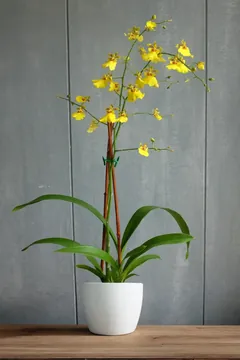
Oncidium altissimum
- LightDancing Lady Orchid prefers bright indirect light of 150 to…
- WaterWater Dancing Lady Orchid when the top of its potting…
- ToxicitySafe for cats & dogs
- Mature sizeFlowering growth may reach 2 to 4 ft /…
Dancing Lady Orchid is an epiphytic orchid known for long, branching flower sprays. Its yellow and brown blooms have a shape often compared with small dancing figures. The airy display adds height without requiring a broad, leafy plant. It suits growers with some orchid experience who can provide filtered light, an open bark mix, and careful watering.
Shop this plant
Full care guide →
Care notes
Dancing Lady Orchid prefers bright indirect light of 150 to 250 μmol·m⁻²·s⁻¹. Bright filtered exposure supports sturdy growth and flower spikes.
- Place it about 5 ft / 1.5 m from a south, west, or east-facing window.
- It should not have a direct view of the sky. Filter unavoidable sunlight through a sheer curtain.
- Too much light: leaves may turn pale or develop scorched patches.
- Too little light: foliage darkens and flowering may stop. A PAR meter or PAR meter app can measure PPFD in μmol·m⁻²·s⁻¹.
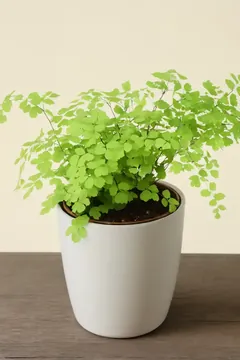
Adiantum raddianum
- LightDelta Maidenhair Fern prefers bright indirect light of 150…
- WaterKeep Delta Maidenhair Fern soil consistently moist, but…
- ToxicitySafe for cats & dogs
- Mature sizeIt reaches 1 to 2 ft / 30 to 60 cm in…
Delta Maidenhair Fern forms delicate triangular fronds carried on arching black stems. Its finely laced foliage creates a soft look while the plant remains naturally compact. It works well on a shaded stand, in a bright bathroom, or inside a humid plant display. Care is intermediate because the thin fronds react quickly to dry soil and dry air.
Shop this plant
Full care guide →
Care notes
Delta Maidenhair Fern prefers bright indirect light of 150 to 250 μmol·m⁻²·s⁻¹. Its delicate fronds need good brightness without direct exposure.
- Place it around 5 ft / 1.5 m from a south, west, or east-facing window.
- Avoid a direct view of the sky. A sheer curtain can filter sunlight that would otherwise reach the plant.
- Too much light: fronds bleach, curl, or scorch quickly.
- Too little light: growth becomes sparse and weak. A PAR meter or PAR meter app can measure PPFD in μmol·m⁻²·s⁻¹.
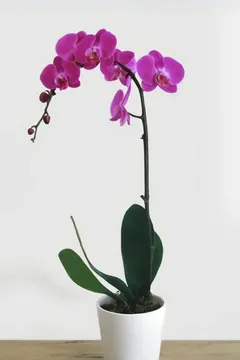
Dendrobium
- LightDendrobium Orchid prefers bright indirect light of 150 to…
- WaterWater Dendrobium Orchid when the top of the potting medium…
- ToxicitySafe for cats & dogs
- Mature sizeIt reaches 1 to 2 ft / 30 to 60 cm tall…
Dendrobium Orchid refers to a diverse group of epiphytic orchids with showy, long-lasting flowers. Blooms may be white, purple, yellow, or pink, depending on the species or cultivar. Their upright or arching canes create a strong shape even when flowers are absent. They suit growers with some experience because temperature and seasonal needs can differ across the group.
Shop this plant
Full care guide →
Care notes
Dendrobium Orchid prefers bright indirect light of 150 to 250 μmol·m⁻²·s⁻¹. Bright filtered exposure supports firm canes and regular flowering.
- Place it about 5 ft / 1.5 m from a south, west, or east-facing window.
- Avoid a direct view of the sky. Use a sheer curtain when direct sunlight cannot otherwise be prevented.
- Too much light: leaves may become pale or develop dry scorch marks.
- Too little light: canes weaken and blooming may stop. A PAR meter or PAR meter app can measure PPFD in μmol·m⁻²·s⁻¹.
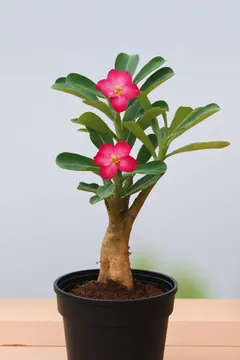
Adenium obesum
- LightDesert Rose needs bright direct light at 250 to 1000…
- WaterLet the potting mix dry completely before watering Desert…
- ToxicityToxic to pets
- Mature sizeIndoors, it can eventually stand 3 to 6…
Desert Rose is a succulent shrub with a thick, swollen base called a caudex. Glossy green leaves grow from its branching stems. Trumpet-shaped blooms appear in pink, red, or white. Its sculptural form and colorful flowers make it an appealing indoor specimen. It suits growers who can provide strong sun, careful watering, and a warm location.
Shop this plant
Full care guide →
Care notes
Desert Rose needs bright direct light at 250 to 1000 μmol·m⁻²·s⁻¹. A PAR meter or PAR meter app can measure this PPFD level.
- Give it 6+ hours of direct sunlight each day.
- Set it within 2 ft / 60 cm of a south or southwest-facing window. It should have an open view of the sky.
- Too much light without gradual adjustment may scorch the leaves.
- Too little light causes weak growth and fewer flowers. Grow lights can help during winter when daylight hours are shorter.
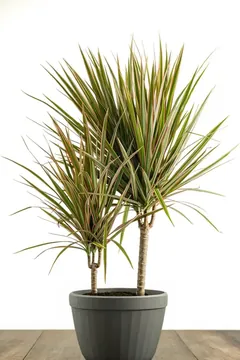
Dracaena marginata
- LightDragon Tree grows best in bright indirect light at 150 to…
- WaterWater Dragon Tree when the top half of the soil has dried…
- ToxicityToxic to pets
- Mature sizeIts eventual spread is 2 to 3 ft / 0
Dragon Tree is an upright houseplant with one or several slender trunks. Narrow, sword-shaped leaves form tufts near the tops, and red edges add subtle color. Its tall, spare outline works well where floor space is limited. It is widely grown for its easy care, tree-like shape, and ability to serve as a strong vertical accent indoors.
Shop this plant
Full care guide →
Care notes
Dragon Tree grows best in bright indirect light at 150 to 250 μmol·m⁻²·s⁻¹. A PAR meter or PAR meter app can check this PPFD range.
- Place it about 5 ft / 1.5 m from a south, west, or east-facing window.
- The leaves should not have a direct view of the sky. Use a sheer curtain if sunlight reaches them.
- Too much direct sun can bleach or scorch the narrow leaves.
- Too little light slows growth and weakens leaf color. Rotate the pot occasionally so all sides receive similar light.
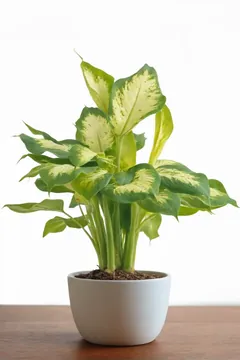
Dieffenbachia
- LightDumb Cane prefers bright indirect light at 150 to 250…
- WaterWater Dumb Cane once the topsoil feels dry. Check the…
- ToxicityToxic to pets
- Mature sizeIts eventual height is 3 to 6 ft / 0
Dumb Cane is a tropical perennial valued for its broad, patterned foliage. Depending on the selection, its leaves combine green with cream or white. The bold markings brighten rooms without requiring direct sun. It develops an upright, leafy form that can become a sizable floor plant. Grow it only where its toxic foliage will remain safely beyond the reach of children and pets.
Shop this plant
Full care guide →
Care notes
Dumb Cane prefers bright indirect light at 150 to 250 μmol·m⁻²·s⁻¹. You can confirm this PPFD range with a PAR meter or PAR meter app.
- Position it about 5 ft / 1.5 m from a south, west, or east-facing window.
- Keep the plant from having a direct view of the sky. Filter unavoidable sun with a sheer curtain.
- Too much direct light can scorch the large leaves or fade their patterns.
- Too little light slows growth and may reduce variegation. Turn the pot from time to time for balanced growth.
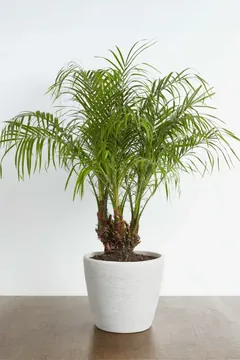
Phoenix roebelenii
- LightDwarf Date Palm needs bright indirect light at 150 to 250…
- WaterWater Dwarf Date Palm when the topsoil feels dry. Check the…
- ToxicitySafe for cats & dogs
- Mature sizeIndoors, it can reach 6 to 8 ft / 1
Dwarf Date Palm is a slow-growing palm with a slim trunk and a full crown of dark green fronds. Each frond arches outward and carries many fine, feathery leaflets. Its graceful shape brings a tropical look to bright indoor spaces. It suits growers who can provide steady moisture, filtered light, and enough room for the spreading crown.
Shop this plant
Full care guide →
Care notes
Dwarf Date Palm needs bright indirect light at 150 to 250 μmol·m⁻²·s⁻¹. A PAR meter or PAR meter app can measure this PPFD range.
- Place the palm about 5 ft / 1.5 m from a south, west, or east-facing window.
- Avoid an open view of the sky from the leaves. If direct sun reaches them, soften it with a sheer curtain.
- Too much direct sunlight can scorch the fronds.
- Too little light slows its already gradual growth and may produce sparse foliage. Rotate the container for balanced exposure.

Alocasia gageana
- LightDwarf Elephant Ear prefers bright indirect light at 150 to…
- WaterWater Dwarf Elephant Ear when the topsoil becomes dry to…
- ToxicityToxic to pets
- Mature sizeIt can eventually reach 3 to 4 ft / 90…
Dwarf Elephant Ear is an evergreen perennial with broad leaves shaped like elephant ears. Each leaf rises on a green petiole, creating a full tropical clump. Its smaller scale makes it easier to place indoors than many large Alocasias. It suits attentive growers who can maintain warm conditions, high humidity, bright filtered light, and evenly managed soil moisture.
Shop this plant
Full care guide →
Care notes
Dwarf Elephant Ear prefers bright indirect light at 150 to 250 μmol·m⁻²·s⁻¹. Check the PPFD level with a PAR meter or PAR meter app if needed.
- Set it around 5 ft / 1.5 m from a south, west, or east-facing window.
- The foliage should not have a direct view of the sky. Use a sheer curtain where direct sunlight cannot be avoided.
- Too much sun can bleach or scorch the broad leaves.
- Too little light leads to weak stems and slow growth. Turn the pot regularly to keep the clump even.
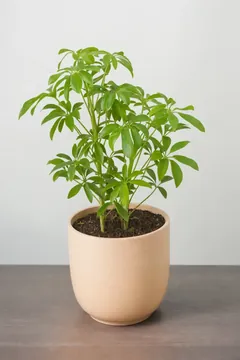
Schefflera arboricola
- LightDwarf Umbrella Tree grows best in bright indirect light at…
- WaterWater Dwarf Umbrella Tree when the topsoil feels dry. Test…
- ToxicityToxic to pets
- Mature sizeIndoors, it can grow 4 to 8 ft / 1
Dwarf Umbrella Tree is a glossy-leaved houseplant with leaflets that spread like the ribs of an umbrella. Its finger-like foliage forms a dense canopy above branching stems. It can grow as a bushy floor plant or be trained into a small tree shape. This plant suits growers who can offer bright filtered light and regular care without keeping the soil constantly wet.
Shop this plant
Full care guide →
Care notes
Dwarf Umbrella Tree grows best in bright indirect light at 150 to 250 μmol·m⁻²·s⁻¹. A PAR meter or PAR meter app can measure this PPFD range.
- Place it about 5 ft / 1.5 m from a south, west, or east-facing window.
- Do not give the foliage a direct view of the sky. Filter unavoidable sun through a sheer curtain.
- Too much direct sunlight may bleach or scorch the glossy leaflets.
- Too little light causes sparse, stretched growth and leaf drop. Rotate the pot regularly so the canopy develops evenly.
Questions about plants that start with D
How many indoor plants start with D?
9, as listed on this page.
Is Dancing Lady Orchid safe for cats and dogs?
Safe for cats & dogs. Dancing Lady Orchid is regarded as non-toxic to people and pets. However, Oncidium altissimum has no clear species-specific ASPCA safety ruling, so it cannot be called pet safe on that basis. Keep flowers, bark, and plant treatments away from pets that chew indoor plants.
How much light does a Dancing Lady Orchid need?
Dancing Lady Orchid prefers bright indirect light of 150 to 250 μmol·m⁻²·s⁻¹. Bright filtered exposure supports sturdy growth and flower spikes.Place it about 5 ft / 1.5 m from a south, west, or east-facing window. It should not have a direct view of the sky. Filter unavoidable sunlight through a sh
How do I know which of these plants suits my room?
Sort by the facts strip: low-light plants for north-facing rooms, pet-safe names if you have a cat or dog, and the smaller species for shelves and desks.