LightSago Palm prefers bright indirect light at 150 to 250…
WaterAllow the soil to dry completely before watering Sago Palm…
ToxicityToxic to pets
Mature sizeA mature specimen may eventually stand…
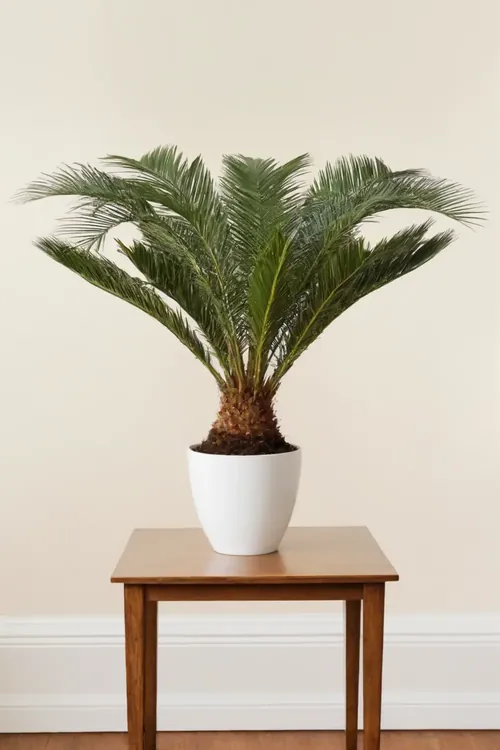
Sago Palm is an evergreen cycad, not a true palm. It develops a balanced rosette of stiff, glossy, dark green leaves with a feather-like form. Growth is extremely slow, so it changes little from year to year indoors. The structured shape works well as a long-term floor plant. It suits patient growers, but its serious toxicity makes it unsuitable for homes where children or pets can reach it.
Care data checked 25 September 2026 · Dany · A-Z Plants
Light requirements
Sago Palm prefers bright indirect light at 150 to 250 μmol·m⁻²·s⁻¹ PPFD. Use a PAR meter or app if you need to confirm the level.
Placement: set it 5 ft / 1.5 m from a south, west, or east-facing window.
Keep the leaves from having a direct view of the sky. A sheer curtain can filter unavoidable sun.
Too much light: sudden, strong exposure may bleach or burn the fronds.
Too little light: new leaves may become weak, sparse, or stretched toward the window.
Watering
Allow the soil to dry completely before watering Sago Palm. Check more than the surface by inserting a knitting needle or chopstick to different depths. Use room temperature rainwater, distilled water, or reverse osmosis water.
Water deeply until excess flows from every drainage hole.
Wait for the pot to drain fully before returning it to a saucer or decorative planter.
Water considerably less in winter because the plant is not actively growing.
Soil that stays wet can cause root and crown rot. Very long dry periods may brown or crisp the frond tips. A container with drainage holes is essential for this slow-growing cycad.
Soil
Sago Palm needs a gritty, fast-draining medium. A specialty organic potting mix formulated for succulents works well. Do not use a dense mix that holds water around its roots.
DIY mix: combine 2 parts coir, 2 parts coarse sand, and 1 part pumice.
Always pair the mix with a pot that drains freely.
Feeding
Apply an organic all-purpose fertilizer every 2 to 4 weeks from March to October. Use the package strength intended for indoor plants. Do not exceed the label rate, and avoid maintaining this feeding schedule during the slower winter season.
Temperature & humidity
Sago Palm grows best at 60 to 75 °F / 16 to 24 °C. Avoid sudden chills and cold drafts around new fronds. A humidity range of 40 to 60% is suitable. Average indoor humidity is usually enough when watering and drainage are managed correctly.
What to expect
Sago Palm is notably slow growing. Indoors, it can take 10 to 20 years to reach maturity. A mature specimen may eventually stand 5 to 8 ft / 1.5 to 2.5 m tall. Its symmetrical crown can also spread 5 to 8 ft / 1.5 to 2.5 m.
Varieties & cultivars
C. revoluta: This common form produces glossy, dark green fronds in a balanced crown.
C. revoluta var. Hainesii: A dwarf form that remains more compact than the standard Sago Palm.
C. revoluta ‘Variegata’: This rare cultivar has variegated leaves edged with creamy white.
Sago Palm: questions
Is Sago Palm toxic to cats and dogs?
The ASPCA lists Sago Palm as toxic to cats and dogs, and it is also toxic to people. Treat every accessible plant part as a poisoning risk. Keep the plant, fallen material, and…
How much light does Sago Palm need?
Sago Palm prefers bright indirect light at 150 to 250 μmol·m⁻²·s⁻¹ PPFD. Use a PAR meter or app if you need to confirm the level. - Placement: set it 5 ft / 1.5 m from a south, west, or east-facing window. - Keep the leaves from having a direct view of the sky. A sheer curtain can filter…
How often should I water Sago Palm?
Allow the soil to dry completely before watering Sago Palm. Check more than the surface by inserting a knitting needle or chopstick to different depths. Use room temperature rainwater, distilled water, or reverse osmosis water. - Water deeply until excess flows from every drainage hole. - Wait for…
How big does Sago Palm get?
Mature size indoors: A mature specimen may eventually stand….