LightSatin Pothos grows best in bright indirect light at 150 to…
WaterWater Satin Pothos when the topsoil feels dry. Check below…
ToxicityToxic to pets
Mature sizeIts climbing or trailing stems can…
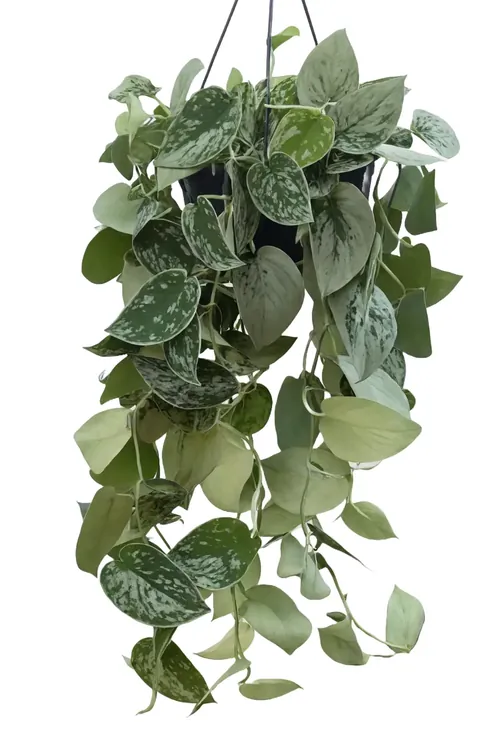
Satin Pothos is a trailing vine with soft-looking, heart-shaped leaves. The dark green foliage has a velvety surface and silvery-grey splashes that catch the light. Stems can trail from a shelf or hanging planter, or climb a support. It is easy to grow when drainage is good. This plant suits beginners seeking patterned foliage, but it must be kept away from children and pets because it is toxic.
Care data checked 25 September 2026 · Dany · A-Z Plants
Light requirements
Satin Pothos grows best in bright indirect light at 150 to 250 μmol·m⁻²·s⁻¹ PPFD. A PAR meter or app can confirm whether the site is bright enough.
Placement: keep it 5 ft / 1.5 m from a south, west, or east-facing window.
Avoid a direct view of the sky. Add a sheer curtain if sun reaches the foliage.
Too much light: strong direct rays can bleach the silver pattern and scorch leaves.
Too little light: growth slows, gaps lengthen between leaves, and variegation may become less distinct.
Watering
Water Satin Pothos when the topsoil feels dry. Check below the surface as well so the lower mix is not still saturated. Use room temperature rainwater, distilled water, or reverse osmosis water.
Soak the root ball until water runs from the drainage holes.
Let all excess water escape before putting the pot back on a saucer or inside a decorative planter.
Water considerably less during winter, when the vine is not actively growing.
Persistently wet soil can lead to root rot and yellow leaves. Waiting too long may cause wilted foliage and crisp edges. A pot with drainage holes is essential for reliable watering.
Soil
Satin Pothos prefers a chunky, free-draining mix. Combine 2 parts organic all-purpose potting mix with 1 part bark and 1 part biochar for a ready blend.
DIY mix: use 1 part coir, 1 part pumice, 1 part bark, and 1 part biochar.
Top dress the finished mix with worm castings.
Feeding
Apply an organic all-purpose fertilizer every 2 to 4 weeks from March to October. Use the indoor-plant strength stated on the package. Avoid feeding more often than directed, and pause the regular schedule while Satin Pothos grows slowly in winter.
Temperature & humidity
Keep Satin Pothos at 65 to 85 °F / 18 to 29 °C. Protect it from cold drafts and sudden temperature changes. Humidity between 40 and 50% is suitable. Average indoor conditions generally work, although very dry air may brown leaf edges.
What to expect
Satin Pothos has a moderate growth rate and may take about 5 years to mature. Its climbing or trailing stems can reach 4 to 10 ft / 1.2 to 3 m. A mature plant may occupy a spread of 1.5 to 3 ft / 0.5 to 1 m.
Varieties & cultivars
S. pictus ‘Argyraeus’: Smaller dark green leaves have evenly scattered silver marks and continuous silver edges.
S. pictus ‘Exotica’: Larger leaves display broad and strongly defined silver markings.
S. pictus ‘Silver Splash’: The silver pattern has a splashed look similar to, but distinct from, ‘Exotica’.
S. pictus ‘Silver Lady’: Dense silver variegation covers the leaves, which have a mint-green underside.
Satin Pothos: questions
Is Satin Pothos toxic to cats and dogs?
The ASPCA lists Satin Pothos as toxic to cats and dogs. It is also toxic to people when eaten. Place the vine where children and animals cannot chew its leaves or stems, and…
How much light does Satin Pothos need?
Satin Pothos grows best in bright indirect light at 150 to 250 μmol·m⁻²·s⁻¹ PPFD. A PAR meter or app can confirm whether the site is bright enough. - Placement: keep it 5 ft / 1.5 m from a south, west, or east-facing window. - Avoid a direct view of the sky. Add a sheer curtain if sun reaches the…
How often should I water Satin Pothos?
Water Satin Pothos when the topsoil feels dry. Check below the surface as well so the lower mix is not still saturated. Use room temperature rainwater, distilled water, or reverse osmosis water. - Soak the root ball until water runs from the drainage holes. - Let all excess water escape before…
How big does Satin Pothos get?
Mature size indoors: Its climbing or trailing stems can….