9 indoor plants begin with F: Fiddle Leaf Fig, Fire Flash Plant, Fishbone Cactus, Flame Violet, Flaming Katy, Flamingo Flower. Every entry below shows the facts you came for first: light, water, toxicity and mature size, with the full care guide one click away. 4 of them are safe for cats and dogs.
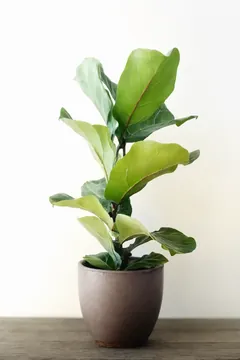
Ficus lyrata
- LightFiddle Leaf Fig needs bright indirect light at 150 to 250…
- WaterDuring active growth, water Fiddle Leaf Fig when the top…
- ToxicityToxic to pets
- Mature sizeIndoors, it can grow 6 to 10 ft / 1
Fiddle Leaf Fig is an upright, single-stemmed indoor tree with large, glossy leaves. Their broad shape narrows through the middle, resembling a fiddle. Deep green foliage and a strong vertical form make it a dramatic floor plant. It suits experienced growers who can provide consistent light, careful watering, stable warmth, and enough room for its broad canopy.
Shop this plant
Full care guide →
Care notes
Fiddle Leaf Fig needs bright indirect light at 150 to 250 μmol·m⁻²·s⁻¹. A PAR meter or PAR meter app can check this PPFD range.
- Place it about 5 ft / 1.5 m from a south, west, or east-facing window.
- The leaves should not have a direct view of the sky. Filter unavoidable direct sunlight with a sheer curtain.
- Too much sun can scorch the broad leaves, especially after a sudden move.
- Too little light leads to slow growth, leaf loss, and a sparse canopy. Rotate the pot regularly for balanced growth.
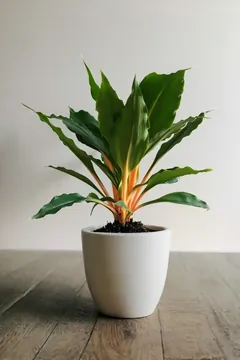
Chlorophytum orchidastrum
- LightFire Flash Plant prefers bright indirect light at 150 to…
- WaterWater Fire Flash Plant when the topsoil feels dry to the…
- ToxicitySafe for cats & dogs
- Mature sizeIt can grow 12 to 18 in / 30 to 45 cm…
Fire Flash Plant is a clumping houseplant with arching green leaves and vivid orange stems. Mature plants may send out long runners tipped with small plantlets called spiderettes. The contrast between green foliage and orange growth gives it a bright tropical look. Its manageable size and straightforward care suit shelves, stands, or tabletops with strong filtered light.
Shop this plant
Full care guide →
Care notes
Fire Flash Plant prefers bright indirect light at 150 to 250 μmol·m⁻²·s⁻¹. A PAR meter or PAR meter app can measure this PPFD range.
- Place it about 5 ft / 1.5 m from a south, west, or east-facing window.
- Do not give the foliage a direct view of the sky. Use a sheer curtain if sunlight reaches the leaves.
- Too much direct sun may scorch the foliage or fade the orange stems.
- Too little light slows growth and weakens stem color. Rotate the container to maintain a balanced clump.
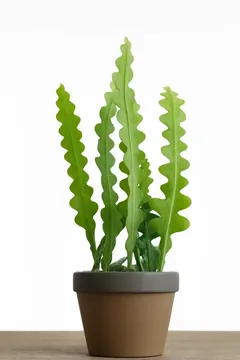
Epiphyllum anguliger
- LightFishbone Cactus prefers bright indirect light at 150 to 250…
- WaterWater Fishbone Cactus when the topsoil feels dry. Although…
- ToxicitySafe for cats & dogs
- Mature sizeIts trailing growth can reach 1 to 2 ft…
Fishbone Cactus is an epiphytic cactus with long, flattened stems that trail from its container. Deep, regular lobes give each stem the outline of a fish skeleton. Unlike desert cacti, it prefers filtered light and somewhat more moisture and humidity. Its cascading habit makes it well suited to hanging baskets, high shelves, and containers where the patterned stems can remain visible.
Shop this plant
Full care guide →
Care notes
Fishbone Cactus prefers bright indirect light at 150 to 250 μmol·m⁻²·s⁻¹. A PAR meter or PAR meter app can measure this PPFD range.
- Set it about 5 ft / 1.5 m from a south, west, or east-facing window.
- Avoid giving the stems a direct view of the sky. Soften unavoidable sunlight with a sheer curtain.
- Too much direct sun can bleach or scorch the flattened stems.
- Too little light slows growth and may reduce flowering. Rotate hanging baskets so all stems receive balanced exposure.
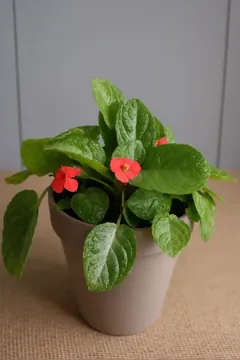
Episcia cupreata
- LightFlame Violet prefers bright indirect light at 150 to 250…
- WaterWater Flame Violet when the topsoil feels dry to the touch…
- ToxicitySafe for cats & dogs
- Mature sizeIt stays 4 to 8 in / 10 to 20 cm tall…
Flame Violet is a trailing evergreen perennial that forms rosettes of soft, velvety leaves. Its stems cascade over container edges, while bright red, funnel-shaped flowers add color. Under suitable conditions, blooming can continue throughout the year. The plant works well in hanging baskets but suits growers who can provide warm air, raised humidity, bright filtered light, and careful watering.
Shop this plant
Full care guide →
Care notes
Flame Violet prefers bright indirect light at 150 to 250 μmol·m⁻²·s⁻¹. A PAR meter or PAR meter app can check this PPFD range.
- Position it about 5 ft / 1.5 m from a south, west, or east-facing window.
- Do not give the foliage a direct view of the sky. Filter unavoidable sunlight through a sheer curtain.
- Too much direct sun may scorch the velvety leaves or fade their markings.
- Too little light produces weak trailing growth and fewer flowers. Rotate the pot carefully for balanced exposure.
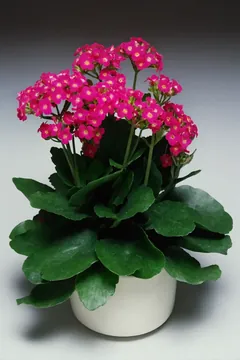
Kalanchoe blossfeldiana
- LightFlaming Katy grows best in bright, indirect light measuring…
- WaterWater Flaming Katy after the surface soil becomes dry…
- ToxicityToxic to pets
- Mature sizeA mature plant stands about 12 to 18 in…
Flaming Katy is a compact, branching succulent with shiny green foliage and dense flower clusters. Its vivid blooms add lasting color without taking up much room. The fleshy leaves store water, so it handles occasional missed watering better than constantly wet soil. It suits bright indoor spaces and growers who want a small flowering plant with simple seasonal care.
Shop this plant
Full care guide →
Care notes
Flaming Katy grows best in bright, indirect light measuring 150 to 250 μmol·m⁻²·s⁻¹.
- Set it about 5 ft / 1.5m from a south, west or east-facing window.
- Choose a place where the leaves have no direct view of the sky. Filter unavoidable sun with a sheer curtain.
- Excess direct light can bleach or scorch the foliage. Weak light reduces growth and flowering.
- A PAR meter or PAR meter app can measure photosynthetically active radiation as PPFD in μmol·m⁻²·s⁻¹.
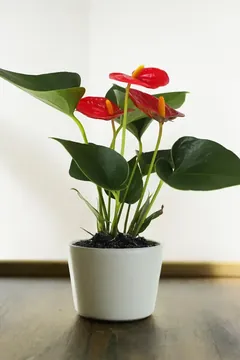
Anthurium andraeanum
- LightFlamingo Flower prefers bright, indirect light at 150 to…
- WaterWater Flamingo Flower once the topsoil feels dry. Test the…
- ToxicityToxic to pets
- Mature sizeIndoors, its eventual height is 1 to 2…
Flamingo Flower is an upright tropical plant that naturally grows as an epiphyte. It has broad, glossy leaves with a clear heart shape. Colorful spathes rise above the foliage and provide its main indoor display. This plant suits someone who can offer bright filtered light, an airy root mix and steady moisture without leaving the roots waterlogged.
Shop this plant
Full care guide →
Care notes
Flamingo Flower prefers bright, indirect light at 150 to 250 μmol·m⁻²·s⁻¹.
- Position it around 5 ft / 1.5m from a south, west or east-facing window.
- Keep the plant where it does not have an open view of the sky. Use a sheer curtain if sunlight reaches the foliage directly.
- Strong direct sun may scorch or fade the broad leaves. Low light can slow growth and reduce spathe production.
- Check photosynthetically active radiation with a PAR meter or PAR meter app, reading PPFD in μmol·m⁻²·s⁻¹.
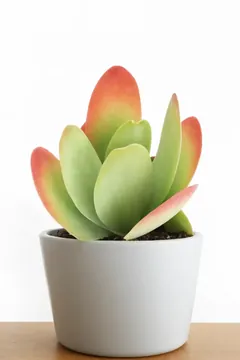
Kalanchoe thyrsiflora
- LightFlapjack Plant needs bright, indirect light in the range of…
- WaterLet the Flapjack Plant's soil dry completely before…
- ToxicityToxic to pets
- Mature sizeIts eventual height is 12 to 18 in / 30…
Flapjack Plant is a perennial succulent built around a low basal rosette. Its large, fleshy leaves are round to wedge-shaped, with greyish-green surfaces and red-toned margins. The bold leaf form gives it a sculptural look indoors. It is easy to manage when given bright filtered light, lean soil and long dry periods between thorough waterings.
Shop this plant
Full care guide →
Care notes
Flapjack Plant needs bright, indirect light in the range of 150 to 250 μmol·m⁻²·s⁻¹.
- Place it about 5 ft / 1.5m from a south, west or east-facing window.
- Prevent a direct view of the sky from the foliage. If sun reaches the leaves, soften it through a sheer curtain.
- Too much direct light can scorch the broad leaves. Too little light may weaken growth and reduce the red coloring.
- Use a PAR meter or PAR meter app to check photosynthetically active radiation as PPFD in μmol·m⁻²·s⁻¹.
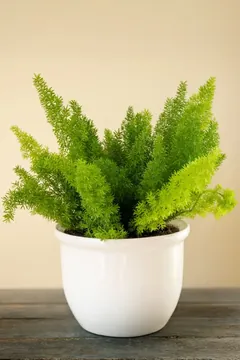
Asparagus densiflorus
- LightFoxtail Fern performs best under bright, indirect light…
- WaterWater Foxtail Fern after the topsoil feels dry. Check the…
- ToxicityToxic to pets
- Mature sizeIts eventual height is 2 to 3 ft / 60…
Foxtail Fern is an airy plant with soft, needle-like foliage arranged on plump, upright stems. Each stem resembles a fluffy fox tail, creating a fine texture without the look of a typical broad-leaf houseplant. Despite its common name, it is an asparagus relative rather than a true fern. It suits growers who can provide filtered light, regular watering and room for a rounded mature clump.
Shop this plant
Full care guide →
Care notes
Foxtail Fern performs best under bright, indirect light measuring 150 to 250 μmol·m⁻²·s⁻¹.
- Keep it around 5 ft / 1.5m from a south, west or east-facing window.
- Select a spot without a direct view of the sky. Filter any unavoidable sunlight through a sheer curtain.
- Strong direct sun may bleach or burn the delicate foliage. Dim conditions can produce weak, sparse stems.
- A PAR meter or PAR meter app can measure photosynthetically active radiation as PPFD in μmol·m⁻²·s⁻¹.
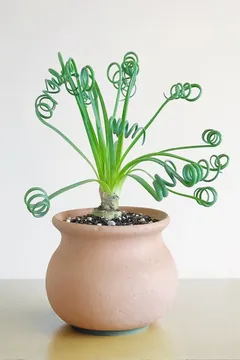
Albuca spiralis
- LightFrizzle Sizzle Plant favors bright, indirect light at 150…
- WaterAllow the Frizzle Sizzle Plant's soil to become completely…
- ToxicitySafe for cats & dogs
- Mature sizeIt eventually stands 8 to 12 in / 20 to…
Frizzle Sizzle Plant is a compact bulb plant known for narrow leaves that twist into corkscrew curls. The foliage rises from an underground bulb and gives the plant an unusual shape even when it is not blooming. In late winter or spring, tall stalks carry yellow flowers with a vanilla fragrance. It suits a bright room and a grower comfortable with a seasonal growth cycle.
Shop this plant
Full care guide →
Care notes
Frizzle Sizzle Plant favors bright, indirect light at 150 to 250 μmol·m⁻²·s⁻¹.
- Place it near, but about 5 ft / 1.5m from, a south, west or east-facing window.
- Keep the leaves from having a direct view of the sky. A sheer curtain can soften sunlight that would otherwise strike them.
- Harsh direct sun can scorch the curls. Low light may cause weak, straighter foliage and poorer flowering.
- Measure photosynthetically active radiation with a PAR meter or PAR meter app, using PPFD in μmol·m⁻²·s⁻¹.
Questions about plants that start with F
How many indoor plants start with F?
9, as listed on this page.
Is Fiddle Leaf Fig safe for cats and dogs?
Toxic to pets. Fiddle Leaf Fig is toxic to people, cats, and dogs. Its milky sap and plant tissues should not be eaten. Keep it beyond the reach of children and pets. Wear gloves during pruning, avoid contact with eyes and mouth, and wash away sap promptly.
How much light does a Fiddle Leaf Fig need?
Fiddle Leaf Fig needs bright indirect light at 150 to 250 μmol·m⁻²·s⁻¹. A PAR meter or PAR meter app can check this PPFD range.Place it about 5 ft / 1.5 m from a south, west, or east-facing window. The leaves should not have a direct view of the sky. Filter unavoidable direct sunlight with a sheer c
How do I know which of these plants suits my room?
Sort by the facts strip: low-light plants for north-facing rooms, pet-safe names if you have a cat or dog, and the smaller species for shelves and desks.