LightScarlet Star prefers bright indirect light at 150 to 250…
WaterKeep fresh water in the central cup of Scarlet Star. Flush…
ToxicitySafe for cats & dogs
Mature sizeA full rosette can reach 1 to 2 ft / 30…
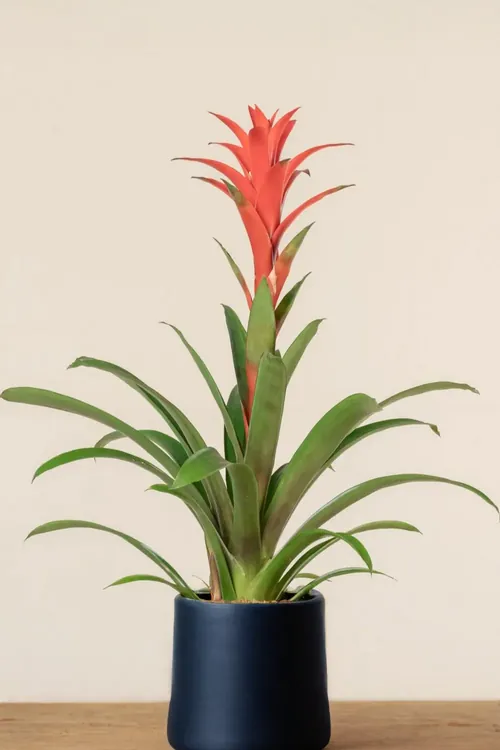
Scarlet Star is a bromeliad that forms a central rosette of stiff, sword-shaped leaves. The overlapping bases create a cup that naturally holds water. A bright central bract, which is a modified leaf, provides the display commonly mistaken for a flower. Its tidy shape and long-lasting color suit tabletops and shelves. It is easy indoors when the cup stays fresh and the root mix remains airy.
Care data checked 25 September 2026 · Dany · A-Z Plants
Light requirements
Scarlet Star prefers bright indirect light at 150 to 250 μmol·m⁻²·s⁻¹ PPFD. A PAR meter or app can help check the site.
Placement: keep it 5 ft / 1.5 m from a south, west, or east-facing window.
The leaves should not have a direct view of the sky. Filter unavoidable sunlight through a sheer curtain.
Too much light: foliage and colorful bracts can fade or scorch.
Too little light: growth slows, the rosette weakens, and future color may be poor.
Watering
Keep fresh water in the central cup of Scarlet Star. Flush the cup and replace its water monthly. Water the potting mix after the top third has dried. Check deeper moisture with a knitting needle or chopstick. Use room temperature rainwater, distilled water, or reverse osmosis water.
Wet the mix until water drains from the pot, then allow all excess to escape.
Never leave the container standing in a filled saucer or decorative planter.
Water the soil considerably less in winter when active growth slows.
Stale cup water or saturated soil can encourage rot. An empty cup and prolonged dryness may cause crisp leaf edges. Drainage holes are essential.
Soil
Scarlet Star needs a loose specialty organic bromeliad mix that drains quickly and leaves air around the roots. Standard dense potting soil can remain wet for too long.
DIY mix: combine 2 parts bark, 1 part pumice, and 1 part biochar.
Use a pot with open drainage holes and do not compress the mixture firmly.
Feeding
Apply an organic fertilizer formulated for bromeliads every 2 to 4 weeks from March to October. Follow the package strength for indoor bromeliads. Avoid overfeeding the cup or roots, and reduce fertilizer use when Scarlet Star is not actively growing.
Temperature & humidity
Scarlet Star accepts temperatures from 60 to 95 °F / 15 to 35 °C. Keep it away from sudden cold drafts despite this broad range. Aim for 50 to 60% humidity. Moist air supports healthy foliage, while airflow helps keep the water-holding rosette fresh.
What to expect
Scarlet Star grows at a slow to moderate rate and takes about 5 years to mature. A full rosette can reach 1 to 2 ft / 30 to 60 cm tall. Its eventual spread is also about 1 to 2 ft / 30 to 60 cm.
Varieties & cultivars
G. conifera: Silvery leaves surround bright red, pine cone-like flower bracts. This is a rare and distinctive bromeliad.
G. monostachia: Long, narrow leaves frame a tall spike with white or yellow flowers and red or purple bracts.
Scarlet Star: questions
Is Scarlet Star toxic to cats and dogs?
The ASPCA lists Scarlet Star as non-toxic to cats and dogs. It is also considered non-toxic to people. Its stiff leaves may still be unpleasant to chew, so keep the plant from…
How much light does Scarlet Star need?
Scarlet Star prefers bright indirect light at 150 to 250 μmol·m⁻²·s⁻¹ PPFD. A PAR meter or app can help check the site. - Placement: keep it 5 ft / 1.5 m from a south, west, or east-facing window. - The leaves should not have a direct view of the sky. Filter unavoidable sunlight through a sheer…
How often should I water Scarlet Star?
Keep fresh water in the central cup of Scarlet Star. Flush the cup and replace its water monthly. Water the potting mix after the top third has dried. Check deeper moisture with a knitting needle or chopstick. Use room temperature rainwater, distilled water, or reverse osmosis water. - Wet the mix…
How big does Scarlet Star get?
Mature size indoors: A full rosette can reach 1 to 2 ft / 30….