LightSwedish Ivy performs best in bright, indirect light of 150…
WaterLet the soil become almost dry before watering Swedish Ivy…
ToxicitySafe for cats & dogs
Mature sizeIts eventual height is 2 to 3 ft / 60…
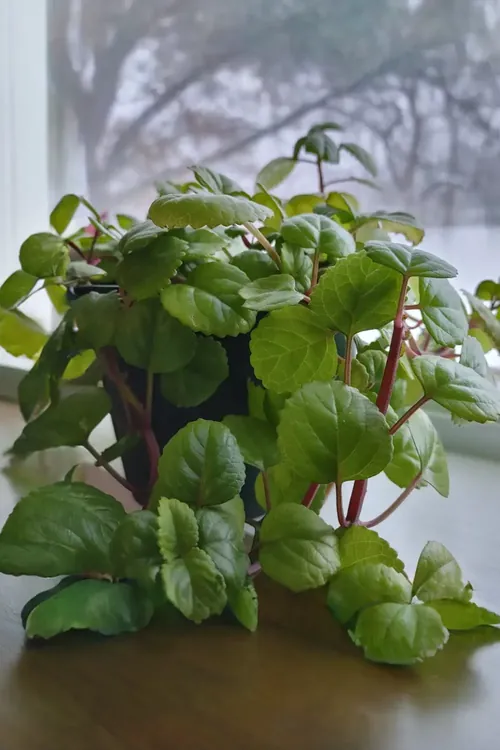
Swedish Ivy is a trailing evergreen perennial with glossy green foliage and softly scalloped edges. Flexible stems spread outward and spill over container rims, making it useful for hanging baskets and high shelves. Small purple flowers may appear during fall. This easy houseplant offers quick visual coverage without needing complex care. It suits growers who can provide bright filtered light and allow the soil to become nearly dry.
Care data checked 25 September 2026 · Dany · A-Z Plants
Light requirements
Swedish Ivy performs best in bright, indirect light of 150 to 250 μmol·m⁻²·s⁻¹. Steady filtered light helps keep the trailing growth full.
Keep the plant about 5 ft / 1.5m from a south, west or east-facing window.
Select a spot without a direct view of the sky. Use a sheer curtain when sunlight would otherwise strike the leaves.
Excess direct sun may scorch the glossy foliage. Too little light can weaken growth and reduce flowering.
A PAR meter or PAR meter app can read photosynthetically active radiation as PPFD (μmol·m⁻²·s⁻¹).
Watering
Let the soil become almost dry before watering Swedish Ivy. Avoid keeping the root zone constantly wet, but do not leave it dry for long periods during active growth.
Check moisture at different depths with a chopstick or knitting needle before deciding to water.
Use room temperature rainwater, distilled water, or reverse osmosis water. Soak the soil until water runs from the drainage holes.
Wait for excess water to drain before placing the pot in a saucer or decorative planter. A pot without drainage can hold enough water to cause root rot.
Water considerably less during winter, when the plant is not actively growing. Prolonged dryness may leave foliage limp with brown, crispy edges.
Soil
Swedish Ivy grows well in an organic all-purpose potting mix that drains freely while holding some moisture. The container needs drainage holes so water cannot gather around the roots.
For a DIY medium, combine 3 parts Coir with 1 part Pumice.
Finish with a top dressing of Worm Castings rather than packing them deeply around the roots.
Feeding
Apply an organic all-purpose fertilizer every 2 to 4 weeks from March through October. Use the stated dilution and feed only when the soil is moist. Do not add extra fertilizer to speed growth, and pause feeding during the quieter winter months.
Temperature & humidity
Swedish Ivy prefers a broad temperature range of 50 to 75 °F / 10 to 24 °C. Maintain indoor humidity around 40 to 50%. Protect the foliage from sudden cold drafts and drying air from heating or cooling equipment.
What to expect
Swedish Ivy generally matures within 3 to 4 years. Its eventual height is 2 to 3 ft / 60 to 90 cm, with a similar spread of 2 to 3 ft / 60 to 90 cm. Trailing stems gradually fill available space.
Varieties & cultivars
P. verticillatus: This fast-growing trailer has shiny green leaves with scalloped margins. Small tubular flowers range from white to pale mauve.
P. coleoides ‘Variegatus’: Green leaves have white borders. Its trailing growth is well suited to hanging baskets.
P. purpuratus: Purple tones color the leaves and stems, creating contrast among green houseplants.
P. oertendahlii: Known as Swedish Ivy ‘Silver Shield’, it combines silver-grey leaves, green veins, and a trailing form.
Swedish Ivy: questions
Is Swedish Ivy toxic to cats and dogs?
Swedish Ivy is considered non-toxic to people and pets, including cats and dogs. It is still best to prevent chewing or swallowing large amounts of foliage. Place hanging stems…
How much light does Swedish Ivy need?
Swedish Ivy performs best in bright, indirect light of 150 to 250 μmol·m⁻²·s⁻¹. Steady filtered light helps keep the trailing growth full. - Keep the plant about 5 ft / 1.5m from a south, west or east-facing window. - Select a spot without a direct view of the sky. Use a sheer curtain when sunlight…
How often should I water Swedish Ivy?
Let the soil become almost dry before watering Swedish Ivy. Avoid keeping the root zone constantly wet, but do not leave it dry for long periods during active growth. - Check moisture at different depths with a chopstick or knitting needle before deciding to water. - Use room temperature rainwater…
How big does Swedish Ivy get?
Mature size indoors: Its eventual height is 2 to 3 ft / 60….