LightGive String of Tears bright, indirect light in the 150 to…
WaterAllow the entire potting mix to dry before watering String…
ToxicitySafe for cats & dogs
Mature sizesee care guide
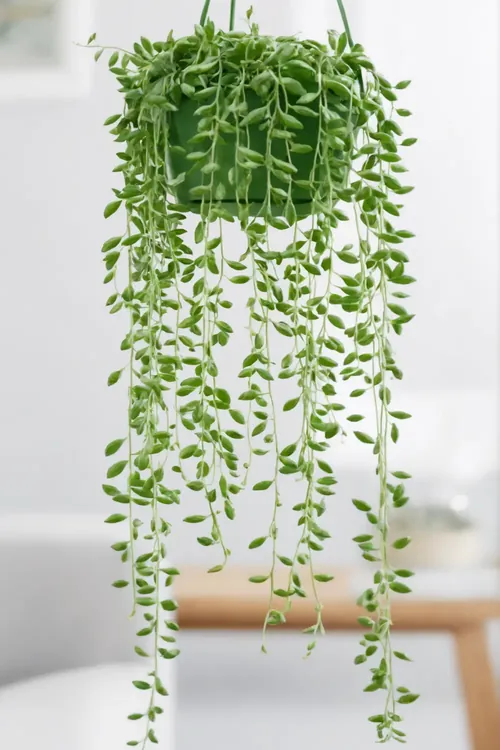
String of Tears is a trailing succulent known for fleshy, tear-shaped leaves arranged along slender stems. Its cascading form works well in hanging baskets and on shelves where the growth can fall freely. The leaves store moisture, making this an easy plant for careful waterers. It is a practical choice for smaller indoor spaces with bright filtered light, though the fragile stems should be handled gently.
Care data checked 25 September 2026 · Dany · A-Z Plants
Light requirements
Give String of Tears bright, indirect light in the 150 to 250 μmol·m⁻²·s⁻¹ range. Good exposure supports dense leaves along the trailing stems.
Position the pot 5 ft / 1.5m from a south, west or east-facing window.
Use a place where the plant lacks a direct view of the sky. Hang a sheer curtain if direct sunlight cannot be avoided.
Harsh sun can mark or scorch the leaves. Insufficient light may make the stems thin and widely spaced.
Measure photosynthetically active radiation as PPFD (μmol·m⁻²·s⁻¹) with a PAR meter or PAR meter app.
Watering
Allow the entire potting mix to dry before watering String of Tears. Its fleshy foliage stores moisture, so the roots should not remain damp between waterings.
Test several depths with a knitting needle or chopstick. The surface may feel dry while the lower mix is still moist.
Water with room temperature rainwater, distilled water, or reverse osmosis water. Continue until water comes through the drainage holes.
Drain the pot completely before returning it to a saucer or decorative planter. Drainage holes are essential, since trapped moisture can cause root rot.
Cut watering considerably during winter, when growth is less active. Extended drought may shrivel leaves and produce dry or crispy stem tips.
Soil
String of Tears needs a coarse, airy medium that releases water quickly. Choose a specialty organic potting mix made for succulents. Always use a pot with working drainage holes.
A simple DIY recipe is 2 parts Coir, 2 parts Coarse Sand, and 1 part Pumice. Blend all parts thoroughly to prevent dense, wet pockets.
Feeding
Use an organic fertilizer formulated for succulents every 2 to 4 weeks between March and October. Apply only the recommended dilution and avoid feeding dry roots. Do not continue routine feeding through winter, when String of Tears uses fewer nutrients.
Temperature & humidity
String of Tears prefers temperatures of 65 to 75 °F / 18 to 24 °C. Aim for an indoor humidity range of 40 to 50%. Keep the plant away from cold drafts and strong heating or cooling vents that cause rapid changes.
What to expect
This trailing succulent reaches maturity in about 2 to 3 years. Its stems can eventually hang 3 ft / 1 m below the pot. The mature spread is around 1 ft / 30 cm, with branching gradually filling the container.
Varieties & cultivars
S. rowleyanus ‘Variegata’: Also called Variegated String of Pearls, it has cream streaks across bead-like leaves.
S. radicans ‘Glauca’: Known as Blue String of Bananas, this form has blue-green leaves shaped like bananas.
S. herreianus ‘Purple Flush’: Also called String of Beads, it develops purple coloring over its tear-shaped leaves.
S. herreianus ‘Variegata’: White streaks mark the foliage of this variegated String of Tears.
String of Tears: questions
Is String of Tears toxic to cats and dogs?
String of Tears is described as non-toxic to people and pets, including cats and dogs. Plant material still should not be treated as food. Keep it away from children or animals…
How much light does String of Tears need?
Give String of Tears bright, indirect light in the 150 to 250 μmol·m⁻²·s⁻¹ range. Good exposure supports dense leaves along the trailing stems. - Position the pot 5 ft / 1.5m from a south, west or east-facing window. - Use a place where the plant lacks a direct view of the sky. Hang a sheer curtain…
How often should I water String of Tears?
Allow the entire potting mix to dry before watering String of Tears. Its fleshy foliage stores moisture, so the roots should not remain damp between waterings. - Test several depths with a knitting needle or chopstick. The surface may feel dry while the lower mix is still moist. - Water with room…