LightString of Dolphins requires bright direct light at 250 to…
WaterAllow the potting mix to dry completely before watering…
ToxicityToxic to pets
Mature sizeIts trailing growth reaches an eventual…
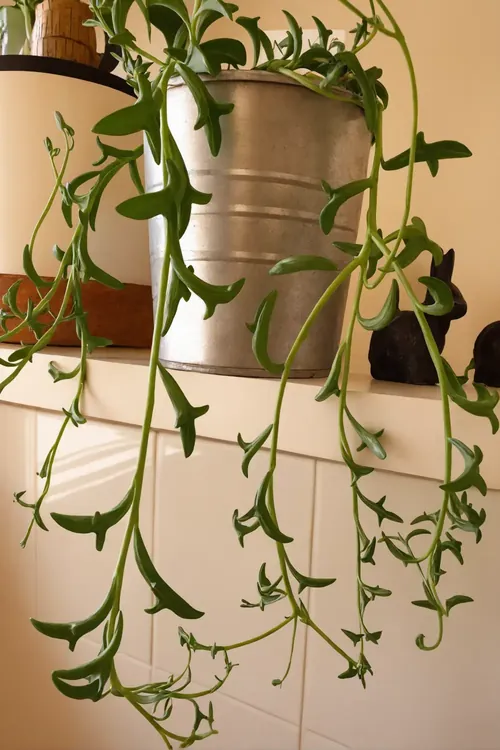
String of Dolphins is a trailing succulent known for leaves shaped like leaping dolphins. The unusual leaves line long, hanging tendrils that show best from a shelf or suspended planter. Its sculptural form remains compact at the crown while the stems extend downward. This easy plant suits very bright indoor spaces and growers who prefer infrequent watering. Keep it away from children and pets because the foliage is toxic.
Care data checked 25 September 2026 · Dany · A-Z Plants
Light requirements
String of Dolphins requires bright direct light at 250 to 1000 μmol·m⁻²·s⁻¹ PPFD. Provide 6+ hours of direct sunlight per day.
Placement: set it within 2 ft / 60 cm of a south or southwest-facing window.
Give the plant an unobstructed view of the sky. A PAR meter or app can verify the intensity.
Too much light: sudden exposure to harsh sun can scorch the fleshy leaves.
Too little light: stems stretch and the dolphin-shaped leaves may grow less distinct. Grow lights can help during shorter winter days.
Watering
Allow the potting mix to dry completely before watering String of Dolphins. Test several depths with a knitting needle or chopstick instead of relying only on the surface. Use room temperature rainwater, distilled water, or reverse osmosis water.
Water deeply until excess flows through the drainage holes.
Let the container drain completely before returning it to a saucer or decorative planter.
Water considerably less in winter because the plant is not actively growing.
Soil that remains wet can cause root and stem rot. A severe lack of water may leave the fleshy leaves wrinkled, dry, or crisp. A pot with drainage holes is essential.
Soil
String of Dolphins needs a specialty organic potting mix made for succulents. Fast drainage protects the roots after each thorough watering and lets the mix dry fully.
DIY mix: combine 2 parts coir, 2 parts coarse sand, and 1 part pumice.
Avoid compacted soil and always use a pot with open drainage holes.
Feeding
Apply an organic fertilizer formulated for succulents every 2 to 4 weeks from March to October. Use the label strength intended for indoor succulents. Avoid excess fertilizer, and pause frequent applications while String of Dolphins grows slowly during winter.
Temperature & humidity
Keep String of Dolphins at 65 to 75 °F / 18 to 24 °C. Protect the trailing stems from cold drafts and abrupt heat. A humidity range of 40 to 50% is suitable. Average indoor air is enough, and frequent misting is not required.
What to expect
String of Dolphins grows at a moderate rate and can mature in 2 to 3 years. Its trailing growth reaches an eventual height or length of 1 to 2 ft / 30 to 60 cm. A mature planting may spread 12 to 18 in / 30 to 45 cm.
Varieties & cultivars
S. peregrinus ‘Variegatus’: Green dolphin-shaped leaves carry creamy white variegation.
S. peregrinus ‘Monstrose’: Shorter, wider leaves look more like peas than leaping dolphins.
String of Dolphins: questions
Is String of Dolphins toxic to cats and dogs?
String of Dolphins is toxic to people and pets, including cats and dogs. Its hanging stems can be easy for animals or children to reach. Place the pot securely above them and…
How much light does String of Dolphins need?
String of Dolphins requires bright direct light at 250 to 1000 μmol·m⁻²·s⁻¹ PPFD. Provide 6+ hours of direct sunlight per day. - Placement: set it within 2 ft / 60 cm of a south or southwest-facing window. - Give the plant an unobstructed view of the sky. A PAR meter or app can verify the…
How often should I water String of Dolphins?
Allow the potting mix to dry completely before watering String of Dolphins. Test several depths with a knitting needle or chopstick instead of relying only on the surface. Use room temperature rainwater, distilled water, or reverse osmosis water. - Water deeply until excess flows through the…
How big does String of Dolphins get?
Mature size indoors: Its trailing growth reaches an eventual….