LightStaghorn Fern grows best in bright indirect light at 150 to…
WaterSoak the entire Staghorn Fern in rainwater for 20 to 30…
ToxicitySafe for cats & dogs
Mature sizesee care guide
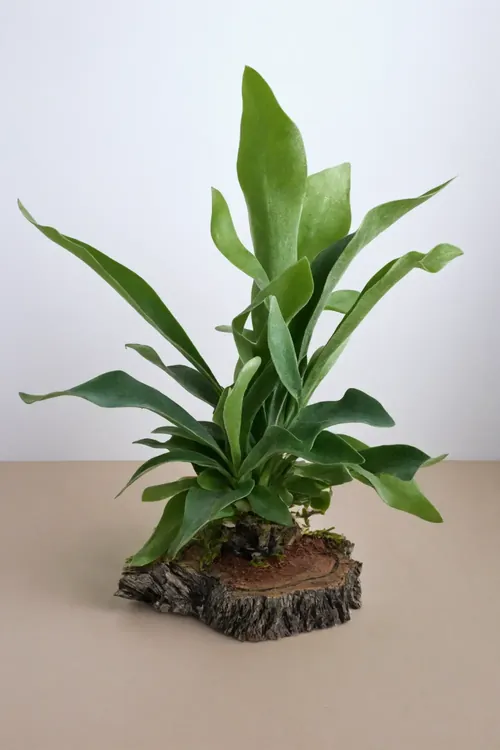
Staghorn Fern is an epiphytic fern with two very different frond types. Flat, rounded sterile fronds cover its base and help gather moisture and nutrients. Large fertile fronds grow upward and divide into antler-like forks. Mature plants make striking wall-mounted displays, while young plants can begin in an epiphyte mix. This easy fern suits growers who can provide regular soaking, filtered light, humidity, and airflow.
Care data checked 25 September 2026 · Dany · A-Z Plants
Light requirements
Staghorn Fern grows best in bright indirect light at 150 to 250 μmol·m⁻²·s⁻¹ PPFD. A PAR meter or app can be used to verify the level.
Placement: keep it 5 ft / 1.5 m from a south, west, or east-facing window.
Do not provide a direct view of the sky. Filter unavoidable sunlight with a sheer curtain.
Too much light: exposed fronds may bleach, dry, or develop scorched areas.
Too little light: fertile fronds grow weakly, and a wet plant dries too slowly after soaking.
Watering
Soak the entire Staghorn Fern in rainwater for 20 to 30 minutes every week from spring to autumn. Mist between weekly soaks when the mounting material or fronds dry quickly. Check behind the sterile shield fronds because they can retain moisture longer than the exposed foliage.
Wet the root area and mounting medium fully during each soak.
Let excess water drain away and provide airflow before returning the plant to its display.
A root mass that stays wet may rot.
Too little water can cause drooping fertile fronds and crisp edges. Rainwater is the specified choice and helps prevent residue on the fronds.
Soil
Start a young Staghorn Fern in a specialty potting mix made for epiphytes. A mature plant can be attached to bark or driftwood instead of staying in a conventional pot. The root area needs both moisture retention and open airflow.
DIY mix: combine 4 parts bark, 1 part pumice, and 1 part biochar.
Feeding
Spray Staghorn Fern with an organic fertilizer formulated for epiphytes every 2 to 4 weeks from March to October. Apply the label strength intended for mounted or epiphytic plants. Do not overfeed or allow concentrated fertilizer to collect behind the shield fronds.
Temperature & humidity
Staghorn Fern prefers 68 to 86 °F / 20 to 30 °C. Protect it from cold drafts, especially while wet. Maintain 50 to 70% humidity. Moist air supports the large fronds, but circulation is equally important for drying the root area after soaking.
What to expect
Staghorn Fern grows at a moderate pace and generally matures in 3 to 5 years. An established plant may reach 3 ft / 0.9 m tall. Its shield and fertile fronds can create an eventual spread of about 31 in / 0.8 m.
Varieties & cultivars
P. bifurcatum (Common Staghorn Fern): This widely grown form has large, antler-shaped fertile fronds.
P. hillii (Tasmanian Staghorn Fern): A smaller, more compact plant than P. bifurcatum, making it useful in limited spaces.
P. superbum (Large Staghorn Fern): The largest listed form has fronds reaching up to 6 ft / 1.8 m long.
P. alcicorne (Elkhorn Fern): It resembles P. bifurcatum but develops broader fertile fronds shaped like elk horns.
P. vascosii (Leather Staghorn Fern): Thick, leathery, dark green fronds distinguish this form.
Staghorn Fern: questions
Is Staghorn Fern toxic to cats and dogs?
The ASPCA lists Staghorn Fern as non-toxic to cats and dogs. It is also considered non-toxic to people. The fronds are still ornamental rather than edible, so discourage chewing…
How much light does Staghorn Fern need?
Staghorn Fern grows best in bright indirect light at 150 to 250 μmol·m⁻²·s⁻¹ PPFD. A PAR meter or app can be used to verify the level. - Placement: keep it 5 ft / 1.5 m from a south, west, or east-facing window. - Do not provide a direct view of the sky. Filter unavoidable sunlight with a sheer…
How often should I water Staghorn Fern?
Soak the entire Staghorn Fern in rainwater for 20 to 30 minutes every week from spring to autumn. Mist between weekly soaks when the mounting material or fronds dry quickly. Check behind the sterile shield fronds because they can retain moisture longer than the exposed foliage. - Wet the root area…