Home › Plants that start with S › Spider Plant
Indoor plant care
Spider Plant
Chlorophytum comosum
Light requirements
Spider Plant prefers bright indirect light but tolerates low light, within 50 to 250 μmol·m⁻²·s⁻¹ PPFD. A PAR meter or app can confirm the level.
- Placement: keep it 5 to 8 ft / 1.5 to 2.5 m from a north, south, west, or east-facing window.
- Avoid an open view of the sky. Use a sheer curtain if direct sun reaches the leaves.
- Too much light: foliage may bleach or develop scorched patches.
- Too little light: growth slows, variegation weakens, and fewer flowers or spiderettes may appear.
Watering
Keep Spider Plant consistently moist, but never leave the soil soggy. Check the mix at several depths with a knitting needle or chopstick. Room temperature rainwater, distilled water, or reverse osmosis water is suitable.
- Water thoroughly until excess runs through the drainage holes.
- Let the pot finish draining before placing it back on a saucer or inside a decorative planter.
- Water considerably less in winter when active growth has slowed.
- Constantly saturated soil can cause root rot and yellow leaves. Allowing it to become too dry may produce wilted foliage and crisp brown edges. A container with drainage holes is essential for healthy roots.
Soil
Spider Plant grows well in an organic all-purpose potting mix that holds moderate moisture without becoming waterlogged. Good drainage supports its thick roots and helps prevent rot.
- DIY mix: combine 3 parts coir with 1 part pumice.
- Top dress with worm castings to supply organic matter without making the root zone too dense.
Feeding
Apply an organic all-purpose fertilizer every 2 to 4 weeks from March to October. Use the package strength recommended for indoor plants. Do not increase the dose to force more spiderettes, and pause regular feeding during the slower winter period.
Temperature & humidity
Spider Plant prefers 65 to 75 °F / 18 to 24 °C. Keep it away from cold drafts and sudden temperature shifts. A humidity range of 40 to 50% is suitable. Very dry air can contribute to brown leaf tips, even when the soil is moist.
What to expect
Spider Plant grows quickly under suitable indoor conditions and can mature in 1 to 2 years. The central foliage reaches about 1 to 2 ft / 30 to 60 cm tall. Its clump spreads 12 to 18 in / 30 to 45 cm, excluding long flowering stems.
Varieties & cultivars
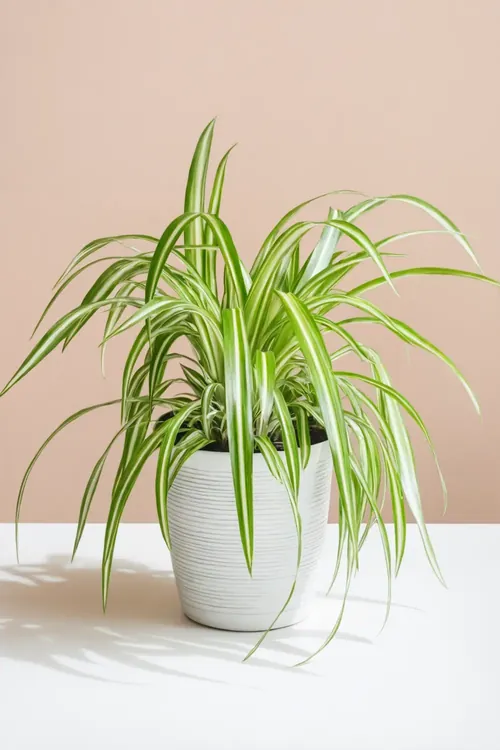
- C. comosum ‘Variegatum’: This common form has green leaves edged with creamy white.
- C. comosum ‘Ocean Green’: Solid, deep green leaves create an unvariegated plant.
- C. comosum ‘Lemon Lime’: The narrow foliage is a bright lime green.
- C. comosum ‘Curly Sue’: Narrow green and white leaves curl instead of arching straight.
- C. comosum ‘Maureanum’ and C. comosum ‘Vittatum’: ‘Maureanum’ has green leaves with broad white variegation. ‘Vittatum’ has thin green leaves with a creamy white central stripe.
Spider Plant: questions
Is Spider Plant toxic to cats and dogs?
The ASPCA lists Spider Plant as non-toxic to cats and dogs. It is also considered non-toxic to people. Cats may still chew its arching leaves, and eating a large amount of any…
How much light does Spider Plant need?
Spider Plant prefers bright indirect light but tolerates low light, within 50 to 250 μmol·m⁻²·s⁻¹ PPFD. A PAR meter or app can confirm the level. - Placement: keep it 5 to 8 ft / 1.5 to 2.5 m from a north, south, west, or east-facing window. - Avoid an open view of the sky. Use a sheer curtain if…
How often should I water Spider Plant?
Keep Spider Plant consistently moist, but never leave the soil soggy. Check the mix at several depths with a knitting needle or chopstick. Room temperature rainwater, distilled water, or reverse osmosis water is suitable. - Water thoroughly until excess runs through the drainage holes. - Let the…
How big does Spider Plant get?
Mature size indoors: The central foliage reaches about 1 to….