LightBright, indirect light in the 50 to 250 μmol·m⁻²·s⁻¹ PPFD…
WaterLet the Snake Plant's soil dry completely before watering…
ToxicityToxic to pets
Mature sizeExpect an eventual height of 2 to 4 ft…
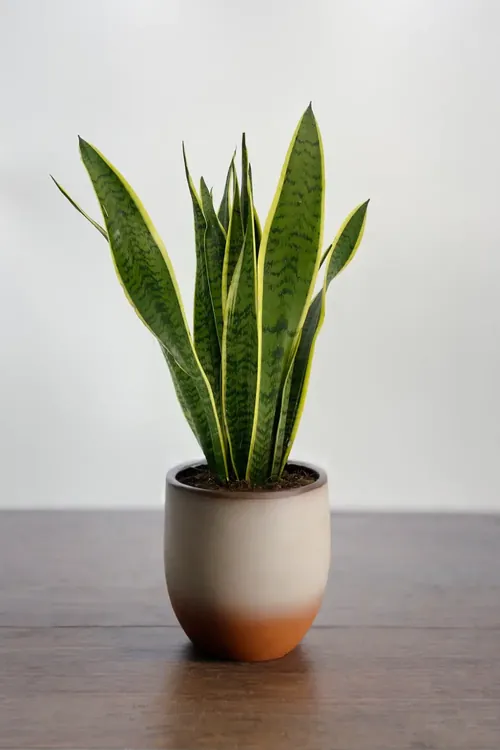
The Snake Plant, Sansevieria trifasciata, is an upright succulent grown for its stiff, sword-like foliage. Leaves may be solid green or patterned with yellow or white variegation. Its strong vertical shape fits narrow indoor spaces, while its easy care suits new plant owners. It grows slowly and tolerates low light, though brighter indirect light supports better color and growth.
Care data checked 25 September 2026 · Dany · A-Z Plants
Light requirements
Bright, indirect light in the 50 to 250 μmol·m⁻²·s⁻¹ PPFD range supports healthy Snake Plant growth, though it can tolerate low light.
Placement: set it 5 to 8 ft / 1.5 to 2.5 m from a north, south, west or east-facing window. Position it without a direct view of the sky.
Too much light: direct sunlight can scorch the leaves. If exposure is unavoidable, filter it through a sheer curtain.
Too little light: the plant may survive, but growth slows and variegated colors can fade.
A PAR meter or PAR meter app can measure photosynthetically active radiation as PPFD (μmol·m⁻²·s⁻¹).
Watering
Let the Snake Plant's soil dry completely before watering again. Do not follow a fixed calendar, since drying time changes with light, season and room conditions.
Test several depths with a knitting needle or chopstick. Water only when it comes out dry.
Use room-temperature rainwater, distilled water or reverse osmosis water.
Water thoroughly until liquid exits the drainage holes. Let the excess drain fully before returning the pot to a saucer or decorative planter.
Cut back considerably during winter, when growth is inactive. Watering again too soon can cause root rot, while leaving the plant dry for too long may produce crispy edges.
Soil
Snake Plant roots need an airy succulent soil that releases water quickly. Choose a ready-made specialty organic potting mix formulated for succulents. Dense mixes hold moisture around the roots and raise the risk of rot.
DIY recipe: combine 2 parts coir, 2 parts coarse sand and 1 part pumice.
Use the mix in a pot with open drainage holes so surplus water can leave freely.
Feeding
Feed the Snake Plant every 2 to 4 weeks from March to October. Use an organic fertilizer formulated for succulents at the label's recommended strength. Do not make a stronger dose or feed more often. Stop outside this growth period, and avoid applying fertilizer when the potting mix is completely dry.
Temperature & humidity
The Snake Plant prefers a warm room at 70 to 90 °F / 21 to 32 °C. Aim for 40 to 50% humidity, which is close to normal indoor conditions. Keep conditions steady when possible. Cold drafts and sudden temperature changes can stress the foliage, while damp air combined with wet soil can raise the risk of rot.
What to expect
This is a slow-growing plant that may need 5 to 10 years to reach maturity. Expect an eventual height of 2 to 4 ft / 60 to 120 cm and a spread of 1 to 2 ft / 30 to 60 cm. Growth tends to be slower in low light than in bright, indirect light.
Varieties & cultivars
S. trifasciata ‘Hahnii’: Also called the Bird’s Nest Snake Plant, it forms a rosette of green leaves with horizontal stripes and reaches up to 8 in / 20 cm tall. The related S. trifasciata ‘Golden Hahnii’ stays compact and has a similar rosette with golden variegation.
S. trifasciata ‘Laurentii’: Yellow-edged leaves give this variety strong contrast. It can grow up to 4 ft / 1.2 m tall.
S. trifasciata ‘Moonshine’: Its foliage has a silvery-green color. Brighter light helps maintain that distinctive shade.
S. kirkii ‘Coppertone’: This rare variety has copper-toned leaves with wavy margins.
S. masoniana ‘Whale Fin’: A single large leaf resembles a whale’s fin, creating a bold, sculptural shape indoors.
Snake Plant: questions
Is Snake Plant toxic to cats and dogs?
The ASPCA lists the Snake Plant as toxic to cats and dogs. It is also toxic to people, so it should not be treated as edible or pet safe. Keep the pot where children and animals…
How much light does Snake Plant need?
Bright, indirect light in the 50 to 250 μmol·m⁻²·s⁻¹ PPFD range supports healthy Snake Plant growth, though it can tolerate low light. - Placement: set it 5 to 8 ft / 1.5 to 2.5 m from a north, south, west or east-facing window. Position it without a direct view of the sky. - Too much light: direct…
How often should I water Snake Plant?
Let the Snake Plant's soil dry completely before watering again. Do not follow a fixed calendar, since drying time changes with light, season and room conditions. - Test several depths with a knitting needle or chopstick. Water only when it comes out dry. - Use room-temperature rainwater, distilled…
How big does Snake Plant get?
Mature size indoors: Expect an eventual height of 2 to 4 ft….