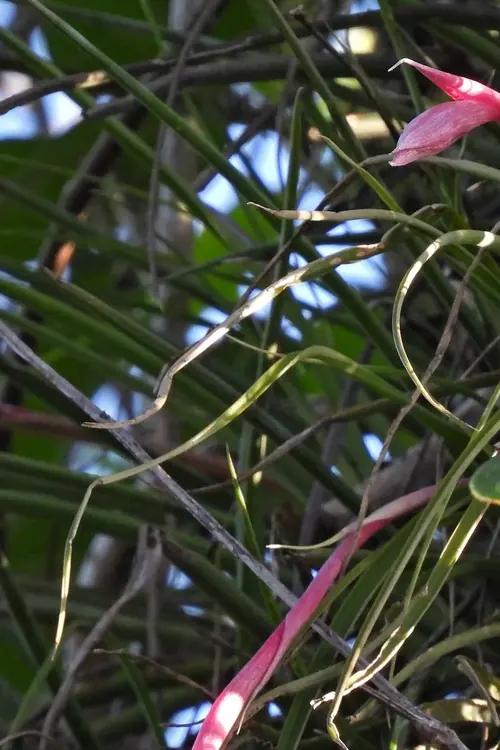
Photo: Hugo Hulsberg, CC0 1.0, via iNaturalist (public domain dedication).
LightBright, indirect light near an east or west window, or…
WaterWater the mix when the top 2 to 3 cm (about an inch) feels…
ToxicityNot ASPCA-listed
Mature sizeAbout 30 to 50 cm (12 to 20 in) tall…
Queen's Tears is a small bromeliad that forms a funnel-shaped rosette of arching, grey-green leaves. In late winter it sends up a drooping spike of pink bracts with green, purple-edged flowers that drip nectar onto the leaves, which is why it is also called the friendship plant.
No retailer link for this plant yet.
Care data checked 25 September 2026 · Dany · A-Z Plants
Light requirements
Bright, indirect light near an east or west window, or filtered light from a south window. Partial shade suits it and direct midday summer sun does not.
Too much light: leaves bleach to a washed-out yellow and then develop dry brown patches on the sunward side.
Too little light: leaves stay dark green but grow long and floppy, and the plant stops producing its winter flower spike.
Watering
Water the mix when the top 2 to 3 cm (about an inch) feels dry, and keep a small amount of fresh water in the central leaf cup, flushing it out once a month so it does not go stale. Use filtered or rainwater if your tap water is hard, because bromeliads mark easily. The usual killer is a permanently wet mix plus cold, stagnant water sitting in the cup, which rots the base of the plant.
Soil
A coarse epiphytic bromeliad mix or orchid bark mix, in a small pot so the roots stay snug. Drainage has to be fast, because standard peat potting soil stays too wet for it. You can also mount it on cork or a branch, since it grows as an epiphyte in the wild.
Feeding
Balanced liquid fertiliser at quarter strength, once a month from spring to early autumn. Do not feed in winter, and do not pour strong fertiliser into the leaf cup. For a mounted plant, use orchid feed at the same weak dose.
Temperature & humidity
16 to 24 degrees C (60 to 75 degrees F) suits it year round, and it can take short spells down to about 5 degrees C (41 degrees F) if the mix is on the dry side. Average indoor humidity of 40 to 60 percent is fine. Brown leaf tips point to dry air, so group it with other plants or stand it on a pebble tray.
What to expect
About 30 to 50 cm (12 to 20 in) tall and wide indoors, spreading into a clump by offsets. Growth is slow to moderate. Each rosette flowers once and is then replaced by pups at its base.
Varieties & cultivars
Billbergia x windii, the hybrid most often sold as Queen's Tears, very like the species and just as easy.
Billbergia pyramidalis (summer torch), a close relative with a stiff upright red flower spike.
Billbergia 'Fantasia', a registered hybrid with a dense red flower spike.
True Billbergia nutans is often mislabelled in the trade, so buy from a bromeliad specialist if you want the species itself.
Queen's Tears: questions
Is Queen's Tears toxic to cats and dogs?
Not ASPCA-listed, so there is no safety ruling for this plant and it cannot be called pet safe on that basis. Bromeliads the ASPCA does list, including Neoregelia, Guzmania and…
How much light does Queen's Tears need?
Bright, indirect light near an east or west window, or filtered light from a south window. Partial shade suits it and direct midday summer sun does not. - Too much light: leaves bleach to a washed-out yellow and then develop dry brown patches on the sunward side. - Too little light: leaves stay…
How often should I water Queen's Tears?
Water the mix when the top 2 to 3 cm (about an inch) feels dry, and keep a small amount of fresh water in the central leaf cup, flushing it out once a month so it does not go stale. Use filtered or rainwater if your tap water is hard, because bromeliads mark easily. The usual killer is a…
How big does Queen's Tears get?
Mature size indoors: About 30 to 50 cm (12 to 20 in) tall….