LightAfrican Milk Tree prefers bright, indirect light at 150 to…
WaterLet the potting mix dry completely before watering African…
ToxicityToxic to pets
Mature sizeIndoors, it can eventually reach 6 to 9…
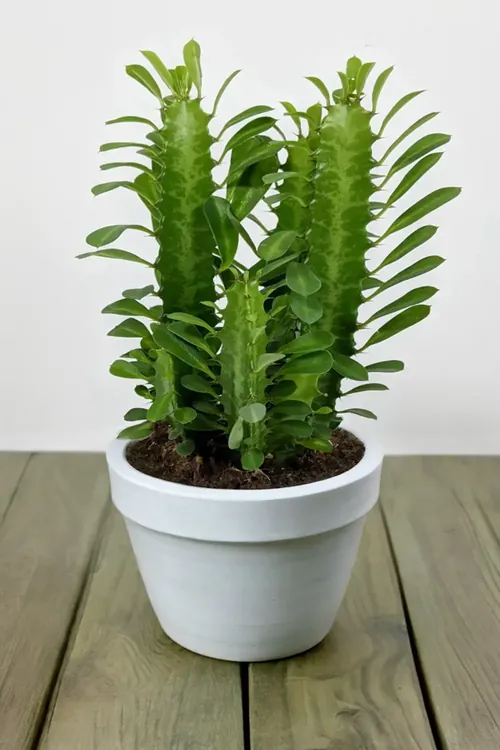
African Milk Tree is a tall succulent with upright, branching stems. Each stem has three angled sides, raised ridges, and small leaves that do not last long. Mature plants may also produce small white flowers. Its sculptural shape works well in bright rooms with limited floor space. It is easy to maintain when given strong filtered light, dry soil, and careful handling.
Care data checked 25 September 2026 · Dany · A-Z Plants
Light requirements
African Milk Tree prefers bright, indirect light at 150 to 250 μmol·m⁻²·s⁻¹.
Set it 5 ft / 1.5 m from a south, west, or east-facing window, where it lacks a direct view of the sky.
Filter unavoidable direct sunlight with a sheer curtain. Sudden exposure can scorch stems and leaves.
Weak light may cause thin, leaning, or stretched growth.
A PAR meter or PAR meter app can check photosynthetically active radiation as PPFD (μmol·m⁻²·s⁻¹).
Watering
Let the potting mix dry completely before watering African Milk Tree. Test moisture at several depths with a knitting needle or chopstick rather than checking only the surface. Its succulent stems store water, so frequent watering is unnecessary.
Use room temperature rainwater, distilled water, or reverse osmosis water.
Soak the mix until water flows through the drainage holes. Let all excess drain before replacing the pot in a saucer or decorative planter.
Water considerably less in winter because growth is slower.
Wet soil can quickly cause root and stem rot. Severe drought is less dangerous, although prolonged dryness may cause leaves to drop or stem tips to shrivel.
Soil
African Milk Tree needs a fast-draining specialty organic potting mix made for succulents. The container must also release excess water quickly. For a DIY mix, combine 2 parts coir, 2 parts coarse sand, and 1 part pumice. Avoid dense all-purpose soil because it can remain wet around the roots.
Feeding
Use an organic fertilizer formulated for succulents every 2 to 4 weeks from March to October. Apply it only while African Milk Tree is actively growing and the soil is moist. Stop regular feeding during winter. Heavy or frequent fertilizer can produce weak growth and salt buildup.
Temperature & humidity
Keep African Milk Tree at 65 to 75 °F / 18 to 24 °C. It prefers humidity near 40%, which is common in many homes. Avoid cold windows, chilly drafts, and persistently damp air. Good airflow helps its succulent stems remain dry and healthy.
What to expect
African Milk Tree may take 5 to 10 years to mature. Indoors, it can eventually reach 6 to 9 ft / 1.8 to 2.7 m tall. Its spread is much narrower at 1 to 2 ft / 30 to 60 cm. Growth is steady but generally slow.
Varieties & cultivars
Euphorbia trigona ‘Rubra’ or ‘Royal Red’: The stems and leaves combine rich red shades with green.
Euphorbia trigona ‘Alba’: This rare cultivar has white or cream-colored stems and leaves.
African Milk Tree: questions
Is African Milk Tree toxic to cats and dogs?
African Milk Tree is toxic to people, cats, and dogs. Its milky Euphorbia sap can irritate skin and eyes, while ingestion may cause mouth and stomach problems. The ASPCA…
How much light does African Milk Tree need?
African Milk Tree prefers bright, indirect light at 150 to 250 μmol·m⁻²·s⁻¹. - Set it 5 ft / 1.5 m from a south, west, or east-facing window, where it lacks a direct view of the sky. - Filter unavoidable direct sunlight with a sheer curtain. Sudden exposure can scorch stems and leaves. - Weak light…
How often should I water African Milk Tree?
Let the potting mix dry completely before watering African Milk Tree. Test moisture at several depths with a knitting needle or chopstick rather than checking only the surface. Its succulent stems store water, so frequent watering is unnecessary. - Use room temperature rainwater, distilled water…
How big does African Milk Tree get?
Mature size indoors: Indoors, it can eventually reach 6 to 9….