LightAfrican Violet flowers best in bright, indirect light…
WaterWater African Violet when the topsoil feels dry. Bottom…
ToxicitySafe for cats & dogs
Mature sizeA full-grown plant generally reaches 6…
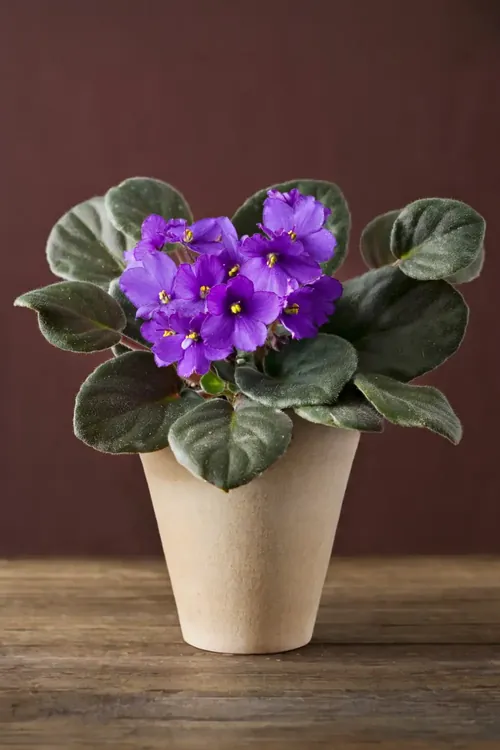
African Violet is a compact perennial that forms a neat rosette of soft, velvety leaves. Colorful flowers rise above the foliage and may appear in many shades. Its small size suits shelves, desks, and bright windowsills. It can bloom for long periods when light, moisture, and temperature remain stable. Beginners can grow it, although careful watering helps prevent marked or damaged leaves.
Care data checked 25 September 2026 · Dany · A-Z Plants
Light requirements
African Violet flowers best in bright, indirect light measuring 150 to 250 μmol·m⁻²·s⁻¹.
Place it 5 ft / 1.5 m from a south, west, or east-facing window, without a direct view of the sky.
Use a sheer curtain if direct sun reaches the leaves. Harsh light can bleach foliage or create scorched patches.
Too little light reduces blooming and encourages stretched growth.
A PAR meter or PAR meter app can measure photosynthetically active radiation as PPFD (μmol·m⁻²·s⁻¹).
Watering
Water African Violet when the topsoil feels dry. Bottom watering helps protect its fuzzy leaves from spotting. Use room temperature rainwater, distilled water, or reverse osmosis water.
Stand the pot in water for about 30 minutes, allowing the mix to absorb moisture from below.
Remove the pot and let it drain fully before returning it to a saucer or decorative planter. Drainage holes are essential.
Once a month, use a long-spout watering can to flush the soil from above. This restores oxygen and removes accumulated salts, but keep water off the leaves.
Water considerably less during winter. Soggy soil may cause root rot, while extended dryness can wilt leaves and leave crisp edges.
Soil
Choose a light specialty organic potting mix formulated for African violets. It should hold some moisture while allowing air to reach the fine roots. A simple DIY recipe uses 2 parts coir, 1 part pumice, and 1 part vermiculite. Always use a container with drainage holes so excess water can escape.
Feeding
Apply an organic fertilizer made for African violets every 2 to 4 weeks from March to October. Use it as directed and avoid feeding dry soil. Reduce or stop feeding in winter. Too much fertilizer can burn roots, build up salts, and reduce healthy flowering.
Temperature & humidity
African Violet prefers 65 to 75°F / 18 to 24°C and steady indoor conditions. Aim for humidity between 50 to 60%. Keep the plant away from cold glass, drafts, heaters, and air-conditioning vents. Stable warmth and moderate humidity support flowers and soft, healthy foliage.
What to expect
African Violet can mature in 6 to 9 months. A full-grown plant generally reaches 6 to 12 in / 15 to 30 cm in height and the same 6 to 12 in / 15 to 30 cm spread. Growth is moderate, with flowering encouraged by stable care.
Varieties & cultivars
Saintpaulia ionantha ‘Optimara’: This compact cultivar produces large single or double flowers in many colors.
Saintpaulia ionantha ‘Sorbet’: A miniature form with vivid bicolored flowers.
Saintpaulia ionantha ‘Chiffon’: Trailing growth carries flowers over the edge of its container.
Saintpaulia kewensis: White to pale lavender flowers appear above leaves with distinct patterns.
Saintpaulia confusa: Fragrant white flowers feature purple markings.
African Violet: questions
Is African Violet toxic to cats and dogs?
African Violet is considered non-toxic to people. The ASPCA lists it as non-toxic to cats and dogs. This makes it a lower-risk choice for homes with pets, but damaged plants and…
How much light does African Violet need?
African Violet flowers best in bright, indirect light measuring 150 to 250 μmol·m⁻²·s⁻¹. - Place it 5 ft / 1.5 m from a south, west, or east-facing window, without a direct view of the sky. - Use a sheer curtain if direct sun reaches the leaves. Harsh light can bleach foliage or create scorched…
How often should I water African Violet?
Water African Violet when the topsoil feels dry. Bottom watering helps protect its fuzzy leaves from spotting. Use room temperature rainwater, distilled water, or reverse osmosis water. - Stand the pot in water for about 30 minutes, allowing the mix to absorb moisture from below. - Remove the pot…
How big does African Violet get?
Mature size indoors: A full-grown plant generally reaches 6….