LightPonytail Palm prefers bright, indirect light between 150…
WaterAllow Ponytail Palm soil to dry completely before watering…
ToxicitySafe for cats & dogs
Mature sizeIndoors, it may reach 6 to 10 feet / 1
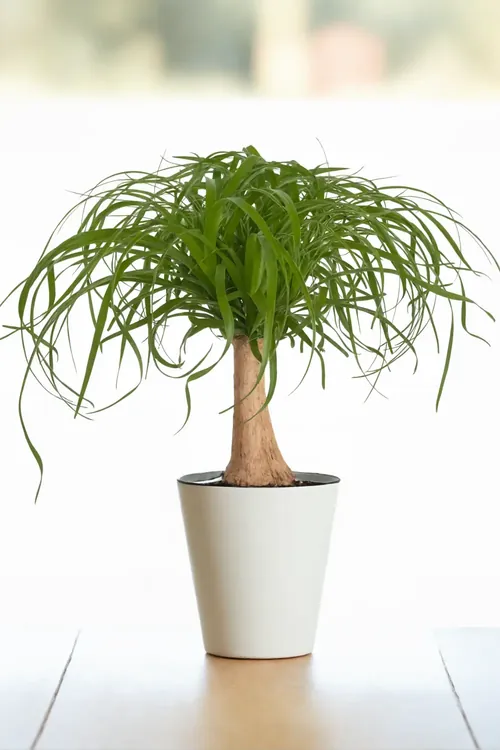
Ponytail Palm is a tree-like succulent rather than a true palm. Its swollen base, called a caudex, stores water. Long, narrow leaves arch from the top and droop like a ponytail. The sculptural form suits bright rooms and requires less frequent watering than tropical palms. It is a good choice for growers comfortable letting soil dry fully between waterings.
Care data checked 25 September 2026 · Dany · A-Z Plants
Light requirements
Ponytail Palm prefers bright, indirect light between 150 and 250 μmol·m⁻²·s⁻¹.
Place it about 5 ft / 1.5 m from a south, west, or east-facing window.
Select a position without a direct view of the sky. Filter unavoidable sunlight with a sheer curtain.
Excess direct light can scorch foliage if the plant is not acclimated. Too little light slows growth.
A PAR meter or PAR meter app can measure photosynthetically active radiation as PPFD (μmol·m⁻²·s⁻¹).
Watering
Allow Ponytail Palm soil to dry completely before watering. Its swollen base stores water, so frequent watering creates more risk than a short dry spell. Check several depths with a knitting needle or chopstick.
Use room temperature rainwater, distilled water, or reverse osmosis water.
Soak the soil until water runs through the drainage holes. Let the pot drain fully before placing it on a saucer or inside a decorative planter.
A pot with drainage holes is essential. Constant moisture can rot the roots and caudex, while extreme drought may cause crisp leaf tips.
Water considerably less in winter when the plant is not actively growing.
Soil
Use an organic succulent potting mix that drains and dries quickly. Dense, moisture-retentive soil can damage the roots and swollen base.
DIY mix: combine 2 parts coir, 2 parts coarse sand, and 1 part pumice.
Use a freely draining container.
Feeding
Apply an organic succulent fertiliser every 2 to 4 weeks from March to October. Follow the product strength and feed only moist soil. Do not increase fertiliser to speed this naturally measured growth. Stop regular feeding during winter.
Temperature & humidity
Ponytail Palm prefers 60 to 80 °F / 15 to 27 °C. Keep it away from prolonged cold and sudden drafts. Humidity from 40 to 50% is suitable, so it adapts well to average indoor air.
What to expect
Ponytail Palm takes about 5 to 7 years to mature. Indoors, it may reach 6 to 10 feet / 1.8 to 3 m tall. Its eventual spread is 3 to 5 feet / 0.9 to 1.5 m. Growth is generally slow.
Varieties & cultivars
B. stricta: This species has shorter, stiffer leaves and a more compact habit.
B. gracilis: Slender leaves with a bluish tone distinguish this form.
B. guatemalensis: Known as the red ponytail palm, it develops a reddish shade on its foliage.
B. recurvata ‘Mini’: This dwarf selection remains much smaller and reaches only 2 to 3 ft / 0.6 to 0.9 m tall.
Ponytail Palm: questions
Is Ponytail Palm toxic to cats and dogs?
The ASPCA classifies Ponytail Palm as non-toxic to cats and dogs. It is also regarded as non-toxic to people. Long leaves may attract playful pets, so place the plant securely to…
How much light does Ponytail Palm need?
Ponytail Palm prefers bright, indirect light between 150 and 250 μmol·m⁻²·s⁻¹. - Place it about 5 ft / 1.5 m from a south, west, or east-facing window. - Select a position without a direct view of the sky. Filter unavoidable sunlight with a sheer curtain. - Excess direct light can scorch foliage if…
How often should I water Ponytail Palm?
Allow Ponytail Palm soil to dry completely before watering. Its swollen base stores water, so frequent watering creates more risk than a short dry spell. Check several depths with a knitting needle or chopstick. - Use room temperature rainwater, distilled water, or reverse osmosis water. - Soak the…
How big does Ponytail Palm get?
Mature size indoors: Indoors, it may reach 6 to 10 feet / 1.