LightThe Peacock Plant needs bright, indirect light at 150 to…
WaterKeep the Peacock Plant's mix consistently moist, but not…
ToxicitySafe for cats & dogs
Mature sizeExpect a height of 1 to 2 ft / 30 to 60…
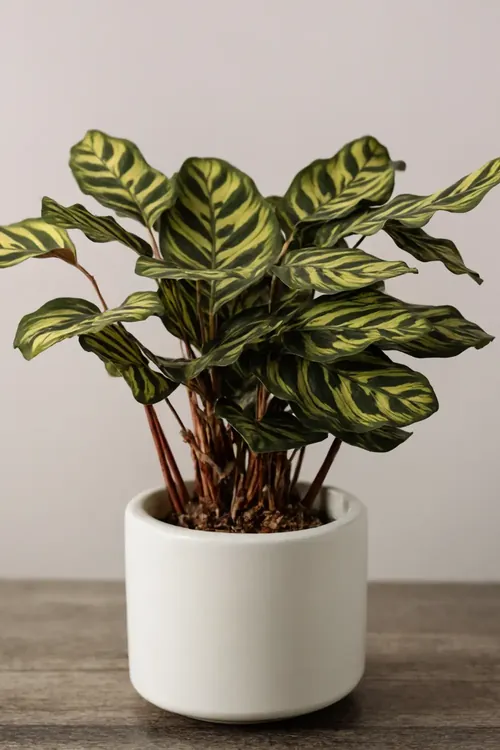
The Peacock Plant is grown for broad, pale green leaves marked with dark feather-like patterns. Each leaf has a rich reddish-purple underside, adding color when the foliage moves. Its layered markings make it useful as a compact statement plant. It suits growers who can provide stable moisture, warm temperatures, and moderate humidity without exposing the leaves to harsh sun.
Care data checked 25 September 2026 · Dany · A-Z Plants
Light requirements
The Peacock Plant needs bright, indirect light at 150 to 250 μmol·m⁻²·s⁻¹ to keep its patterns clear.
Position it about 5 ft / 1.5 m from a south, west, or east-facing window.
Do not give the leaves a direct view of the sky. Use a sheer curtain when sunlight cannot be avoided.
Excess sun can fade patterns and scorch foliage. Dim conditions slow growth and weaken color.
Measure photosynthetically active radiation as PPFD (μmol·m⁻²·s⁻¹) with a PAR meter or PAR meter app if needed.
Watering
Keep the Peacock Plant's mix consistently moist, but not saturated. A knitting needle or chopstick can reveal moisture at several depths before you water.
Choose room temperature rainwater, distilled water, or reverse osmosis water. Sensitive leaves may develop crisp edges when water quality is poor.
Soak the mix until water exits the drainage holes. Let all excess drain before replacing the pot in a saucer or decorative planter.
Drainage holes are essential. Soggy soil can suffocate roots and cause rot, while extended dryness can curl or crisp the leaves.
Cut watering considerably during winter because growth is less active, but do not let the root zone remain bone dry.
Soil
Use an organic all-purpose potting mix that balances moisture retention with open drainage. The Peacock Plant dislikes both compacted soil and standing water.
DIY mix: blend 3 parts coir with 1 part pumice.
Finish with a light top dressing of worm castings.
Feeding
Apply an organic all-purpose fertiliser every 2 to 4 weeks from March to October. Feed moist soil and follow the stated strength. Avoid overfeeding, since built-up salts may damage sensitive roots and leaf edges. Stop routine applications during slower winter growth.
Temperature & humidity
Keep the Peacock Plant at 65 to 85 °F / 18 to 29 °C. Avoid cold drafts and abrupt changes around windows or vents. It prefers humidity of 50 to 60%, which helps its thin leaves remain smooth and less prone to crisping.
What to expect
The Peacock Plant reaches maturity in about 2 to 3 years. Expect a height of 1 to 2 ft / 30 to 60 cm. A mature clump spreads roughly 12 to 18 inches / 30 to 45 cm. Growth remains compact indoors.
Varieties & cultivars
G. orbifolia ‘Fusion White’: Oval leaves display strong white and green veins.
G. makoyana ‘Variegata’: This form resembles the standard Peacock Plant but carries stronger white variegation.
G. makoyana ‘Flamingo Star’: Dark green foliage is marked by a central pink stripe.
G. makoyana ‘Silver Illusion’: Silvery-green leaves have a soft, subtle shimmer.
G. makoyana ‘Network’: Dark green leaves feature a connected pattern of lighter green veins.
Peacock Plant: questions
Is Peacock Plant toxic to cats and dogs?
The ASPCA classifies calatheas such as the Peacock Plant as non-toxic to cats and dogs. It is also considered non-toxic to people. This lowers the poisoning risk, but damaged or…
How much light does Peacock Plant need?
The Peacock Plant needs bright, indirect light at 150 to 250 μmol·m⁻²·s⁻¹ to keep its patterns clear. - Position it about 5 ft / 1.5 m from a south, west, or east-facing window. - Do not give the leaves a direct view of the sky. Use a sheer curtain when sunlight cannot be avoided. - Excess sun can…
How often should I water Peacock Plant?
Keep the Peacock Plant's mix consistently moist, but not saturated. A knitting needle or chopstick can reveal moisture at several depths before you water. - Choose room temperature rainwater, distilled water, or reverse osmosis water. Sensitive leaves may develop crisp edges when water quality is…
How big does Peacock Plant get?
Mature size indoors: Expect a height of 1 to 2 ft / 30 to 60….