LightPanda Plant prefers bright, indirect light at 150 to 250…
WaterAllow Panda Plant soil to dry out completely before…
ToxicityToxic to pets
Mature sizeIts eventual height is 1 to 2 ft / 30…
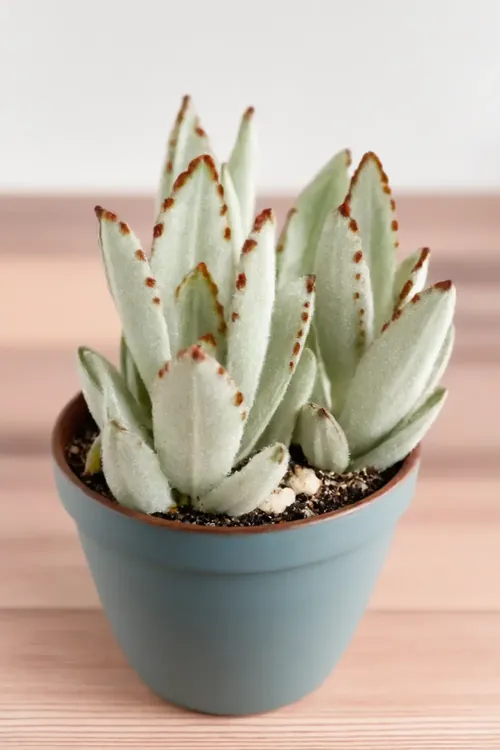
Panda Plant is a succulent with thick, velvety leaves in soft greyish-green. Fine hairs cover the foliage, while scalloped edges add darker detail. It may produce small bell-shaped flowers in red, pink, yellow, or orange, though blooming is rare indoors. This plant suits bright rooms and growers who prefer infrequent watering. Its tactile foliage is appealing, but the toxic leaves must stay away from children and pets.
Care data checked 25 September 2026 · Dany · A-Z Plants
Light requirements
Panda Plant prefers bright, indirect light at 150 to 250 μmol·m⁻²·s⁻¹ as PPFD. Strong filtered light helps preserve compact growth and darker leaf markings.
Placement: keep it around 5 ft / 1.5 m from a south, west, or east-facing window.
Direct sun: prevent an open view of the sky. Use a sheer curtain if sunlight would strike the leaves.
Too much light: fuzzy foliage may bleach, scorch, or develop dry patches.
Too little light: stems stretch and leaf color becomes weaker. A PAR meter or PAR meter app can measure photosynthetically active radiation as PPFD (μmol·m⁻²·s⁻¹).
Watering
Allow Panda Plant soil to dry out completely before watering. Its fleshy leaves store moisture, so repeatedly damp soil creates a serious risk of root damage.
Test moisture at several depths with a knitting needle or chopstick. Wait until the tool comes out dry.
Use room temperature rainwater, distilled water, or reverse osmosis water. Avoid wetting the fuzzy leaves unnecessarily, and watch for crispy edges.
Water the soil thoroughly until runoff exits the drainage holes. Let the pot drain fully before returning it to a saucer or decorative planter.
Water considerably less in the winter months when active growth slows. A pot without drainage can cause root rot, while extreme drought may leave foliage wrinkled or brittle.
Soil
Use a specialty organic potting mix formulated for succulents. Panda Plant needs fast drainage so its roots can dry between waterings.
DIY recipe: blend 2 parts coir, 2 parts coarse sand, and 1 part pumice.
Select a pot with drainage holes. Dense or compacted soil may remain wet long enough to cause root rot.
Feeding
Apply an organic fertilizer formulated for succulents every 2 to 4 weeks from March to October. Use the recommended strength during active growth. Do not pour concentrated feed onto dry roots, and stop routine applications when growth slows during winter.
Temperature & humidity
Panda Plant prefers an ideal temperature range of 60 to 75 °F / 15 to 24 °C. Its ideal humidity is 40%. Typical dry indoor air is suitable, but cold drafts and constantly humid, wet conditions may stress the succulent.
What to expect
Panda Plant reaches maturity in about 2 to 3 years. Its eventual height is 1 to 2 ft / 30 to 60 cm, with a matching spread of 1 to 2 ft / 30 to 60 cm. Growth is slow to moderate indoors.
Varieties & cultivars
K. tomentosa: The common form has broad greyish-green leaves covered in white-silvery hairs. Dark chocolate-colored edging adds contrast.
K. tomentosa ‘Chocolate Soldier’: Blue-green fuzzy leaves develop red or brown margins as they mature.
K. tomentosa ‘Golden Girl’: This slow-growing succulent has fine white hairs and golden-colored foliage.
K. tomentosa ‘Ling ling’: Upright stems carry foliage ranging from green to blue-green.
K. tomentosa ‘Nigra’: Long, slender leaves have brown edges and black tips on a shrub-like stem.
Panda Plant: questions
Is Panda Plant toxic to cats and dogs?
The ASPCA lists Kalanchoe plants as toxic to cats and dogs. Panda Plant is also toxic to people if swallowed. Keep every part of it away from children and pets, including fallen…
How much light does Panda Plant need?
Panda Plant prefers bright, indirect light at 150 to 250 μmol·m⁻²·s⁻¹ as PPFD. Strong filtered light helps preserve compact growth and darker leaf markings. - Placement: keep it around 5 ft / 1.5 m from a south, west, or east-facing window. - Direct sun: prevent an open view of the sky. Use a sheer…
How often should I water Panda Plant?
Allow Panda Plant soil to dry out completely before watering. Its fleshy leaves store moisture, so repeatedly damp soil creates a serious risk of root damage. - Test moisture at several depths with a knitting needle or chopstick. Wait until the tool comes out dry. - Use room temperature rainwater…
How big does Panda Plant get?
Mature size indoors: Its eventual height is 1 to 2 ft / 30….