LightPeace Lily performs best in bright, indirect light…
WaterKeep Peace Lily soil consistently moist without making it…
ToxicityToxic to pets
Mature sizeDepending on the variety, it may grow 1…
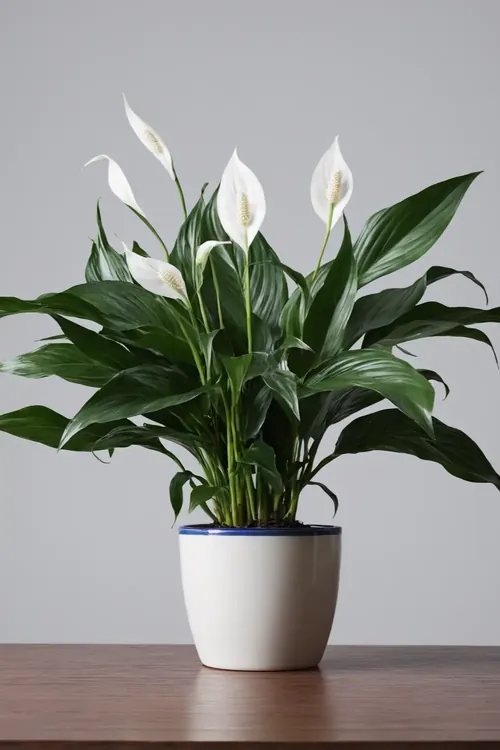
The Peace Lily is a leafy tropical grown for glossy, dark green foliage and upright white spathes. These flower-like structures are modified leaves surrounding the true flowers. Its full shape works well on floors, desks, and shaded indoor displays. It is easy to maintain when moisture stays steady, though its toxicity makes careful placement important in homes with pets or young children.
Care data checked 25 September 2026 · Dany · A-Z Plants
Light requirements
Peace Lily performs best in bright, indirect light measuring 150 to 250 μmol·m⁻²·s⁻¹.
Set it about 5 ft / 1.5 m from a south, west, or east-facing window.
Choose a position without a direct view of the sky. Filter unavoidable sun through a sheer curtain.
Strong direct light may bleach or scorch the leaves. Weak light reduces growth and flowering.
A PAR meter or PAR meter app can measure photosynthetically active radiation as PPFD (μmol·m⁻²·s⁻¹).
Watering
Keep Peace Lily soil consistently moist without making it soggy. Test several depths with a knitting needle or chopstick instead of judging only the surface.
Use room temperature rainwater, distilled water, or reverse osmosis water.
Water until excess flows through the drainage holes. Wait for the pot to drain fully before placing it on a saucer or inside a decorative planter.
Always use a pot with drainage holes. Constant saturation can cause root rot, while prolonged dryness leads to wilting and crisp edges.
Water considerably less in winter because the plant is not growing as actively. Continue checking the mix rather than following a fixed calendar.
Soil
Peace Lily needs a moisture-retentive mix with enough coarse material for drainage. Amend 2 parts organic all-purpose potting mix with 1 part bark and 1 part biochar.
DIY mix: use 1 part coir, 1 part pumice, 1 part bark, and 1 part biochar. Add a top dressing of worm castings.
Feeding
Give Peace Lily an organic all-purpose fertiliser every 2 to 4 weeks from March to October. Use the label strength and apply it to moist soil. Avoid excessive feeding, which can damage roots and leaf tips. Stop regular feeding when active growth ends.
Temperature & humidity
Maintain 65 to 80 °F / 18 to 27 °C around a Peace Lily. Protect it from cold drafts and sudden changes. Humidity between 40 and 60% is suitable. Higher moisture in the air can help prevent dry leaf edges.
What to expect
Peace Lily usually needs 3 to 5 years to reach maturity. Depending on the variety, it may grow 1 to 4 ft / 30 to 120 cm tall. Its mature spread is about 1 to 3 ft / 30 to 90 cm.
Varieties & cultivars
Spathiphyllum ‘Piccolino’: A dwarf selection with dark green foliage and white blooms.
Spathiphyllum ‘Sensation’: The largest selection, reaching 4 to 6 ft / 1.2 to 1.8 m with immense tropical leaves.
Spathiphyllum ‘Patricia’ and Spathiphyllum ‘Sonia’: ‘Patricia’ is compact with rich green leaves, while ‘Sonia’ has a small form. Both carry white blooms.
Spathiphyllum ‘Little Angel’: A compact dwarf that produces bracts more readily than other cultivars.
Spathiphyllum ‘Domino’ and Spathiphyllum ‘Jetty’: ‘Domino’ has ruffled green leaves with fine white streaks. ‘Jetty’ bears glossy green foliage and long-lasting white bracts.
Peace Lily: questions
Is Peace Lily toxic to cats and dogs?
Peace Lily is toxic to people, cats, and dogs. The ASPCA lists it as toxic to both cats and dogs. Its tissues contain irritating calcium oxalate crystals. Keep the plant out of…
How much light does Peace Lily need?
Peace Lily performs best in bright, indirect light measuring 150 to 250 μmol·m⁻²·s⁻¹. - Set it about 5 ft / 1.5 m from a south, west, or east-facing window. - Choose a position without a direct view of the sky. Filter unavoidable sun through a sheer curtain. - Strong direct light may bleach or…
How often should I water Peace Lily?
Keep Peace Lily soil consistently moist without making it soggy. Test several depths with a knitting needle or chopstick instead of judging only the surface. - Use room temperature rainwater, distilled water, or reverse osmosis water. - Water until excess flows through the drainage holes. Wait for…
How big does Peace Lily get?
Mature size indoors: Depending on the variety, it may grow 1….