Home › Plants that start with P › Parlour Palm
Indoor plant care
Parlour Palm
Chamaedorea elegans
Light requirements
The Parlour Palm prefers bright, indirect light but tolerates lower levels from 50 to 250 μmol·m⁻²·s⁻¹.
- Place it 5 to 8 ft / 1.5 to 2.5 m from a north, south, west, or east-facing window.
- Keep it where the leaves have no direct view of the sky. A sheer curtain can soften unavoidable sunlight.
- Too much light can scorch or fade the fronds. Too little light slows growth.
- A PAR meter or PAR meter app can check photosynthetically active radiation as PPFD (μmol·m⁻²·s⁻¹).
Watering
Keep the Parlour Palm evenly moist, but never leave its roots in saturated soil. Check moisture at several depths with a knitting needle or chopstick before watering again.
- Use room temperature rainwater, distilled water, or reverse osmosis water.
- Water deeply until liquid leaves the drainage holes. Let the pot finish draining before returning it to a saucer or decorative planter.
- A container with drainage holes is essential. Standing water can lead to root rot and declining fronds.
- Reduce watering considerably during winter, when active growth slows. Letting the mix stay dry for too long can cause brown, crisp leaf edges.
Soil
Use an organic potting mix made for palms. It should hold some moisture while allowing extra water to escape quickly. A pot with open drainage holes helps prevent waterlogged roots.
- DIY mix: combine 2 parts coir, 2 parts coarse sand, and 1 part pumice.
Feeding
Apply an organic palm fertiliser every 2 to 4 weeks from March to October. Follow the product strength rather than adding extra. Do not feed heavily or apply fertiliser to dry roots. Pause feeding outside the active growing season.
Temperature & humidity
The Parlour Palm grows best at 65 to 80 °F / 18 to 27 °C. Keep it away from cold drafts and sharp temperature shifts. An indoor humidity level of 40 to 60% suits the foliage and helps limit dry, brown edges.
What to expect
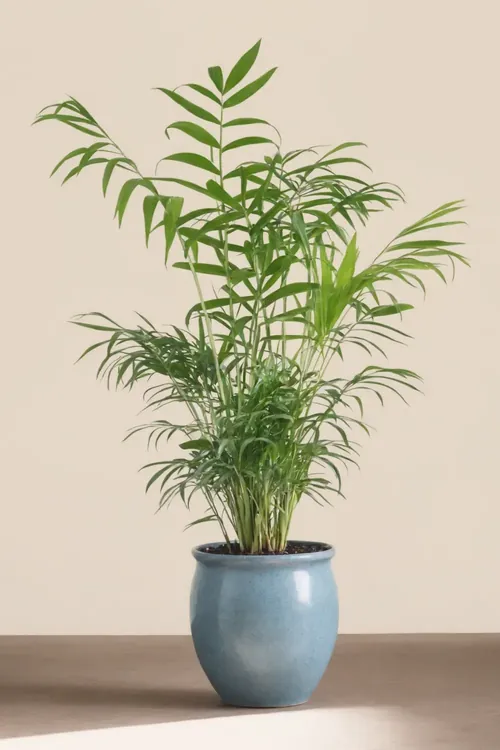
A Parlour Palm generally takes 3 to 5 years to mature. Indoors, it can reach 3 to 6 feet / 0.9 to 1.8 m tall. Its eventual spread is about 2 to 3 feet / 0.6 to 0.9 m. Growth is usually gradual indoors.
Varieties & cultivars
- C. elegans ‘Bella’: A compact form and the variety most often grown indoors.
- C. erumpens: Also called the Bamboo Palm, it grows slightly larger than C. elegans and has more fan-like leaves.
- C. seifrizii: This form develops bamboo-like clumps and grows somewhat taller.
- C. hooperiana: A less common choice with a more open arrangement of fronds.
Parlour Palm: questions
Is Parlour Palm toxic to cats and dogs?
The ASPCA classifies the Parlour Palm as non-toxic to cats and dogs. It is also considered non-toxic to people. Even so, chewing leaves may cause mild stomach upset or create a…
How much light does Parlour Palm need?
The Parlour Palm prefers bright, indirect light but tolerates lower levels from 50 to 250 μmol·m⁻²·s⁻¹. - Place it 5 to 8 ft / 1.5 to 2.5 m from a north, south, west, or east-facing window. - Keep it where the leaves have no direct view of the sky. A sheer curtain can soften unavoidable sunlight. -…
How often should I water Parlour Palm?
Keep the Parlour Palm evenly moist, but never leave its roots in saturated soil. Check moisture at several depths with a knitting needle or chopstick before watering again. - Use room temperature rainwater, distilled water, or reverse osmosis water. - Water deeply until liquid leaves the drainage…
How big does Parlour Palm get?
Mature size indoors: Indoors, it can reach 3 to 6 feet / 0.