LightPink Quill needs bright, indirect light between 150 and 250…
WaterPink Quill absorbs much of its water through its foliage…
ToxicitySafe for cats & dogs
Mature sizesee care guide
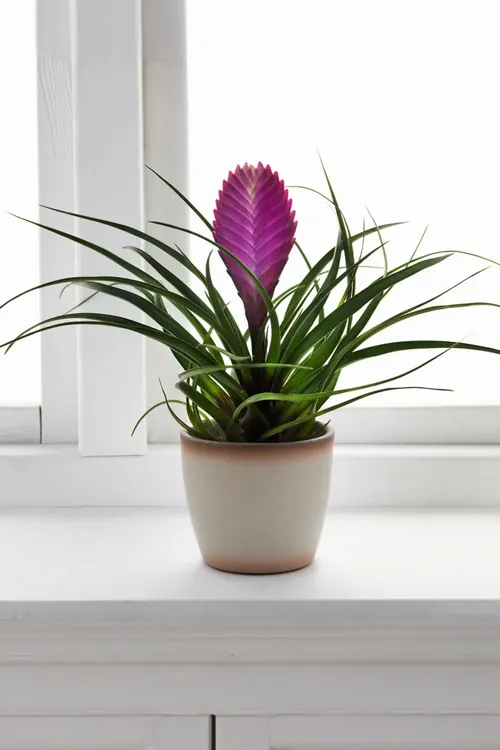
Pink Quill is a small evergreen air plant with arching green leaves and a flat, long-lasting pink bract. Its shape resembles a decorative quill. Violet flowers emerge from the bract during summer. The plant needs no conventional soil, so it works well on mounts, in coarse media, or as part of a compact indoor display with bright filtered light.
Care data checked 25 September 2026 · Dany · A-Z Plants
Light requirements
Pink Quill needs bright, indirect light between 150 and 250 μmol·m⁻²·s⁻¹.
Place it about 5 ft / 1.5 m from a south, west, or east-facing window.
Select a spot without a direct view of the sky. Filter unavoidable direct light with a sheer curtain.
Harsh sun can bleach or scorch the leaves and bract. Low light may slow growth and reduce flowering.
A PAR meter or PAR meter app can measure photosynthetically active radiation as PPFD (μmol·m⁻²·s⁻¹).
Watering
Pink Quill absorbs much of its water through its foliage rather than through ordinary potting soil. Soak the whole plant in rainwater for 20 to 30 minutes every week from spring to autumn.
Mist between weekly soaks when the plant begins drying too quickly.
After soaking, allow trapped water to drain away and give the leaves good airflow. Water left around the plant for too long can encourage rot.
Watch the foliage between sessions. Crisp, curling leaves may point to insufficient moisture, while soft or dark tissue can indicate that the plant remains wet.
The supplied schedule covers spring through autumn. Adjust carefully during slower periods rather than keeping the plant constantly damp.
Soil
Pink Quill does not require soil. It can grow mounted on driftwood or shells, or displayed in a terrarium. Ensure water does not remain trapped around its base. It may also be set in a free-draining container filled with a coarse medium such as bark.
Feeding
Spray Pink Quill with an organic fertiliser made for bromeliads every 2 to 4 weeks from March to October. Apply it as directed rather than making a strong solution. Do not let concentrated fertiliser collect in the leaves or around the base.
Temperature & humidity
Pink Quill prefers temperatures of 60 to 75 °F / 15 to 24 °C. Keep it away from cold drafts and heating vents. Humidity between 50 and 60% supports the foliage, provided the plant also receives airflow after soaking or misting.
What to expect
Pink Quill takes about 2 to 4 years to mature. It can eventually reach 20 inches / 50 cm tall and spread to 20 inches / 50 cm. Growth is compact, with the arching leaves gradually forming a full rosette.
Varieties & cultivars
T. cyanea ‘Pink Glow’: This cultivar develops brighter pink bracts than the typical form.
T. cyanea ‘Magenta Glow’: Its bracts have a vivid magenta color that differs from the usual pink.
Pink Quill: questions
Is Pink Quill toxic to cats and dogs?
Pink Quill is generally regarded as non-toxic to people and pets. However, there is no clear ASPCA safety ruling for Tillandsia cyanea, so it cannot be called pet safe on that…
How much light does Pink Quill need?
Pink Quill needs bright, indirect light between 150 and 250 μmol·m⁻²·s⁻¹. - Place it about 5 ft / 1.5 m from a south, west, or east-facing window. - Select a spot without a direct view of the sky. Filter unavoidable direct light with a sheer curtain. - Harsh sun can bleach or scorch the leaves and…
How often should I water Pink Quill?
Pink Quill absorbs much of its water through its foliage rather than through ordinary potting soil. Soak the whole plant in rainwater for 20 to 30 minutes every week from spring to autumn. - Mist between weekly soaks when the plant begins drying too quickly. - After soaking, allow trapped water to…