LightPersian Shield keeps its strongest color in bright…
WaterWater Persian Shield when the topsoil feels dry. Check the…
ToxicityNot ASPCA-listed
Mature sizeIndoors, it may grow 3 to 4 ft / 90 to…
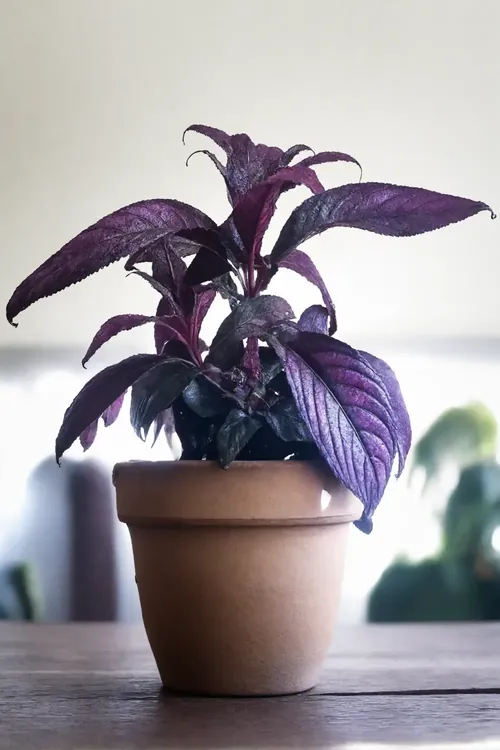
Persian Shield is a foliage plant prized for its intense metallic color. Long, deep green leaves develop an iridescent purple sheen that shifts with the light. Its upright form and bold surface color create a strong indoor accent. It suits growers who can provide bright filtered light, regular moisture, and moderate humidity while keeping the foliage away from harsh direct sun.
Care data checked 25 September 2026 · Dany · A-Z Plants
Light requirements
Persian Shield keeps its strongest color in bright, indirect light at 150 to 250 μmol·m⁻²·s⁻¹.
Position it about 5 ft / 1.5 m from a south, west, or east-facing window.
Avoid giving the leaves a direct view of the sky. A sheer curtain can filter unavoidable sunlight.
Strong direct sun may scorch the foliage. Too little light can dull the purple color and weaken growth.
Check photosynthetically active radiation as PPFD (μmol·m⁻²·s⁻¹) with a PAR meter or PAR meter app if desired.
Watering
Water Persian Shield when the topsoil feels dry. Check the mix with a finger before watering, since indoor drying speed changes with light and temperature.
Use room temperature rainwater, distilled water, or reverse osmosis water.
Water the entire root ball until excess drains from the holes. Allow the pot to stop dripping before placing it on a saucer or inside a decorative planter.
A pot with drainage holes is essential. Saturated soil can cause root rot, while prolonged dryness may produce wilted growth and crisp leaf edges.
Use considerably less water during winter when growth is not active. Do not let reduced watering become repeated severe drought.
Soil
Persian Shield grows in an organic all-purpose potting mix that holds moderate moisture but drains freely. Avoid dense soil that remains wet after watering.
DIY mix: combine 3 parts coir and 1 part pumice.
Add a top dressing of worm castings for gentle organic enrichment.
Feeding
Use an organic all-purpose fertiliser every 2 to 4 weeks from March to October. Apply it at the directed strength while the soil is moist. Do not overfeed, since excess salts can harm roots and leaf edges. Pause during slower winter growth.
Temperature & humidity
Persian Shield prefers 60 to 75 °F / 16 to 24 °C. Protect it from cold drafts and abrupt temperature changes. Keep humidity between 50 and 60% to support broad, healthy foliage and reduce dry edges.
What to expect
Persian Shield usually reaches maturity in 2 to 3 years. Indoors, it may grow 3 to 4 ft / 90 to 120 cm tall. Its eventual spread is 2 to 3 ft / 60 to 90 cm. Regular growth produces a substantial upright plant.
Varieties & cultivars
S. dyerianus ‘Persian Shield’: The standard form has vivid, iridescent purple leaves with a metallic finish.
S. dyerianus ‘Royal Purple’: This selection has a deeper purple shade and slightly larger leaves than the standard form.
S. dyerianus ‘Silver Shield’: A stronger silver sheen contrasts with the purple undertones.
Persian Shield: questions
Is Persian Shield toxic to cats and dogs?
Persian Shield is generally described as non-toxic to people and pets. However, it is not included on the ASPCA toxic and non-toxic plant list. There is therefore no ASPCA safety…
How much light does Persian Shield need?
Persian Shield keeps its strongest color in bright, indirect light at 150 to 250 μmol·m⁻²·s⁻¹. - Position it about 5 ft / 1.5 m from a south, west, or east-facing window. - Avoid giving the leaves a direct view of the sky. A sheer curtain can filter unavoidable sunlight. - Strong direct sun may…
How often should I water Persian Shield?
Water Persian Shield when the topsoil feels dry. Check the mix with a finger before watering, since indoor drying speed changes with light and temperature. - Use room temperature rainwater, distilled water, or reverse osmosis water. - Water the entire root ball until excess drains from the holes…
How big does Persian Shield get?
Mature size indoors: Indoors, it may grow 3 to 4 ft / 90 to….