LightOlive Tree needs bright direct light at 250 to 1000…
WaterAllow the soil around an Olive Tree to become almost dry…
ToxicitySafe for cats & dogs
Mature sizeIt may grow 3 to 6 ft / 1 to 2 m tall…
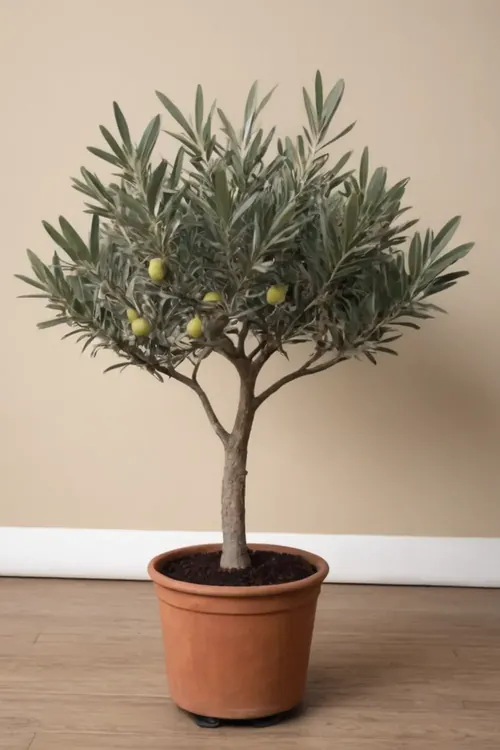
Olive Tree is an evergreen with narrow, lance-shaped leaves in silvery green. As it ages, the trunk develops a twisted, gnarled look that gives the plant strong character. A container-grown tree can produce small olives with proper care, although indoor fruiting is uncommon. It needs abundant direct sun and suits growers with a bright south-facing window, low humidity, and enough space for a woody specimen.
Care data checked 25 September 2026 · Dany · A-Z Plants
Light requirements
Olive Tree needs bright direct light at 250 to 1000 μmol·m⁻²·s⁻¹ as PPFD. Provide 6+ hours of direct sunlight each day to support dense growth and any chance of fruiting.
Placement: keep the tree within 2 ft / 60 cm of a south or southwest-facing window.
Give it an unobstructed view of the sky for the strongest available natural light.
Too little light: growth weakens, leaves may drop, and fruiting becomes unlikely.
Consider grow lights during wintertime when daylight hours are shorter. A PAR meter or PAR meter app can measure photosynthetically active radiation as PPFD (μmol·m⁻²·s⁻¹).
Watering
Allow the soil around an Olive Tree to become almost dry before watering. Check below the surface because the upper layer may dry while deeper roots still have moisture.
Test several depths with a knitting needle or chopstick. Water when the tool comes out nearly dry.
Use room temperature rainwater, distilled water, or reverse osmosis water. This can reduce mineral buildup and crispy leaf edges.
Water thoroughly until runoff exits the drainage holes. Let the pot empty completely before returning it to a saucer or decorative planter.
A container with drainage holes is essential, since wet soil may cause root rot. Water considerably less during the winter months when active growth slows. Extreme dryness can also cause curled, brittle leaves or leaf drop.
Soil
Use an organic all-purpose potting mix that drains quickly enough for Olive Tree roots. The container must release excess water freely, since the tree dislikes prolonged wetness.
DIY recipe: combine 3 parts coir, 1 part pumice, and 1 part worm castings.
Avoid compacted soil, blocked drainage holes, or a saucer that remains filled after watering.
Feeding
Apply an organic all-purpose fertilizer every 2 to 4 weeks from March to October. Feed Olive Tree at the recommended strength and apply it to damp soil. Do not increase the dose to force fruiting, and pause routine fertilizer during slower winter growth.
Temperature & humidity
Olive Tree prefers an ideal temperature range of 65 to 80 °F / 18 to 27 °C. Keep humidity at < 40%. Dry indoor air suits this Mediterranean tree, but provide airflow and protect it from sudden cold drafts or sharp temperature changes.
What to expect
Olive Tree reaches indoor maturity in about 3 to 5 years. It may grow 3 to 6 ft / 1 to 2 m tall, with a spread of 3 to 5 ft / 1 to 1.5 m. Growth is moderate, and pruning can maintain a compact canopy.
Varieties & cultivars
Olea europaea ‘Arbequina’: This small, adaptable tree has a weeping habit and tolerates frost and poor soil. It may be self-fertile and bears olives for eating or oil.
Olea europaea ‘Cipressino’: An upright, vigorous tree resembling Italian cypress. It handles coastal conditions well but needs a pollinator for abundant fruit.
Olea europaea ‘Frantoio’: This self-fertile tree also serves as a good pollinator. Its olives produce fruity, aromatic oil.
Olea europaea ‘Hojiblanca’: Long arching branches show distinct white undersides. The cold-tolerant tree bears long oval fruit for table use and oil.
Olea europaea ‘Leccino’: Its open habit is semi-pendulous, adaptable, and easy to cultivate. It produces quality table and oil olives but is self-sterile and needs a pollinator.
Olive Tree: questions
Is Olive Tree toxic to cats and dogs?
The ASPCA lists Olea europaea as non-toxic to cats and dogs. Olive Tree is also considered non-toxic to people. Fallen leaves, twigs, or pits can still create digestive or choking…
How much light does Olive Tree need?
Olive Tree needs bright direct light at 250 to 1000 μmol·m⁻²·s⁻¹ as PPFD. Provide 6+ hours of direct sunlight each day to support dense growth and any chance of fruiting. - Placement: keep the tree within 2 ft / 60 cm of a south or southwest-facing window. - Give it an unobstructed view of the sky…
How often should I water Olive Tree?
Allow the soil around an Olive Tree to become almost dry before watering. Check below the surface because the upper layer may dry while deeper roots still have moisture. - Test several depths with a knitting needle or chopstick. Water when the tool comes out nearly dry. - Use room temperature…
How big does Olive Tree get?
Mature size indoors: It may grow 3 to 6 ft / 1 to 2 m tall….