LightMoth Orchid grows best in bright, indirect light at 150 to…
WaterWater Moth Orchid when the top of the medium feels dry or…
ToxicitySafe for cats & dogs
Mature sizeA mature plant stands about 1 to 2 ft /…
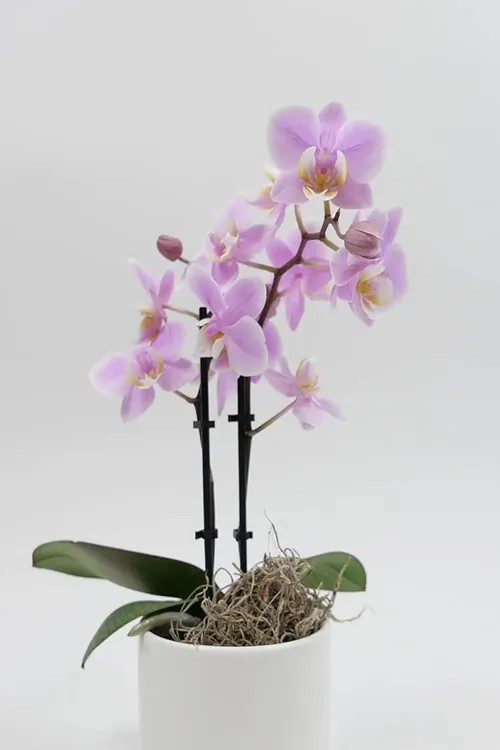
Moth Orchid is a popular flowering orchid with broad, leathery dark green leaves. Long arching spikes carry elegant blooms in many colors and patterns. The flowers often remain attractive for an extended period, making this orchid a common indoor display plant. It suits growers who can provide filtered light, an airy bark mix, and careful watering based on root color rather than a rigid calendar.
Care data checked 25 September 2026 · Dany · A-Z Plants
Light requirements
Moth Orchid grows best in bright, indirect light at 150 to 250 μmol·m⁻²·s⁻¹ as PPFD. Filtered light supports flowering while protecting its broad leaves.
Placement: position it about 5 ft / 1.5 m from a south, west, or east-facing window.
Direct sun: do not give the leaves a clear view of the sky. Use a sheer curtain if sunlight would reach them.
Too much light: foliage may turn pale or develop scorched spots.
Too little light: leaves may become very dark and flowering may stop. A PAR meter or PAR meter app can measure photosynthetically active radiation as PPFD (μmol·m⁻²·s⁻¹).
Watering
Water Moth Orchid when the top of the medium feels dry or when visible roots turn silvery-green. Green roots usually still contain moisture, so root color can be more useful than a fixed schedule.
Use room temperature rainwater, distilled water, or reverse osmosis water. This helps limit salt buildup and crispy root or leaf tips.
Soak the medium thoroughly until water runs from the drainage holes. Let all excess drain before returning the pot to a saucer or decorative planter.
A container with drainage holes is essential. Never leave the orchid standing in water, since wet, airless roots can rot.
Water considerably less during the winter months when active growth slows. Avoid leaving water trapped around the leaf crown.
Soil
Moth Orchid needs a specialty organic potting mix formulated for orchids rather than standard soil. The coarse medium must provide strong airflow and rapid drainage around its roots.
DIY recipe: combine 4 parts bark, 1 part pumice, and 1 part biochar.
Use a well-drained orchid pot. Replace the mix when it breaks down and begins holding too much water.
Feeding
Apply an organic fertilizer formulated for orchids every 2 to 4 weeks from March to October. Use the recommended strength on damp roots. Do not apply concentrated feed to a dry orchid, and avoid allowing fertilizer salts to collect in the bark mix.
Temperature & humidity
Moth Orchid prefers an ideal temperature range of 65 to 80 °F / 18 to 27 °C. Maintain humidity between 50 and 70%. Pair higher humidity with airflow, and protect flowers and leaves from cold drafts or direct blasts from heating vents.
What to expect
Moth Orchid usually takes 1 to 2 years to reach its first flowering. A mature plant stands about 1 to 2 ft / 30 to 60 cm tall and spreads 12 to 18 in / 30 to 45 cm. Growth is gradual, with new leaves and roots appearing between flowering cycles.
Varieties & cultivars
P. amabilis (White Moth Orchid): Large, fragrant white flowers have a purple-spotted lip.
P. aphrodite (Pink Moth Orchid): This compact plant carries clusters of vivid pink blooms.
P. doris (Phalaenopsis with Spots): White petals are marked with purple or red spots.
P. sogo ‘Gold’ (Yellow Moth Orchid): Showy yellow flowers feature a spotted lip.
Moth Orchid: questions
Is Moth Orchid toxic to cats and dogs?
The ASPCA lists Phalaenopsis orchids as non-toxic to cats and dogs. Moth Orchid is also considered non-toxic to people. Chewing can still damage the plant or cause mild digestive…
How much light does Moth Orchid need?
Moth Orchid grows best in bright, indirect light at 150 to 250 μmol·m⁻²·s⁻¹ as PPFD. Filtered light supports flowering while protecting its broad leaves. - Placement: position it about 5 ft / 1.5 m from a south, west, or east-facing window. - Direct sun: do not give the leaves a clear view of the…
How often should I water Moth Orchid?
Water Moth Orchid when the top of the medium feels dry or when visible roots turn silvery-green. Green roots usually still contain moisture, so root color can be more useful than a fixed schedule. - Use room temperature rainwater, distilled water, or reverse osmosis water. This helps limit salt…
How big does Moth Orchid get?
Mature size indoors: A mature plant stands about 1 to 2 ft /….