LightMajesty Palm grows best in bright, indirect light at 150 to…
WaterKeep Majesty Palm soil consistently moist without making it…
ToxicityNot ASPCA-listed
Mature sizeIts broad fronds may create a mature…
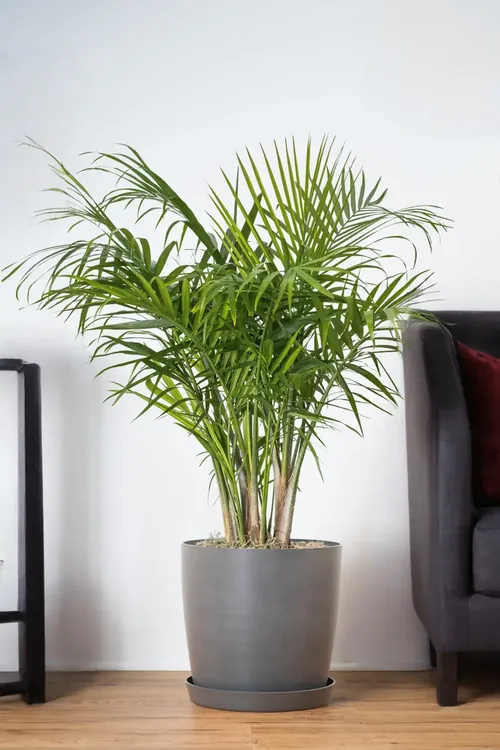
Majesty Palm is a tropical palm with large, feathery fronds that form a graceful indoor canopy. It comes from Madagascar, where it naturally grows near riverbanks and across swampy lowlands. That background explains its preference for steady moisture and humid air. This intermediate plant suits a roomy, bright position and a grower prepared to monitor both watering and humidity closely.
Care data checked 25 September 2026 · Dany · A-Z Plants
Light requirements
Majesty Palm grows best in bright, indirect light at 150 to 250 μmol·m⁻²·s⁻¹.
Position it 5 ft / 1.5 m from a south, west, or east-facing window.
Avoid giving the fronds an unobstructed view of the sky. Filter unavoidable direct sunlight through a sheer curtain.
Harsh sun can scorch the leaflets. Too little light may weaken growth and reduce the palm's full shape.
Measure photosynthetically active radiation with a PAR meter or PAR meter app, using PPFD (μmol·m⁻²·s⁻¹).
Watering
Keep Majesty Palm soil consistently moist without making it soggy. Check the mix at several depths with a knitting needle or chopstick. Large containers can stay wet in the center even when the surface looks dry. Water considerably less during winter when active growth slows.
Use room temperature rainwater, distilled water, or reverse osmosis water.
Water the complete root area until excess leaves the drainage holes. Let the pot drain fully before returning it to a saucer or decorative planter.
Drainage holes are essential because standing water may cause root rot.
Do not let the root ball dry completely. Long dry spells can produce brown, crispy leaflet tips and declining fronds.
Soil
Use an organic potting mix made for palms. Majesty Palm needs a blend that holds steady moisture but still drains enough to prevent stagnant conditions.
For a DIY recipe, combine 2 parts coir, 2 parts coarse sand, and 1 part pumice.
Use a container with reliable drainage holes.
Feeding
Apply an organic palm fertiliser every 2 to 4 weeks from March to October. Follow the label's dilution because no separate strength is provided. Do not increase the feeding rate, and suspend routine applications during winter.
Temperature & humidity
Majesty Palm prefers temperatures from 65 to 80 °F / 18 to 26 °C. Maintain humidity between 50 and 70%. Consistent warmth and humid air help protect the many leaflets from dry tips and browning.
What to expect
Majesty Palm needs about 8 to 10 years to mature, so growth indoors is measured. It can eventually stand 10 ft / 3 m tall. Its broad fronds may create a mature spread of 5 to 8 ft / 1.5 to 2.5 m.
Varieties & cultivars
Ravenea rivularis ‘Compacta’: A smaller and more compact Majesty Palm suited to tighter indoor spaces.
Ravenea rivularis ‘Variegata’: Yellow and green streaks create variegation across the fronds.
Majesty Palm: questions
Is Majesty Palm toxic to cats and dogs?
The supplied safety information describes Majesty Palm as non-toxic to people and pets. No ASPCA listing is included here, so there is no ASPCA safety ruling to claim from this…
How much light does Majesty Palm need?
Majesty Palm grows best in bright, indirect light at 150 to 250 μmol·m⁻²·s⁻¹. - Position it 5 ft / 1.5 m from a south, west, or east-facing window. - Avoid giving the fronds an unobstructed view of the sky. Filter unavoidable direct sunlight through a sheer curtain. - Harsh sun can scorch the…
How often should I water Majesty Palm?
Keep Majesty Palm soil consistently moist without making it soggy. Check the mix at several depths with a knitting needle or chopstick. Large containers can stay wet in the center even when the surface looks dry. Water considerably less during winter when active growth slows. - Use room temperature…
How big does Majesty Palm get?
Mature size indoors: Its broad fronds may create a mature….