WaterKeep Maidenhair Fern soil consistently moist but never…
ToxicityNot ASPCA-listed
Mature size5 ft / 30 to 75 cm tall
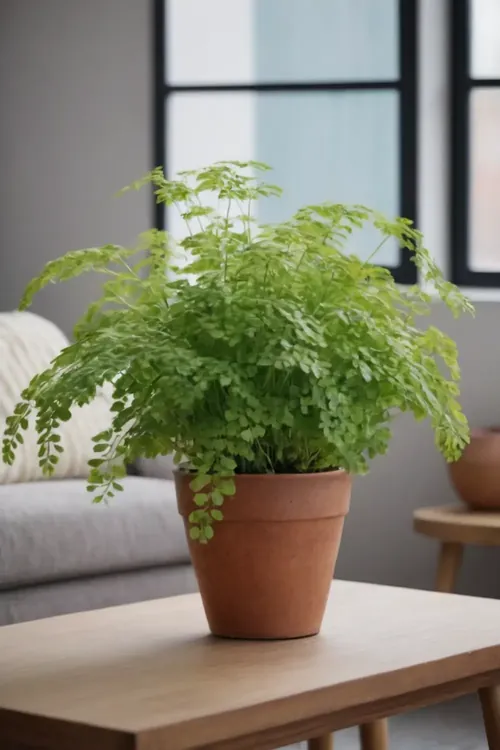
Maidenhair Fern has airy, fan-shaped fronds held on thin, black, wiry stems. The delicate foliage creates a soft texture but reacts quickly when the root zone becomes dry. It favors warm rooms with humid air and steady moisture. This intermediate plant suits attentive growers who can monitor its pot often and protect the fragile fronds from direct sunlight and dry drafts.
Care data checked 25 September 2026 · Dany · A-Z Plants
Light requirements
Maidenhair Fern prefers bright, indirect light measuring 150 to 250 μmol·m⁻²·s⁻¹. It tolerates lower light, but growth may slow.
Position it 5 ft / 1.5 m from a south, west, or east-facing window.
Do not give the fern a direct view of the sky. Use a sheer curtain if sunlight would otherwise touch the fronds.
Excess sun can scorch the delicate foliage. Deep shade produces slower, weaker growth.
A PAR meter or PAR meter app can measure photosynthetically active radiation as PPFD (μmol·m⁻²·s⁻¹).
Watering
Keep Maidenhair Fern soil consistently moist but never soggy. Use a knitting needle or chopstick to test moisture at several depths. This fern can decline quickly if the full root ball becomes dry. Water considerably less during winter, while still maintaining light moisture.
Use room temperature rainwater, distilled water, or reverse osmosis water.
Water evenly until excess flows through the drainage holes. Let the pot drain fully before setting it on a saucer or inside a decorative planter.
Drainage holes are essential because stagnant water can lead to root rot.
Dry soil and low moisture can turn the fine fronds brown and crispy. Check the pot often during warm conditions.
Soil
Use an organic all-purpose potting mix that stays lightly moist while still draining excess water. Maidenhair Fern has fine roots that struggle in either compacted or saturated soil.
Combine 3 parts coir, 1 part pumice, and 1 part bark for a DIY mix.
Add worm castings as a top dressing.
Feeding
Apply an organic all-purpose fertiliser every 2 to 4 weeks from March through October. Use the label dilution, since no strength is specified. Do not overfeed Maidenhair Fern, and stop regular applications during winter.
Temperature & humidity
Maidenhair Fern prefers warm temperatures of 70 to 80 °F / 21 to 27 °C. Maintain humidity between 50 and 70%. Protect the fine fronds from cold drafts and dry heated air, which can quickly cause browning.
What to expect
Maidenhair Fern matures in about 2 to 4 years, with a moderate growth pace under stable care. It eventually reaches 1 to 2.5 ft / 30 to 75 cm tall. Its mature spread is 1 to 2 ft / 30 to 60 cm.
Varieties & cultivars
A. raddianum: Delta Maidenhair Fern has delicate, fan-shaped fronds and prefers high humidity.
A. capillus-veneris: Southern Maidenhair Fern has compact growth and thrives in warmer climates.
A. pedatum: Northern Maidenhair Fern has distinctively shaped fronds arranged around a dark central stem.
A. venustum: Himalayan Maidenhair Fern is hardy and has a creeping habit suited to ground cover.
A. aleuticum: Western Maidenhair Fern is noted for resilience and adaptability across different environments.
Maidenhair Fern: questions
Is Maidenhair Fern toxic to cats and dogs?
The supplied safety information identifies Maidenhair Fern as non-toxic to people and pets. No specific ASPCA listing is provided here, so there is no ASPCA safety ruling to cite…
How much light does Maidenhair Fern need?
Maidenhair Fern prefers bright, indirect light measuring 150 to 250 μmol·m⁻²·s⁻¹. It tolerates lower light, but growth may slow. - Position it 5 ft / 1.5 m from a south, west, or east-facing window. - Do not give the fern a direct view of the sky. Use a sheer curtain if sunlight would otherwise…
How often should I water Maidenhair Fern?
Keep Maidenhair Fern soil consistently moist but never soggy. Use a knitting needle or chopstick to test moisture at several depths. This fern can decline quickly if the full root ball becomes dry. Water considerably less during winter, while still maintaining light moisture. - Use room temperature…