LightMoses in the Cradle prefers bright, indirect light at 150…
WaterKeep the soil around Moses in the Cradle consistently moist…
ToxicityToxic to pets
Mature sizesee care guide
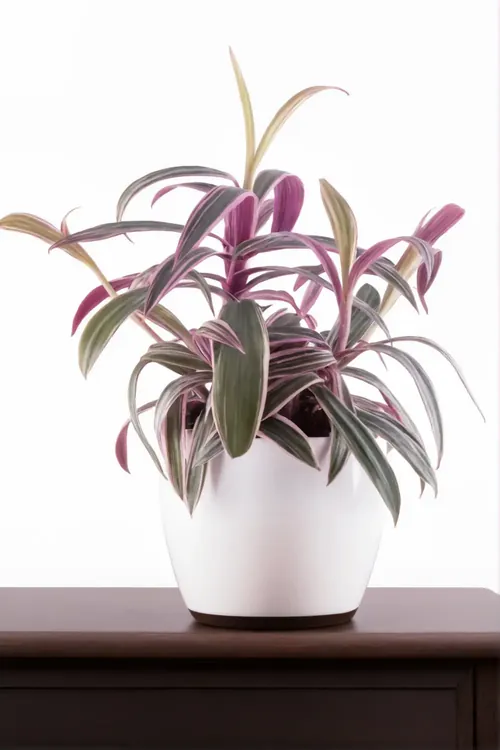
Moses in the Cradle is an evergreen perennial that forms upright rosettes of long, sword-shaped leaves. Their upper surfaces are glossy green, while the undersides are rich purple. Small white flowers with three petals appear inside purple, boat-like bracts among the foliage. The plant offers strong color without relying on blooms and stays compact enough for windowsills, tables, or mixed indoor displays.
Care data checked 25 September 2026 · Dany · A-Z Plants
Light requirements
Moses in the Cradle prefers bright, indirect light at 150 to 250 μmol·m⁻²·s⁻¹ as PPFD. Useful filtered light helps maintain the green and purple leaf color.
Placement: keep it around 5 ft / 1.5 m from a south, west, or east-facing window.
Direct sun: prevent an open view of the sky. Filter unavoidable sunlight with a sheer curtain.
Too much light: leaves may bleach or develop dry, scorched patches.
Too little light: growth slows and the purple coloring may weaken. A PAR meter or PAR meter app can measure photosynthetically active radiation as PPFD (μmol·m⁻²·s⁻¹).
Watering
Keep the soil around Moses in the Cradle consistently moist but not soggy. Check moisture often, especially during warm, bright weather, and avoid leaving the pot saturated.
Use a knitting needle or chopstick to test moisture at several depths. Water before the root zone becomes fully dry.
Choose room temperature rainwater, distilled water, or reverse osmosis water. Poor water quality or dryness may contribute to crispy leaf edges.
Water until excess liquid flows from the drainage holes. Let the pot drain completely before returning it to a saucer or decorative planter.
Drainage holes are essential because standing water can cause root rot. Water considerably less in the winter months when growth slows, but do not let the root ball remain dry for long.
Soil
An organic all-purpose potting mix suits Moses in the Cradle if it drains freely. The soil should keep light, even moisture without becoming waterlogged.
DIY recipe: combine 3 parts coir with 1 part pumice.
Apply worm castings as a top dressing. Use a pot with drainage holes, and never leave it standing in collected runoff.
Feeding
Apply an organic all-purpose fertilizer every 2 to 4 weeks from March to October. Feed Moses in the Cradle at the recommended strength while the soil is moist. Avoid strong fertilizer on dry roots, and stop regular feeding when growth slows outside the stated season.
Temperature & humidity
Moses in the Cradle prefers an ideal temperature range of 60 to 85 °F / 15 to 30 °C. Its ideal humidity is 40%. Typical indoor air is suitable, but cold drafts and hot vents may damage the foliage or dry its edges.
What to expect
Moses in the Cradle reaches maturity in about 2 to 3 years. Its eventual height is 1 ft / 30 cm, with an equal spread of 1 ft / 30 cm. Growth is moderate, and new rosettes gradually create a fuller clump.
Varieties & cultivars
T. spathacea ‘Tricolor’: Stripes of green, cream, and pink run along the foliage.
T. spathacea ‘Sitara’s Gold’: Its leaves display vivid yellow and green striping.
T. spathacea ‘Nanouk’: This compact cultivar has curly green foliage marked with silver variegation.
Moses in the Cradle: questions
Is Moses in the Cradle toxic to cats and dogs?
The ASPCA lists this plant, also known as Moses in the Cradle, as toxic to cats and dogs. It is also toxic to people. Sap and plant tissue may irritate the mouth, skin, or…
How much light does Moses in the Cradle need?
Moses in the Cradle prefers bright, indirect light at 150 to 250 μmol·m⁻²·s⁻¹ as PPFD. Useful filtered light helps maintain the green and purple leaf color. - Placement: keep it around 5 ft / 1.5 m from a south, west, or east-facing window. - Direct sun: prevent an open view of the sky. Filter…
How often should I water Moses in the Cradle?
Keep the soil around Moses in the Cradle consistently moist but not soggy. Check moisture often, especially during warm, bright weather, and avoid leaving the pot saturated. - Use a knitting needle or chopstick to test moisture at several depths. Water before the root zone becomes fully dry. -…