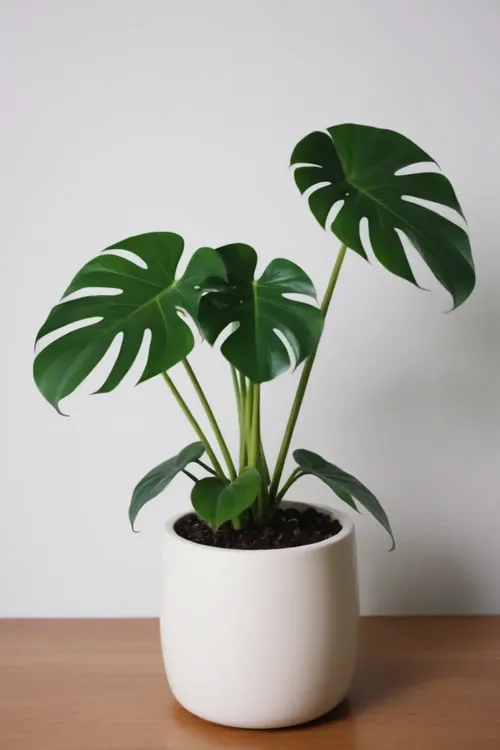
Home › Plants that start with M › Mini Monstera
Indoor plant care
Mini Monstera
Rhaphidophora tetrasperma
Light requirements
Mini Monstera prefers bright, indirect light measuring 150 to 250 μmol·m⁻²·s⁻¹ as PPFD. Good light supports larger leaves and stronger natural splits.
- Placement: position it around 5 ft / 1.5 m from a south, west, or east-facing window.
- Direct sun: avoid a clear view of the sky. Use a sheer curtain if sunlight would fall directly on the leaves.
- Too much light: glossy foliage may bleach or develop scorched patches.
- Too little light: stems stretch and leaves may stay small or less divided. A PAR meter or PAR meter app can measure photosynthetically active radiation as PPFD (μmol·m⁻²·s⁻¹).
Watering
Water Mini Monstera when the topsoil feels dry. Check the pot before each watering instead of relying on a calendar, since climbing plants may use water faster in brighter conditions.
- Use room temperature rainwater, distilled water, or reverse osmosis water. This may limit mineral buildup and dry brown edges.
- Water the full root ball until excess liquid flows through the drainage holes. Let it drain completely before returning the pot to a saucer or decorative planter.
- Drainage holes are essential. Soggy soil can suffocate the roots and lead to yellow leaves or root rot.
- Water considerably less in the winter months when active growth slows. If the mix remains dry for too long, leaves may curl, droop, or develop crispy edges.
Soil
Mini Monstera needs an airy mix that drains freely around its climbing aroid roots. Amend 2 parts organic all-purpose potting mix with 1 part bark and 1 part biochar.
- DIY recipe: combine 1 part coir, 1 part pumice, 1 part bark, and 1 part biochar.
- Top dress with worm castings and use a container with drainage holes.
Feeding
Apply an organic all-purpose fertilizer every 2 to 4 weeks from March to October. Feed Mini Monstera at the label strength while its soil is damp. Do not use an extra-strong solution to speed climbing growth, and pause regular applications during the slower season.
Temperature & humidity
Mini Monstera prefers an ideal temperature range of 65 to 80 °F / 18 to 27 °C. Maintain humidity between 40 and 60%. Keep the vine away from cold drafts and harsh heating vents, which can dry the leaves and slow growth.
What to expect
Mini Monstera reaches maturity in about 3 to 5 years. Supported vines can grow 6 to 10 ft / 1.8 to 3 m tall. Its spread can be trained as desired along a support. Growth is often quick during warm, bright months and slower in winter.
Varieties & cultivars
- R. tetrasperma ‘Marble’: White markings create a marbled pattern across the green leaves. It requires slightly brighter light than the regular plant.
- R. tetrasperma ‘Peru’: This form has unusually large, deeply split leaves with strong veins. It can grow larger than the standard variety.
Mini Monstera: questions
Is Mini Monstera toxic to cats and dogs?
Rhaphidophora tetrasperma has no specific ASPCA safety ruling, so it cannot be called pet safe on that basis. Mini Monstera is still considered toxic to people and pets if chewed…
How much light does Mini Monstera need?
Mini Monstera prefers bright, indirect light measuring 150 to 250 μmol·m⁻²·s⁻¹ as PPFD. Good light supports larger leaves and stronger natural splits. - Placement: position it around 5 ft / 1.5 m from a south, west, or east-facing window. - Direct sun: avoid a clear view of the sky. Use a sheer…
How often should I water Mini Monstera?
Water Mini Monstera when the topsoil feels dry. Check the pot before each watering instead of relying on a calendar, since climbing plants may use water faster in brighter conditions. - Use room temperature rainwater, distilled water, or reverse osmosis water. This may limit mineral buildup and dry…
How big does Mini Monstera get?
Mature size indoors: Supported vines can grow 6 to 10 ft / 1.