LightMedusa’s Head prefers bright, indirect light at 150 to 250…
WaterMedusa’s Head absorbs moisture through its leaves rather…
ToxicitySafe for cats & dogs
Mature sizeA mature plant is usually 6 to 8 in /…
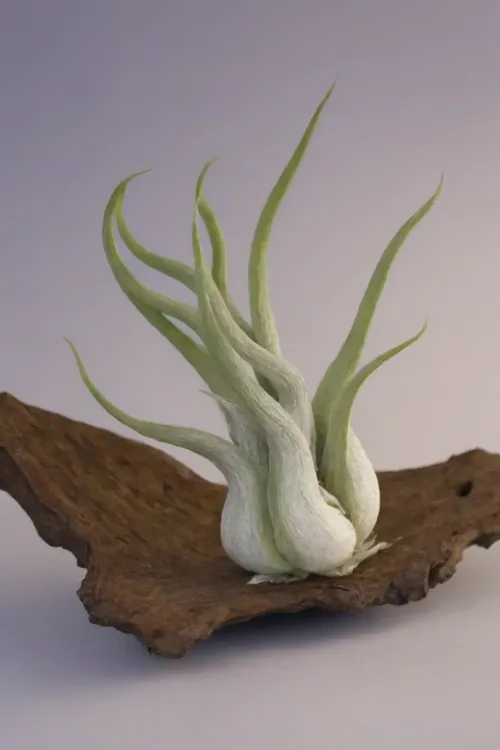
Medusa’s Head is a soil-free air plant with silvery-green leaves that curl and twist outward. Their snake-like form gives the plant its memorable common name. A vivid pink flower can appear during summer. Its small size works well on mounted displays, shelves, or open terrariums. It is easy to place, but regular soaking and good air movement remain important for healthy growth.
Care data checked 25 September 2026 · Dany · A-Z Plants
Light requirements
Medusa’s Head prefers bright, indirect light at 150 to 250 μmol·m⁻²·s⁻¹ as PPFD. Useful light supports firm growth and summer flowering without scorching its silvery foliage.
Placement: position it about 5 ft / 1.5 m from a south, west, or east-facing window.
Direct sun: avoid an open view of the sky. Use a sheer curtain when sunlight would otherwise strike the leaves.
Too much light: foliage may bleach, dry, or develop scorched areas.
Too little light: growth and flowering may slow. A PAR meter or PAR meter app can measure photosynthetically active radiation as PPFD (μmol·m⁻²·s⁻¹).
Watering
Medusa’s Head absorbs moisture through its leaves rather than roots in potting soil. From spring to autumn, soak the whole plant in rainwater for 20 to 30 minutes every week. Mist between these weekly soakings if it dries quickly.
After soaking, let trapped water drain away. Water left around the leaf bases may encourage rot.
Watch the curled leaves for dryness. Crisp tips or tightly rolled foliage can indicate that the plant needs moisture.
Do not leave it standing in water after the soak. Good air movement helps the foliage dry and lowers the risk of decay.
Rainwater is the stated choice for soaking. Avoid placing a wet plant in strong direct sun.
Soil
Medusa’s Head does not need soil, and burying its base can hold too much moisture. Display it on driftwood or shells, or place it in an open terrarium. Any mounting method should allow air to move around the plant and water to drain away after soaking. Avoid enclosed, constantly damp displays that can encourage rot.
Feeding
Spray Medusa’s Head with an organic fertilizer made for bromeliads every 2 to 4 weeks from March to October. Apply it as a light foliar feed rather than soaking the plant in a strong solution. Do not overfeed, since concentrated fertilizer can harm the leaves.
Temperature & humidity
Medusa’s Head accepts a broad ideal temperature range of 50 to 90°F / 10 to 32°C. Keep humidity near 40 to 60%. Humid air should be paired with airflow, since stale, wet conditions may cause the leaf bases to rot.
What to expect
Medusa’s Head reaches maturity in about 2 to 3 years. A mature plant is usually 6 to 8 in / 15 to 20 cm tall and spreads 8 to 12 in / 20 to 30 cm. Its growth is gradual, with the twisting leaves creating most of its width.
Varieties & cultivars
T. ionantha ‘Fuego’: Its green foliage develops a vivid red blush. Stronger bright light makes the red color more intense.
T. harrisii: This air plant has a slimmer, more open shape than the classic Medusa’s Head.
T. cyanea: Twisting foliage combines green with silvery-blue tones for a cooler appearance.
Medusa’s Head: questions
Is Medusa’s Head toxic to cats and dogs?
Tillandsia caput-medusae has no specific ASPCA safety ruling, so it cannot be called pet safe on that basis. The supplied safety guidance considers Medusa’s Head non-toxic to…
How much light does Medusa’s Head need?
Medusa’s Head prefers bright, indirect light at 150 to 250 μmol·m⁻²·s⁻¹ as PPFD. Useful light supports firm growth and summer flowering without scorching its silvery foliage. - Placement: position it about 5 ft / 1.5 m from a south, west, or east-facing window. - Direct sun: avoid an open view of…
How often should I water Medusa’s Head?
Medusa’s Head absorbs moisture through its leaves rather than roots in potting soil. From spring to autumn, soak the whole plant in rainwater for 20 to 30 minutes every week. Mist between these weekly soakings if it dries quickly. - After soaking, let trapped water drain away. Water left around the…
How big does Medusa’s Head get?
Mature size indoors: A mature plant is usually 6 to 8 in /….