LightCroton Plant needs bright indirect light of 150 to 250…
WaterWater Croton Plant when the topsoil feels dry. Check the…
ToxicityToxic to pets
Mature sizeIndoors, it may reach 3 to 8 ft / 0
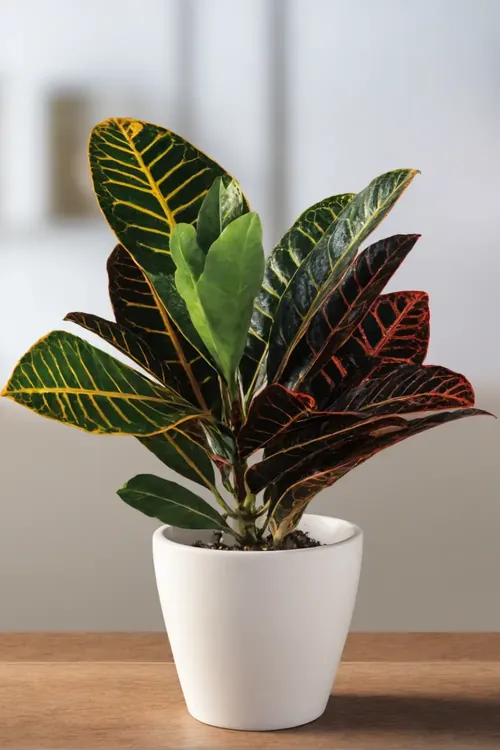
Croton Plant is an upright shrub grown for large, leathery leaves with bold variegation. Its foliage may combine green with vivid yellow, red, orange, or other warm tones. The strong color makes it a striking indoor focal point. It needs more consistent light, warmth, and moisture than many easy houseplants, so it best suits attentive growers.
Care data checked 25 September 2026 · Dany · A-Z Plants
Light requirements
Croton Plant needs bright indirect light of 150 to 250 μmol·m⁻²·s⁻¹. Strong filtered light helps maintain its vivid leaf colors.
Place it about 5 ft / 1.5 m from a south, west, or east-facing window.
Avoid a direct view of the sky. Use a sheer curtain where sunlight would otherwise strike the leaves.
Too much light: intense direct sun may bleach or scorch foliage.
Too little light: new leaves become greener and growth slows. A PAR meter or PAR meter app can measure PPFD in μmol·m⁻²·s⁻¹.
Watering
Water Croton Plant when the topsoil feels dry. Check the mix with a finger before watering, since it dislikes both complete drought and constantly wet roots. Try to keep conditions stable rather than swinging between extremes.
Use room temperature rainwater, distilled water, or reverse osmosis water.
Water thoroughly until liquid exits the drainage holes. Let the pot drain fully before placing it back in a saucer or decorative planter.
Drainage holes are essential. Soggy soil may cause root rot, yellowing, and leaf drop.
Water considerably less during winter when active growth slows. If kept too dry, leaves may droop, fall, or develop crispy edges.
Soil
Use an organic all-purpose potting mix that retains moderate moisture while draining freely. Croton Plant should not sit in compacted or waterlogged soil, and the pot needs drainage holes.
DIY recipe: blend 3 parts coir with 1 part pumice.
Finish with a light top dressing of worm castings.
Feeding
Apply an organic all-purpose fertilizer every 2 to 4 weeks from March to October. Feed after watering and use the strength stated on the label. Do not add extra fertilizer to improve leaf color, and reduce applications when Croton Plant slows during winter.
Temperature & humidity
Croton Plant prefers 60 to 80 °F / 16 to 27 °C. Avoid cold drafts and sudden changes, which may trigger leaf drop. It accepts humidity from 40 to 80%. Higher humidity can help the broad foliage stay fresh, provided the soil drains well.
What to expect
Croton Plant usually takes 3 to 5 years to mature. Indoors, it may reach 3 to 8 ft / 0.9 to 2.4 m tall and spread 3 to 6 ft / 0.9 to 1.8 m. Growth is moderate when warmth and bright light remain steady.
Varieties & cultivars
Codiaeum variegatum ‘Gold Dust’: Bright yellow coloring appears across green leaves as fine speckles.
Codiaeum variegatum ‘Petra’: This common cultivar has broad leaves splashed with several vivid colors.
Croton Plant: questions
Is Croton Plant toxic to cats and dogs?
Croton Plant is toxic to people, cats, and dogs. The ASPCA lists Codiaeum variegatum as toxic to pets. Its sap can irritate skin, while swallowed plant material may affect the…
How much light does Croton Plant need?
Croton Plant needs bright indirect light of 150 to 250 μmol·m⁻²·s⁻¹. Strong filtered light helps maintain its vivid leaf colors. - Place it about 5 ft / 1.5 m from a south, west, or east-facing window. - Avoid a direct view of the sky. Use a sheer curtain where sunlight would otherwise strike the…
How often should I water Croton Plant?
Water Croton Plant when the topsoil feels dry. Check the mix with a finger before watering, since it dislikes both complete drought and constantly wet roots. Try to keep conditions stable rather than swinging between extremes. - Use room temperature rainwater, distilled water, or reverse osmosis…
How big does Croton Plant get?
Mature size indoors: Indoors, it may reach 3 to 8 ft / 0.