LightCape Sundew needs bright direct light at 250 to 1000…
WaterCape Sundew must remain wet at all times. Use only room…
ToxicityNot ASPCA-listed
Mature sizeIt eventually grows 6 to 12 in / 15 to…
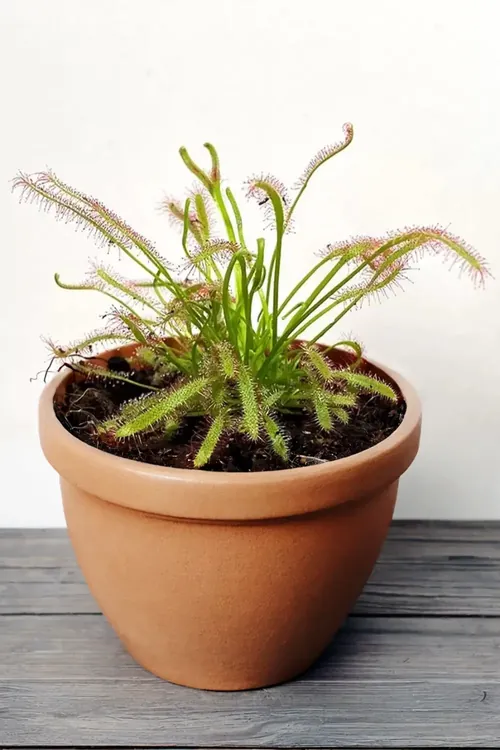
Cape Sundew is a small carnivorous plant that forms a low rosette. Its narrow leaves carry sticky, tentacle-like glands that trap small insects. The glistening droplets give the foliage a jeweled appearance while helping the plant collect nutrients. This sundew suits sunny windows and growers willing to use mineral-free water. Unlike most houseplants, it needs permanently wet, nutrient-poor soil and should never receive standard fertilizer.
Care data checked 25 September 2026 · Dany · A-Z Plants
Light requirements
Cape Sundew needs bright direct light at 250 to 1000 μmol·m⁻²·s⁻¹ PPFD. Give it 6+ hours of direct sunlight each day.
Placement: keep it within 2 ft / 60 cm of a south or southwest-facing window. It should have an unobstructed view of the sky.
Measurement: a PAR meter or PAR meter app can measure photosynthetically active radiation.
Too much light: plants moved suddenly from shade may scorch, so increase exposure gradually.
Too little light: leaves lose color and sticky dew production declines. Grow lights can help during shorter winter daylight hours.
Watering
Cape Sundew must remain wet at all times. Use only room temperature rainwater, distilled water, or reverse osmosis water. Mineral-rich tap water can leave salts in the nutrient-poor soil.
Grow it in a pot with drainage holes, then stand that pot in a tray or saucer.
During the growing season, maintain 1 in / 2.5 cm of water in the tray at all times. Refill it before it becomes dry.
Do not allow the soil to dry, since roots and sticky leaves can decline quickly. Crispy leaf tips may follow a dry spell.
The tray method is intentional for this bog plant. It differs from ordinary houseplant care, where standing water often causes root rot.
Soil
Use a specialty organic potting mix formulated for carnivorous plants. Cape Sundew needs a nutrient-poor medium that remains wet while still holding some air. Ordinary enriched potting soil can harm it.
DIY recipe: combine 1 part coir with 1 part pumice.
Do not add compost, worm castings, or conventional fertilizer to the mix.
Do not fertilize Cape Sundew. It obtains nutrients by trapping insects on its sticky leaves, so routine liquid or granular fertilizer is unnecessary. Added nutrients can damage its sensitive roots and soil. Allow the plant to catch suitable small prey on its own.
Temperature & humidity
Cape Sundew tolerates 50 to 80°F / 10 to 27°C. Keep conditions within this broad range and avoid harsh drafts. Humidity between 40 and 70% is suitable. Correct watering remains essential even at higher humidity, since humid air cannot replace the permanently wet growing medium.
What to expect
Cape Sundew reaches maturity in about 1 to 2 years. It eventually grows 6 to 12 in / 15 to 30 cm tall. The mature rosette spreads about 8 to 10 in / 20 to 25 cm. Growth is relatively quick when light and water remain suitable.
Varieties & cultivars
Drosera capensis ‘Alba’: This pale form has light green leaves and white flowers.
Drosera capensis ‘Red’: Dark red leaves are paired with pink flowers.
Drosera capensis ‘Wide Leaf’: Leaves are broader than those of the typical Cape Sundew.
Drosera capensis ‘Narrow Leaf’: This cultivar produces narrower leaves than the typical form.
Drosera capensis ‘Giant’: Leaves grow larger than those of the standard Cape Sundew.
Cape Sundew: questions
Is Cape Sundew toxic to cats and dogs?
Cape Sundew is not listed by the ASPCA, so there is no official ruling for cats or dogs and it cannot be called pet safe on that basis. It is generally considered non-toxic to…
How much light does Cape Sundew need?
Cape Sundew needs bright direct light at 250 to 1000 μmol·m⁻²·s⁻¹ PPFD. Give it 6+ hours of direct sunlight each day. - Placement: keep it within 2 ft / 60 cm of a south or southwest-facing window. It should have an unobstructed view of the sky. - Measurement: a PAR meter or PAR meter app can…
How often should I water Cape Sundew?
Cape Sundew must remain wet at all times. Use only room temperature rainwater, distilled water, or reverse osmosis water. Mineral-rich tap water can leave salts in the nutrient-poor soil. - Grow it in a pot with drainage holes, then stand that pot in a tray or saucer. - During the growing season…
How big does Cape Sundew get?
Mature size indoors: It eventually grows 6 to 12 in / 15 to….