LightCat Palm prefers bright indirect light at 150 to 250…
WaterWater Cat Palm when the topsoil feels dry. Check below the…
ToxicitySafe for cats & dogs
Mature sizeThe clump can spread 3 to 5 ft / 0
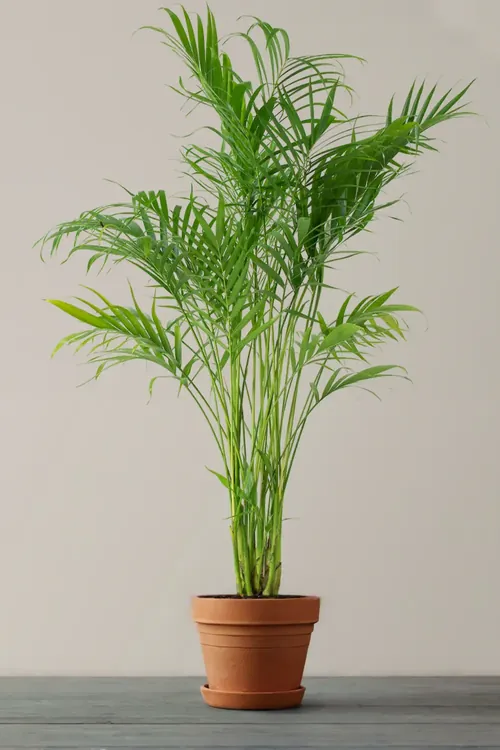
Cat Palm is a small, clustering palm with many arching, feathery fronds. Its bushy growth rises from the base rather than forming one tall, bare trunk. The foliage brings a soft tropical look to floors and broad plant stands. This palm suits a bright room with space for its widening crown. It needs more moisture and humidity than drought-tolerant palms, so regular checks are important.
Care data checked 25 September 2026 · Dany · A-Z Plants
Light requirements
Cat Palm prefers bright indirect light at 150 to 250 μmol·m⁻²·s⁻¹ PPFD. Protect its feathery fronds from strong direct sunlight.
Placement: set it about 5 ft / 1.5 m from a south, west or east-facing window. It should not have a clear view of the sky.
Filtering: hang a sheer curtain if sunlight would otherwise reach the leaves.
Measurement: a PAR meter or PAR meter app can check photosynthetically active radiation.
Too much light may bleach or scorch fronds. Too little light slows growth and produces a thinner, weaker crown.
Watering
Water Cat Palm when the topsoil feels dry. Check below the surface before watering because the lower mix may still contain moisture. Use room temperature rainwater, distilled water, or reverse osmosis water.
Water the whole root ball until liquid flows from the drainage holes. Let excess water escape before returning the pot to a saucer or decorative planter.
A container with drainage holes is essential. Waterlogged soil can rot roots and yellow the fronds.
Water considerably less in winter, when the palm is not actively growing, but do not allow a severe dry spell.
Crispy leaflet edges can indicate dryness or low humidity. Persistent wilt in moist soil may be a sign of damaged roots.
Soil
Use a specialty organic potting mix formulated for palms. Cat Palm needs a blend that holds moderate moisture while allowing air and excess water to move through the root zone.
DIY recipe: combine 2 parts coir, 2 parts coarse sand, and 1 part pumice.
Always use a pot with drainage holes.
Feeding
Apply an organic fertilizer formulated for palms every 2 to 4 weeks from March to October. Feed Cat Palm on moist soil during active growth. Do not exceed the label rate, since excess fertilizer can burn roots and brown the fronds. Pause routine winter feeding.
Temperature & humidity
Cat Palm prefers 70 to 80°F / 21 to 27°C. Protect it from cold drafts and direct blasts from heating or cooling vents. Maintain humidity between 50 and 70%. Higher humidity within this range helps limit dry, brown edges on the fine leaflets.
What to expect
Cat Palm may need 5 to 10 years to mature. Its eventual indoor height is about 3 ft / 0.9 m. The clump can spread 3 to 5 ft / 0.9 to 1.5 m, so it may become wider than it is tall.
Varieties & cultivars
Chamaedorea elegans (Parlor Palm): This popular relative forms a bushy display of dark green fronds.
Chamaedorea metallica (Metallica Cat Palm): Glossy dark green fronds have a distinctive iridescent sheen.
Cat Palm: questions
Is Cat Palm toxic to cats and dogs?
The ASPCA classifies Cat Palm as non-toxic to cats and dogs. It is also regarded as non-toxic to people. Pets may still experience mild stomach upset after eating plant material…
How much light does Cat Palm need?
Cat Palm prefers bright indirect light at 150 to 250 μmol·m⁻²·s⁻¹ PPFD. Protect its feathery fronds from strong direct sunlight. - Placement: set it about 5 ft / 1.5 m from a south, west or east-facing window. It should not have a clear view of the sky. - Filtering: hang a sheer curtain if sunlight…
How often should I water Cat Palm?
Water Cat Palm when the topsoil feels dry. Check below the surface before watering because the lower mix may still contain moisture. Use room temperature rainwater, distilled water, or reverse osmosis water. - Water the whole root ball until liquid flows from the drainage holes. Let excess water…
How big does Cat Palm get?
Mature size indoors: The clump can spread 3 to 5 ft / 0.