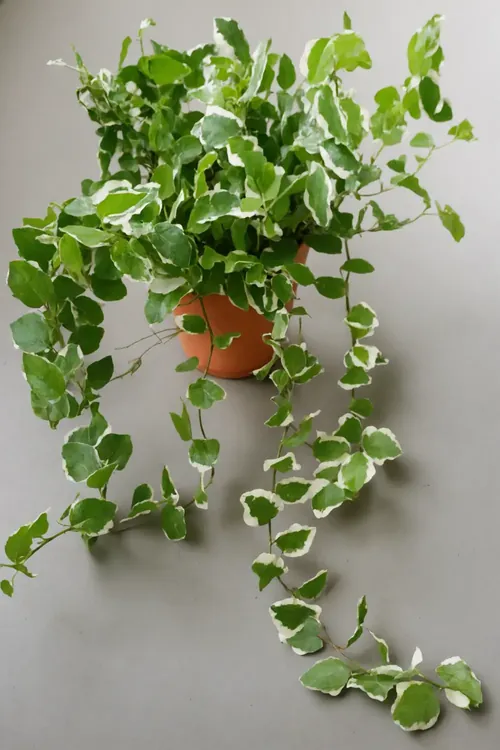
LightCreeping Fig grows in medium to bright indirect light of…
WaterWater Creeping Fig when the topsoil feels dry. Check before…
ToxicityToxic to pets
Mature sizeSupported vines can reach 10 to 15 ft /…
Creeping Fig is a vigorous vine with small, glossy green leaves and a fast growth habit. Adhesive aerial rootlets let its stems cling tightly to walls, supports, and other surfaces. Indoors, it can trail from a pot or cover a frame, but regular pruning keeps it manageable. It suits growers who want dense greenery and can guide its spreading stems.
Care data checked 25 September 2026 · Dany · A-Z Plants
Light requirements
Creeping Fig grows in medium to bright indirect light of 150 to 200 μmol·m⁻²·s⁻¹. Filter direct sun before it reaches the small leaves.
Place it around 6 ft / 1.8 m from a south, west, or east-facing window.
The vine should not have a direct view of the sky. Use a sheer curtain if direct sunlight cannot be avoided.
Too much light: exposed foliage may bleach or scorch.
Too little light: stems become sparse and growth slows. A PAR meter or PAR meter app can measure PPFD in μmol·m⁻²·s⁻¹.
Watering
Water Creeping Fig when the topsoil feels dry. Check before each watering because a dense canopy can hide changes in the potting mix. Keep some moisture around the roots without leaving the soil saturated.
Use room temperature rainwater, distilled water, or reverse osmosis water.
Water until liquid runs through the drainage holes. Let the container drain completely before returning it to a saucer or decorative planter.
Drainage holes are essential. Constant wetness may cause root rot, yellow leaves, and stem loss.
Water considerably less in winter when growth slows. Prolonged dryness can cause wilting, leaf drop, and crispy edges.
Soil
Creeping Fig grows well in an organic all-purpose potting mix. The soil should retain light moisture while releasing excess water quickly, especially in a full, leafy pot.
DIY recipe: combine 3 parts coir with 1 part pumice.
Top dress with worm castings and use a container with drainage holes.
Feeding
Apply an organic all-purpose fertilizer every 2 to 4 weeks from March to October. Use the stated strength on moist soil. Do not overfeed to encourage faster coverage, since weak excess growth is harder to manage. Reduce applications during the slower winter period.
Temperature & humidity
Creeping Fig prefers 65 to 85 °F / 18 to 29 °C. Avoid cold drafts and hot airflow that can dry its small leaves. Maintain humidity between 40 and 50%. Steady warmth and moderate humidity support dense, even coverage.
What to expect
Creeping Fig is fast-growing and usually matures in 2 to 3 years. Supported vines can reach 10 to 15 ft / 3 to 4.5 m, with a spread of 3 to 6 ft / 0.9 to 1.8 m. Regular pruning is needed to control its size indoors.
Varieties & cultivars
Ficus pumila ‘Variegata’: Green leaves have creamy white edges. It is also called Variegated Creeping Fig or Snowflake Creeping Fig.
Ficus pumila ‘Quercifolia’: Small, glossy dark green leaves resemble oak foliage. Other names include Oak Leaf Creeping Fig and Miniature Oak Leaf Fig.
Ficus pumila ‘Curly’: Light green leaves are wavy, curled, and velvety. It is also called Curly Creeping Fig or Crinkle Leaf Creeping Fig.
Ficus pumila ‘Lime Ripple’: Lime green leaves have noticeably wavy margins and add a brighter color.
Ficus pumila ‘Minima’: This dwarf cultivar has smaller rounded leaves and suits terrariums or compact spaces.
Creeping Fig: questions
Is Creeping Fig toxic to cats and dogs?
Creeping Fig is toxic to people, cats, and dogs. The ASPCA lists Ficus pumila as toxic to pets. Its sap can irritate skin, and chewing may affect the mouth or stomach. Wear gloves…
How much light does Creeping Fig need?
Creeping Fig grows in medium to bright indirect light of 150 to 200 μmol·m⁻²·s⁻¹. Filter direct sun before it reaches the small leaves. - Place it around 6 ft / 1.8 m from a south, west, or east-facing window. - The vine should not have a direct view of the sky. Use a sheer curtain if direct…
How often should I water Creeping Fig?
Water Creeping Fig when the topsoil feels dry. Check before each watering because a dense canopy can hide changes in the potting mix. Keep some moisture around the roots without leaving the soil saturated. - Use room temperature rainwater, distilled water, or reverse osmosis water. - Water until…
How big does Creeping Fig get?
Mature size indoors: Supported vines can reach 10 to 15 ft /….