LightCorn Plant prefers medium to bright indirect light of 150…
WaterWater Corn Plant when the topsoil feels dry. Check with a…
ToxicityToxic to pets
Mature sizeIt can reach 6 to 8 ft / 1
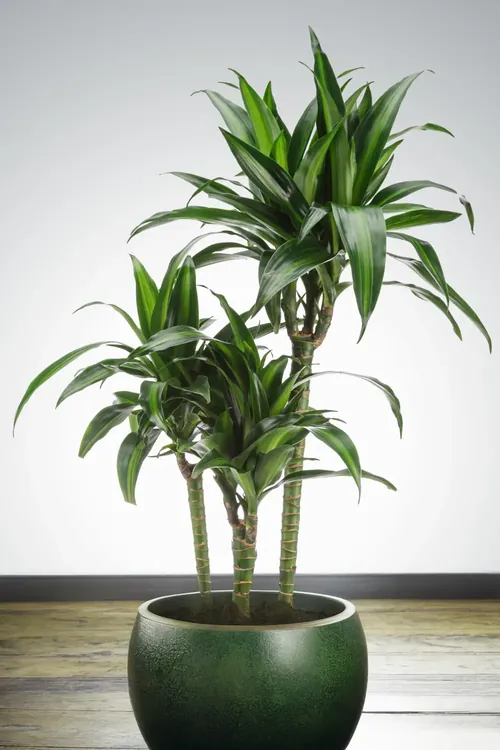
Corn Plant is an upright indoor tree with one or more sturdy trunks. Long, sword-shaped leaves emerge in broad tufts and resemble the foliage of corn stalks. Its strong vertical form works well as a floor plant in homes or offices. It is fairly forgiving, though careful watering and filtered light reduce brown tips and leaf loss.
Care data checked 25 September 2026 · Dany · A-Z Plants
Light requirements
Corn Plant prefers medium to bright indirect light of 150 to 200 μmol·m⁻²·s⁻¹. It needs filtered illumination rather than strong direct rays.
Place it about 6 ft / 1.8 m from a south, west, or east-facing window.
The leaves should not have a direct view of the sky. Use a sheer curtain if direct sunlight is unavoidable.
Too much light: exposed leaves may bleach or develop dry scorch marks.
Too little light: growth slows and patterned cultivars may lose contrast. A PAR meter or PAR meter app can measure PPFD in μmol·m⁻²·s⁻¹.
Watering
Water Corn Plant when the topsoil feels dry. Check with a finger before adding more water, since the lower mix may remain damp after the surface changes color. Avoid both prolonged dryness and constant saturation.
Use room temperature rainwater, distilled water, or reverse osmosis water.
Water thoroughly until liquid runs from the drainage holes. Let the pot empty fully before replacing it in a saucer or decorative planter.
A pot with drainage holes is essential. Soggy soil may cause root rot, yellow leaves, and soft canes.
Water considerably less in winter when growth slows. Long dry spells or poor water quality may contribute to crispy brown tips.
Soil
Corn Plant grows in an organic all-purpose potting mix that holds moderate moisture but still drains freely. Avoid compact soil and use a container with drainage holes.
DIY recipe: mix 3 parts coir with 1 part pumice.
Add a light top dressing of worm castings to the surface.
Feeding
Apply an organic all-purpose fertilizer every 2 to 4 weeks from March to October. Use the label strength and feed after watering. Do not fertilize dry soil or increase the dose to speed growth. Reduce applications when the Corn Plant rests during winter.
Temperature & humidity
Corn Plant prefers 60 to 75 °F / 15 to 24 °C. Protect it from cold drafts and direct airflow from heating or cooling vents. Humidity between 40 and 50% is suitable. Stable conditions help limit brown tips and sudden leaf drop.
What to expect
Corn Plant normally needs 3 to 5 years to mature indoors. It can reach 6 to 8 ft / 1.8 to 2.4 m tall, with a spread of 2 to 3 ft / 0.6 to 0.9 m. Growth is moderate and remains mostly upright.
Varieties & cultivars
Dracaena fragrans ‘Lindenii’: Yellow stripes line the edges of green leaves. It grows up to 6 ft / 1.8 m tall.
Dracaena fragrans ‘Victoria’: Each green leaf has one yellow center stripe. It reaches 5 ft / 1.5 m and tolerates low light.
Dracaena fragrans ‘Lemon Lime’: Lemon-lime green edge stripes frame dark green leaves. It reaches 5 ft / 1.5 m and prefers moderate indirect light.
Dracaena fragrans ‘Warneckii’: White center stripes mark dark green leaves. Its bushier, shorter form reaches up to 4 ft / 1.2 m.
Dracaena fragrans ‘Limelight’: Bright yellow-green leaves contrast with dark stems. This slow-grower reaches up to 5 ft / 1.5 m.
Corn Plant: questions
Is Corn Plant toxic to cats and dogs?
Corn Plant is toxic to people, cats, and dogs. The ASPCA lists Dracaena fragrans as toxic to cats and dogs. Eating it may cause vomiting, drooling, weakness, or appetite loss…
How much light does Corn Plant need?
Corn Plant prefers medium to bright indirect light of 150 to 200 μmol·m⁻²·s⁻¹. It needs filtered illumination rather than strong direct rays. - Place it about 6 ft / 1.8 m from a south, west, or east-facing window. - The leaves should not have a direct view of the sky. Use a sheer curtain if direct…
How often should I water Corn Plant?
Water Corn Plant when the topsoil feels dry. Check with a finger before adding more water, since the lower mix may remain damp after the surface changes color. Avoid both prolonged dryness and constant saturation. - Use room temperature rainwater, distilled water, or reverse osmosis water. - Water…