LightCooper’s Haworthia prefers bright indirect light of 150 to…
WaterLet the soil dry out completely before watering Cooper’s…
ToxicitySafe for cats & dogs
Mature sizesee care guide
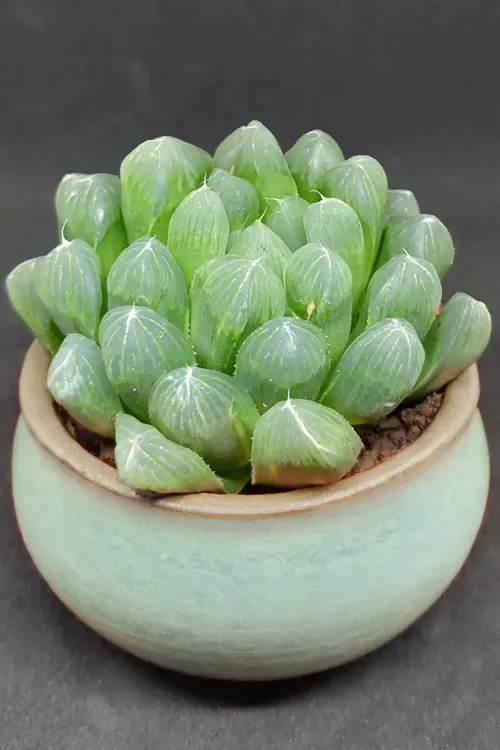
Cooper’s Haworthia is a small succulent that forms tidy clumps of fleshy leaves. Each triangular leaf sits within a compact rosette, often showing a translucent tip that lets light enter. Its limited size makes it useful on windowsills, desks, or narrow shelves. It is easy to maintain when given filtered light, gritty soil, and long drying periods.
Care data checked 25 September 2026 · Dany · A-Z Plants
Light requirements
Cooper’s Haworthia prefers bright indirect light of 150 to 250 μmol·m⁻²·s⁻¹. Filter strong rays to protect its translucent foliage.
Place it about 5 ft / 1.5 m from a south, west, or east-facing window.
It should not have a direct view of the sky. Use a sheer curtain if sunlight would otherwise hit the rosette.
Too much light: leaves may bleach, brown, or develop scorched patches.
Too little light: the rosette stretches and loses its compact form. A PAR meter or PAR meter app can measure PPFD in μmol·m⁻²·s⁻¹.
Watering
Let the soil dry out completely before watering Cooper’s Haworthia. Check several depths with a knitting needle or chopstick, since the surface may dry before the lower mix. Never water only because a set number of days has passed.
Use room temperature rainwater, distilled water, or reverse osmosis water.
Soak the soil until water exits the drainage holes. Let it drain fully before returning the pot to a saucer or decorative planter.
Drainage holes are essential. Repeated moisture around the roots can cause rot and soft, translucent leaves.
Water considerably less in winter, when growth slows. Severe or prolonged dryness may leave the foliage thin, wrinkled, or crispy.
Soil
Use a specialty organic succulent potting mix with rapid drainage. Cooper’s Haworthia cannot tolerate dense soil that holds water around its roots. A small container with open drainage holes is important.
DIY recipe: blend 2 parts coir, 2 parts coarse sand, and 1 part pumice.
Feeding
Apply an organic fertilizer formulated for succulents every 2 to 4 weeks from March to October. Follow the stated strength and feed after watering. Do not fertilize dry roots or continue frequent applications during winter, when Cooper’s Haworthia needs less water and nutrition.
Temperature & humidity
Cooper’s Haworthia prefers 68 to 72 °F / 20 to 22 °C. Keep the plant away from cold drafts and strong heat sources. An indoor humidity range of 40 to 50% is suitable. High humidity combined with wet soil can increase rot risk.
What to expect
Cooper’s Haworthia is slow-growing and takes about 3 to 5 years to mature. A single mature rosette reaches around 3.2 in / 8 cm tall and 3.2 in / 8 cm wide. Offsets may gradually create a broader clump over time.
Varieties & cultivars
Haworthia cooperi var. cooperi: The standard variety has green leaves with translucent tips.
Haworthia cooperi var. gordoniana: Its leaves are rounder and smoother than those of the standard variety.
Haworthia cooperi var. picta: Green and white marbling creates a variegated pattern across the leaves.
Haworthia cooperi ‘Crystalina’: Larger leaf tips appear almost completely transparent.
Haworthia cooperi ‘Variegata’: Creamy yellow margins give the leaves a clearly variegated look.
Cooper’s Haworthia: questions
Is Cooper’s Haworthia toxic to cats and dogs?
Cooper’s Haworthia is generally regarded as non-toxic to people and pets. However, Haworthia cooperi has no clear ASPCA safety ruling, so it cannot be called pet safe on that…
How much light does Cooper’s Haworthia need?
Cooper’s Haworthia prefers bright indirect light of 150 to 250 μmol·m⁻²·s⁻¹. Filter strong rays to protect its translucent foliage. - Place it about 5 ft / 1.5 m from a south, west, or east-facing window. - It should not have a direct view of the sky. Use a sheer curtain if sunlight would otherwise…
How often should I water Cooper’s Haworthia?
Let the soil dry out completely before watering Cooper’s Haworthia. Check several depths with a knitting needle or chopstick, since the surface may dry before the lower mix. Never water only because a set number of days has passed. - Use room temperature rainwater, distilled water, or reverse…