LightClubmoss prefers low to medium indirect light of 50 to 150…
WaterKeep Clubmoss consistently moist without making the soil…
ToxicitySafe for cats & dogs
Mature sizeIt reaches 4 to 6 in / 10 to 15 cm…
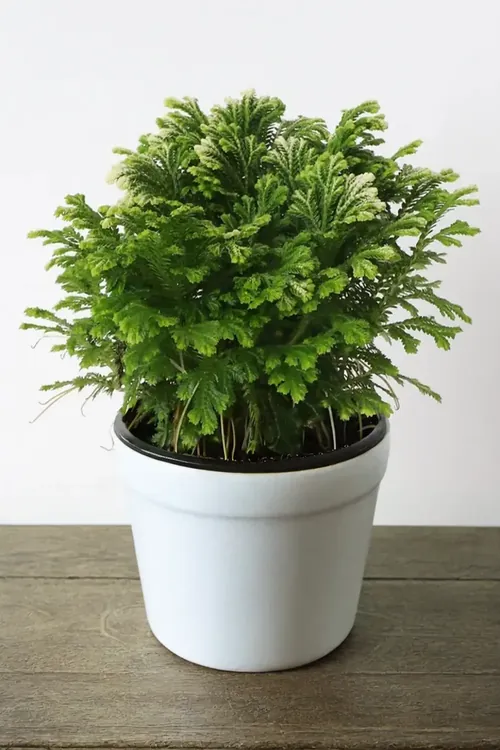
Clubmoss is a low-growing relative of ferns with tiny, bright green leaves that resemble moss. Its creeping stems knit together into dense mats, adding soft texture without much height. It fits humid terrariums, shallow containers, and mixed indoor displays. This easy plant is best for growers who can provide steady moisture and moderate humidity.
Care data checked 25 September 2026 · Dany · A-Z Plants
Light requirements
Clubmoss prefers low to medium indirect light of 50 to 150 μmol·m⁻²·s⁻¹. It does not need a sunny windowsill.
Place it about 8 ft / 2.5 m from a north, east, or west-facing window.
A suitable low-light spot should still be bright enough for comfortable reading without artificial lighting.
Too much light: direct sun can bleach or crisp the fine foliage.
Too little light: growth thins and spreading slows. Use a PAR meter or PAR meter app to check PPFD in μmol·m⁻²·s⁻¹.
Watering
Keep Clubmoss consistently moist without making the soil soggy. Test moisture at several depths with a knitting needle or chopstick. Do not wait for the entire root ball to dry, since its fine foliage wilts quickly.
Use room temperature rainwater, distilled water, or reverse osmosis water.
Water thoroughly until it drains from the holes. Allow all extra water to escape before returning the pot to a saucer or decorative planter.
A container with drainage holes is essential. Saturated soil can cause root rot and collapsing growth.
Water considerably less during winter when growth slows, but retain light moisture. Dry soil can quickly produce brown, crispy stems.
Soil
Clubmoss grows in an organic all-purpose potting mix that holds steady moisture while allowing excess water to drain. Avoid a dense, airless mix and always use a pot with drainage holes.
DIY recipe: combine 3 parts coir with 1 part pumice.
Top dress the surface with worm castings.
Feeding
Apply an organic all-purpose fertilizer every 2 to 4 weeks from March to October. Follow the label strength and feed only after watering. Do not use extra fertilizer to speed growth, and reduce applications during winter when Clubmoss is less active.
Temperature & humidity
Clubmoss prefers 60 to 75°F / 15 to 24°C. Protect its fine foliage from cold drafts and hot, drying vents. Ideal humidity is 50%. Stable warmth, damp soil, and moderate moisture in the air help the dense mat remain green.
What to expect
Clubmoss matures in about 1 to 2 years and spreads more than it grows upward. It reaches 4 to 6 in / 10 to 15 cm tall, with an eventual spread of 8 to 12 in / 20 to 30 cm. Growth is fairly quick under moist conditions.
Varieties & cultivars
Selaginella kraussiana ‘Aurea’: The fronds are flecked with green or gold, giving the mat a brighter tone.
Selaginella kraussiana ‘Variegata’: Dark green fronds end in white tips, creating a frosted appearance.
Selaginella kraussiana ‘Brownii’: Tiny green leaves form a tight, low mass that spreads outward.
Clubmoss: questions
Is Clubmoss toxic to cats and dogs?
Clubmoss is considered non-toxic to people. The ASPCA lists Selaginella kraussiana as non-toxic to cats and dogs. Even so, plant material may cause mild digestive upset when eaten…
How much light does Clubmoss need?
Clubmoss prefers low to medium indirect light of 50 to 150 μmol·m⁻²·s⁻¹. It does not need a sunny windowsill. - Place it about 8 ft / 2.5 m from a north, east, or west-facing window. - A suitable low-light spot should still be bright enough for comfortable reading without artificial lighting. - Too…
How often should I water Clubmoss?
Keep Clubmoss consistently moist without making the soil soggy. Test moisture at several depths with a knitting needle or chopstick. Do not wait for the entire root ball to dry, since its fine foliage wilts quickly. - Use room temperature rainwater, distilled water, or reverse osmosis water. -…
How big does Clubmoss get?
Mature size indoors: It reaches 4 to 6 in / 10 to 15 cm….