LightAreca Palm thrives in bright, indirect light measuring 150…
WaterWater Areca Palm when the topsoil feels dry. Check below…
ToxicitySafe for cats & dogs
Mature sizeIndoors, it can reach 6 to 10 feet / 1
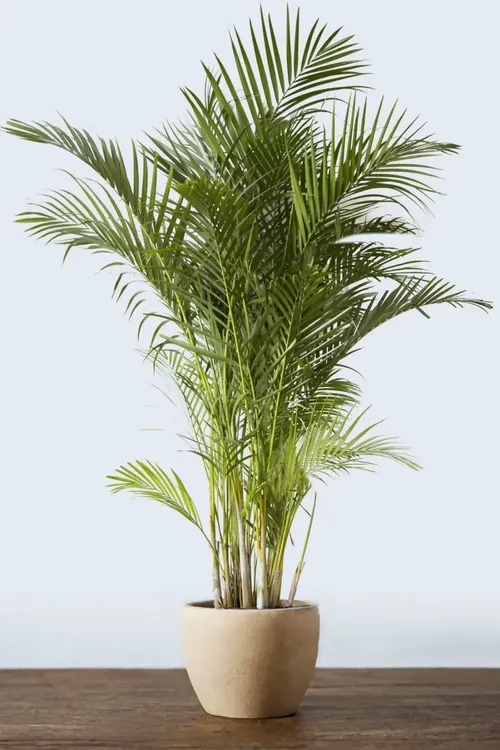
Areca Palm grows as a dense clump of smooth, ringed trunks with a golden-yellow tone. Long, arching fronds divide into narrow green leaflets, creating a soft, feathery look similar to bamboo. It can become a large floor plant and needs room to spread. This palm suits bright interiors where moisture remains steady. Dry air, excess salts, and poor drainage can damage the leaf tips.
Care data checked 25 September 2026 · Dany · A-Z Plants
Light requirements
Areca Palm thrives in bright, indirect light measuring 150 to 250 μmol·m⁻²·s⁻¹.
Place it 5 ft / 1.5 m from a south, west, or east-facing window, where it has no direct view of the sky.
Use a sheer curtain if direct sunlight reaches the fronds. Strong rays may bleach or scorch them.
Too little light slows growth and can produce sparse, weak fronds.
Measure photosynthetically active radiation as PPFD (μmol·m⁻²·s⁻¹) with a PAR meter or PAR meter app.
Watering
Water Areca Palm when the topsoil feels dry. Check below the surface before watering, since a large pot can stay damp near its center. Aim for even moisture without saturation.
Use room temperature rainwater, distilled water, or reverse osmosis water. These options can help avoid mineral buildup and damaged tips.
Water until excess leaves the drainage holes, then let the pot drain fully before returning it to a saucer or decorative planter.
Water considerably less during winter, when active growth slows.
Constant wetness encourages root rot and yellowing. Prolonged dryness can create brown, crispy leaflet edges. Drainage holes are essential.
Soil
Use a specialty organic potting mix formulated for palms. Areca Palm needs a mix that holds moderate moisture but releases excess water promptly. For a DIY recipe, combine 2 parts coir, 2 parts coarse sand, and 1 part pumice. A stable container with drainage holes is important for a mature, top-heavy clump.
Feeding
Apply an organic fertilizer formulated for palms every 2 to 4 weeks from March to October. Feed Areca Palm during active growth and apply fertilizer to moist soil. Stop or reduce feeding in winter. Excess fertilizer and salt buildup can burn roots and turn frond tips brown.
Temperature & humidity
Areca Palm prefers 65 to 75 °F / 18 to 24 °C. Keep humidity within 40 to 60%. Avoid cold drafts, sudden temperature changes, and direct airflow from heaters or cooling vents. Moderate humidity helps prevent dry, brown tips on the fine leaflets.
What to expect
Areca Palm takes about 5 to 7 years to mature. Indoors, it can reach 6 to 10 feet / 1.8 to 3 m tall and spread 3 to 5 feet / 0.9 to 1.5 m. Growth is moderate, with new stems gradually thickening the clump.
Varieties & cultivars
Dypsis lutescens ‘Compacta’: This dwarf cultivar stays smaller, reaching 4 to 6 ft / 1.2 to 1.8 m at maturity.
Dypsis lutescens ‘Marginata’: Yellow edges provide subtle variegation along the green fronds.
Areca Palm: questions
Is Areca Palm toxic to cats and dogs?
The ASPCA lists Areca Palm as non-toxic to cats and dogs, despite some sources describing mild toxicity to pets. Plant material is not intended for people to eat and may still…
How much light does Areca Palm need?
Areca Palm thrives in bright, indirect light measuring 150 to 250 μmol·m⁻²·s⁻¹. - Place it 5 ft / 1.5 m from a south, west, or east-facing window, where it has no direct view of the sky. - Use a sheer curtain if direct sunlight reaches the fronds. Strong rays may bleach or scorch them. - Too little…
How often should I water Areca Palm?
Water Areca Palm when the topsoil feels dry. Check below the surface before watering, since a large pot can stay damp near its center. Aim for even moisture without saturation. - Use room temperature rainwater, distilled water, or reverse osmosis water. These options can help avoid mineral buildup…
How big does Areca Palm get?
Mature size indoors: Indoors, it can reach 6 to 10 feet / 1.