LightFlapjack Plant needs bright, indirect light in the range of…
WaterLet the Flapjack Plant's soil dry completely before…
ToxicityToxic to pets
Mature sizeIts eventual height is 12 to 18 in / 30…
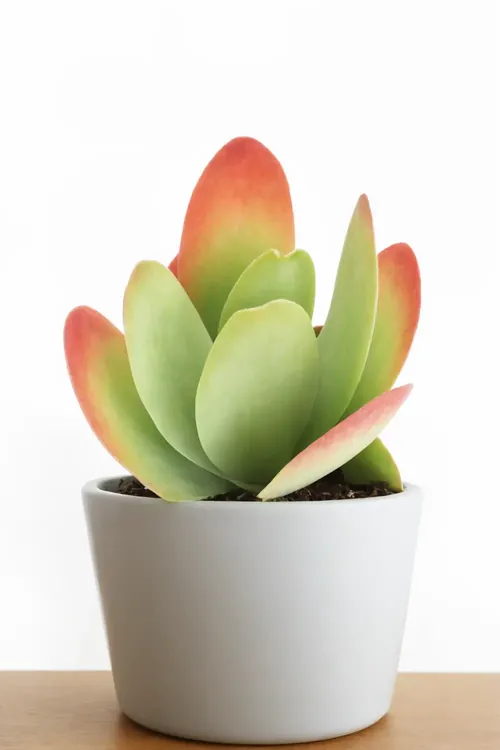
Flapjack Plant is a perennial succulent built around a low basal rosette. Its large, fleshy leaves are round to wedge-shaped, with greyish-green surfaces and red-toned margins. The bold leaf form gives it a sculptural look indoors. It is easy to manage when given bright filtered light, lean soil and long dry periods between thorough waterings.
Care data checked 25 September 2026 · Dany · A-Z Plants
Light requirements
Flapjack Plant needs bright, indirect light in the range of 150 to 250 μmol·m⁻²·s⁻¹.
Place it about 5 ft / 1.5m from a south, west or east-facing window.
Prevent a direct view of the sky from the foliage. If sun reaches the leaves, soften it through a sheer curtain.
Too much direct light can scorch the broad leaves. Too little light may weaken growth and reduce the red coloring.
Use a PAR meter or PAR meter app to check photosynthetically active radiation as PPFD in μmol·m⁻²·s⁻¹.
Watering
Let the Flapjack Plant's soil dry completely before watering again. Check below the surface because the top can feel dry while the lower mix remains damp. A knitting needle or chopstick can test moisture at several depths.
Use room temperature rainwater, distilled water or reverse osmosis water.
Water deeply until the drainage holes release water. Allow the pot to finish draining before setting it in a saucer or decorative planter.
A pot with drainage holes is essential. Wet soil around this succulent can cause root rot and soft, collapsing leaves.
Water considerably less during winter, when growth slows. Excessive drought may produce wrinkled leaves and crisp margins.
Soil
Choose a coarse organic succulent mix for Flapjack Plant. It needs rapid drainage because its thick leaves already store water. A heavy all-purpose soil can remain damp for too long.
DIY mix: blend 2 parts coir, 2 parts coarse sand and 1 part pumice.
Use the mixture in a container with open drainage holes.
Feeding
Feed Flapjack Plant with an organic succulent fertiliser every 2 to 4 weeks from March to October. Apply it at the label strength to damp soil. Avoid extra or overly frequent feeding, and stop during the quieter winter period.
Temperature & humidity
Flapjack Plant prefers 65 to 75°F / 18 to 24°C. Ideal indoor humidity is about 40%. Keep it away from cold drafts and abrupt temperature swings. It does not require humid conditions, and constant dampness around the foliage should be avoided.
What to expect
Flapjack Plant matures in about 2 to 3 years and grows at a moderate rate. Its eventual height is 12 to 18 in / 30 to 45 cm. A mature rosette can also spread 12 to 18 in / 30 to 45 cm.
Varieties & cultivars
Kalanchoe thyrsiflora: The standard Flapjack Plant has greyish-green leaves with a broad, spoon-like form.
Kalanchoe thyrsiflora ‘Variegata’: Its green leaves are bordered by creamy white margins.
Flapjack Plant: questions
Is Flapjack Plant toxic to cats and dogs?
Flapjack Plant is toxic to people and pets. The ASPCA lists kalanchoe plants as toxic to cats and dogs. Keep fallen leaves and the entire pot away from children or animals that…
How much light does Flapjack Plant need?
Flapjack Plant needs bright, indirect light in the range of 150 to 250 μmol·m⁻²·s⁻¹. - Place it about 5 ft / 1.5m from a south, west or east-facing window. - Prevent a direct view of the sky from the foliage. If sun reaches the leaves, soften it through a sheer curtain. - Too much direct light can…
How often should I water Flapjack Plant?
Let the Flapjack Plant's soil dry completely before watering again. Check below the surface because the top can feel dry while the lower mix remains damp. A knitting needle or chopstick can test moisture at several depths. - Use room temperature rainwater, distilled water or reverse osmosis water…
How big does Flapjack Plant get?
Mature size indoors: Its eventual height is 12 to 18 in / 30….