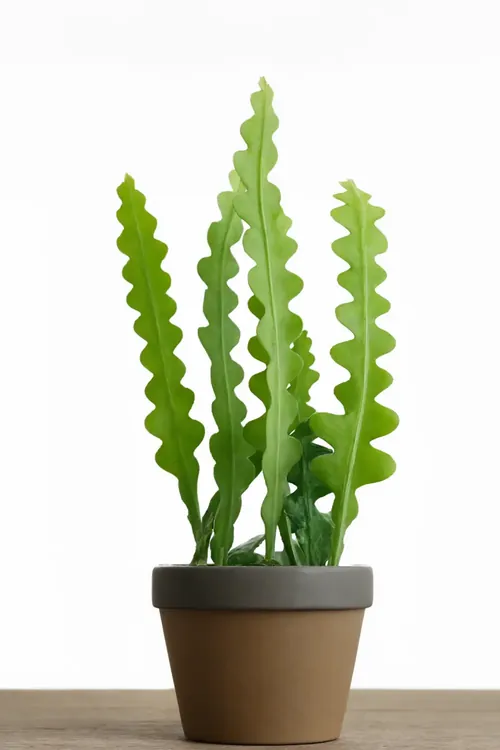
Home › Plants that start with F › Fishbone Cactus
Indoor plant care
Fishbone Cactus
Epiphyllum anguliger
Light requirements
Fishbone Cactus prefers bright indirect light at 150 to 250 μmol·m⁻²·s⁻¹. A PAR meter or PAR meter app can measure this PPFD range.
- Set it about 5 ft / 1.5 m from a south, west, or east-facing window.
- Avoid giving the stems a direct view of the sky. Soften unavoidable sunlight with a sheer curtain.
- Too much direct sun can bleach or scorch the flattened stems.
- Too little light slows growth and may reduce flowering. Rotate hanging baskets so all stems receive balanced exposure.
Watering
Water Fishbone Cactus when the topsoil feels dry. Although it is a cactus, its epiphytic roots should not remain dry for excessive periods during active growth.
- Use room temperature rainwater, distilled water, or reverse osmosis water.
- Water thoroughly until excess runs through the drainage holes. Let the pot drain completely before returning it to a saucer or decorative planter.
- Water considerably less in winter when the plant is not actively growing.
- Constantly wet mix can cause root rot. Severe dryness may wrinkle the stems or leave their edges crispy. A pot with drainage holes is essential.
Soil
Use a specialty organic potting mix formulated for cacti. Fishbone Cactus needs an airy blend that drains freely around its epiphytic roots. For a DIY recipe, combine 2 parts Coir, 2 parts Coarse Sand, and 1 part Pumice. Use a container with open drainage holes and never leave it in runoff.
Feeding
Apply an organic cactus fertilizer every 2 to 4 weeks from March to October. Follow the labeled strength and feed only moist soil. Do not use excess fertilizer to force blooms, and pause regular applications when the Fishbone Cactus slows down in winter.
Temperature & humidity
Fishbone Cactus prefers 60 to 78 °F / 15 to 25 °C. Keep it protected from cold drafts and strong drying heat. Its ideal humidity is 60%, which is higher than many desert cacti prefer. Moderate airflow helps balance this humid environment.
What to expect
Fishbone Cactus takes about 5 to 10 years to mature. Its trailing growth can reach 1 to 2 ft / 30 to 60 cm, with an eventual spread of 12 to 18 in / 30 to 45 cm. Growth is gradual, and stems lengthen as the plant ages.
Varieties & cultivars
- Epiphyllum anguliger ‘El Tecolote’: Bronze-colored stems are paired with white flowers.
- Epiphyllum anguliger × ‘Bonanza Belle’: This hybrid has creamy white inner petals surrounded by lemon yellow outer petals.
- Epiphyllum anguliger ‘Beavertail’: Lighter green stems produce yellow flowers.
Fishbone Cactus: questions
Is Fishbone Cactus toxic to cats and dogs?
Fishbone Cactus is considered non-toxic to people, cats, and dogs. However, the supplied facts do not confirm an ASPCA safety ruling, so it cannot be called pet safe on that…
How much light does Fishbone Cactus need?
Fishbone Cactus prefers bright indirect light at 150 to 250 μmol·m⁻²·s⁻¹. A PAR meter or PAR meter app can measure this PPFD range. - Set it about 5 ft / 1.5 m from a south, west, or east-facing window. - Avoid giving the stems a direct view of the sky. Soften unavoidable sunlight with a sheer…
How often should I water Fishbone Cactus?
Water Fishbone Cactus when the topsoil feels dry. Although it is a cactus, its epiphytic roots should not remain dry for excessive periods during active growth. - Use room temperature rainwater, distilled water, or reverse osmosis water. - Water thoroughly until excess runs through the drainage…
How big does Fishbone Cactus get?
Mature size indoors: Its trailing growth can reach 1 to 2 ft….