LightDendrobium Orchid prefers bright indirect light of 150 to…
WaterWater Dendrobium Orchid when the top of the potting medium…
ToxicitySafe for cats & dogs
Mature sizeIt reaches 1 to 2 ft / 30 to 60 cm tall…
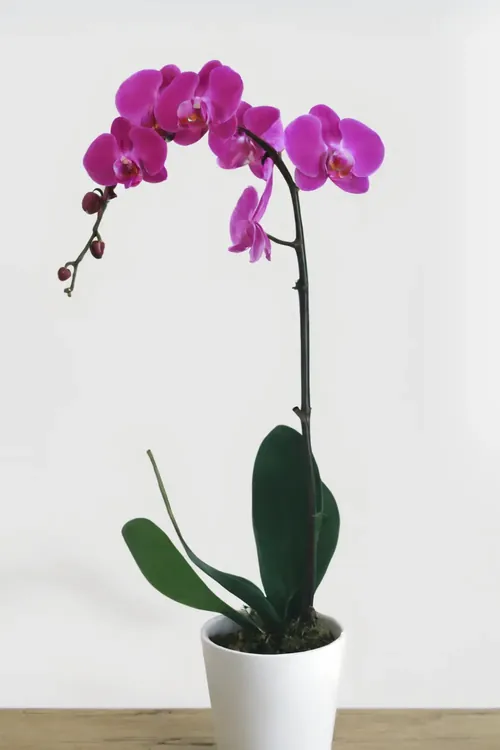
Dendrobium Orchid refers to a diverse group of epiphytic orchids with showy, long-lasting flowers. Blooms may be white, purple, yellow, or pink, depending on the species or cultivar. Their upright or arching canes create a strong shape even when flowers are absent. They suit growers with some experience because temperature and seasonal needs can differ across the group.
Care data checked 25 September 2026 · Dany · A-Z Plants
Light requirements
Dendrobium Orchid prefers bright indirect light of 150 to 250 μmol·m⁻²·s⁻¹. Bright filtered exposure supports firm canes and regular flowering.
Place it about 5 ft / 1.5 m from a south, west, or east-facing window.
Avoid a direct view of the sky. Use a sheer curtain when direct sunlight cannot otherwise be prevented.
Too much light: leaves may become pale or develop dry scorch marks.
Too little light: canes weaken and blooming may stop. A PAR meter or PAR meter app can measure PPFD in μmol·m⁻²·s⁻¹.
Watering
Water Dendrobium Orchid when the top of the potting medium feels dry. Check below the surface because bark pieces can dry at different rates. Let air return to the root zone, but do not leave active growth dry for too long.
Use room temperature rainwater, distilled water, or reverse osmosis water.
Soak the medium until water flows from the drainage holes. Let it drain completely before returning the pot to a saucer or decorative planter.
Drainage holes are essential. Constant wetness can cause root rot and yellow, weakened canes.
Water considerably less during winter when growth is inactive. Severe dryness may wrinkle canes and create crispy leaf edges.
Soil
Use a specialty organic orchid potting mix with a loose, open texture. Dendrobium Orchid roots need excellent airflow and rapid drainage rather than ordinary compact soil.
DIY recipe: combine 4 parts bark, 1 part pumice, and 1 part biochar.
Choose a pot with generous drainage holes.
Feeding
Apply an organic all-purpose fertilizer every 2 to 4 weeks from March to October. Use the recommended strength and feed after watering. Do not apply concentrated fertilizer to dry orchid roots, and reduce feeding during winter when many Dendrobium types slow down.
Temperature & humidity
Dendrobium Orchid grows within 65 to 85 °F / 18 to 30 °C, though individual types may favor different points in that range. Maintain humidity between 50 and 70%. Keep air moving gently around the foliage and protect the plant from cold drafts.
What to expect
Dendrobium Orchid generally takes 2 to 4 years to mature. It reaches 1 to 2 ft / 30 to 60 cm tall and spreads 12 to 18 in / 30 to 45 cm. Growth is moderate, with new canes developing during active seasons.
Varieties & cultivars
Dendrobium nobile: Fragrant purple flowers form in clusters during late winter or spring. This type needs cooler temperatures for best growth.
Dendrobium kingianum: Cascading sprays of orange or yellow flowers appear in summer.
Dendrobium loddigesii: Showy white flowers with purple lips open during spring.
Dendrobium spectabile: Large lavender-pink flowers have a darker lip and bloom from late winter to early spring.
Dendrobium bigibbum: This compact, warmth-loving type produces clusters of white or purple flowers with a clear yellow center.
Dendrobium Orchid: questions
Is Dendrobium Orchid toxic to cats and dogs?
Dendrobium Orchid is considered non-toxic to people. The ASPCA lists Dendrobium orchids as non-toxic to cats and dogs. Chewing flowers, roots, bark, or treated potting material…
How much light does Dendrobium Orchid need?
Dendrobium Orchid prefers bright indirect light of 150 to 250 μmol·m⁻²·s⁻¹. Bright filtered exposure supports firm canes and regular flowering. - Place it about 5 ft / 1.5 m from a south, west, or east-facing window. - Avoid a direct view of the sky. Use a sheer curtain when direct sunlight cannot…
How often should I water Dendrobium Orchid?
Water Dendrobium Orchid when the top of the potting medium feels dry. Check below the surface because bark pieces can dry at different rates. Let air return to the root zone, but do not leave active growth dry for too long. - Use room temperature rainwater, distilled water, or reverse osmosis…
How big does Dendrobium Orchid get?
Mature size indoors: It reaches 1 to 2 ft / 30 to 60 cm tall….