LightDwarf Elephant Ear prefers bright indirect light at 150 to…
WaterWater Dwarf Elephant Ear when the topsoil becomes dry to…
ToxicityToxic to pets
Mature sizeIt can eventually reach 3 to 4 ft / 90…
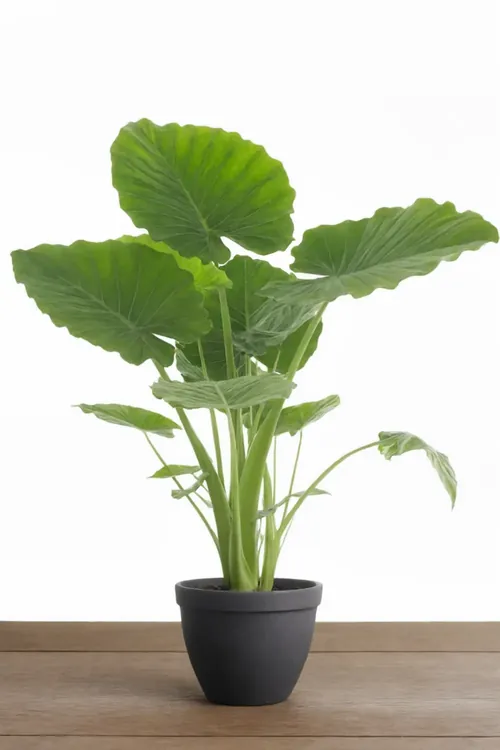
Dwarf Elephant Ear is an evergreen perennial with broad leaves shaped like elephant ears. Each leaf rises on a green petiole, creating a full tropical clump. Its smaller scale makes it easier to place indoors than many large Alocasias. It suits attentive growers who can maintain warm conditions, high humidity, bright filtered light, and evenly managed soil moisture.
Care data checked 25 September 2026 · Dany · A-Z Plants
Light requirements
Dwarf Elephant Ear prefers bright indirect light at 150 to 250 μmol·m⁻²·s⁻¹. Check the PPFD level with a PAR meter or PAR meter app if needed.
Set it around 5 ft / 1.5 m from a south, west, or east-facing window.
The foliage should not have a direct view of the sky. Use a sheer curtain where direct sunlight cannot be avoided.
Too much sun can bleach or scorch the broad leaves.
Too little light leads to weak stems and slow growth. Turn the pot regularly to keep the clump even.
Watering
Water Dwarf Elephant Ear when the topsoil becomes dry to the touch. Check the mix before watering because its needs change with warmth, light, and seasonal growth.
Use room temperature rainwater, distilled water, or reverse osmosis water.
Saturate the mix until water runs from the drainage holes. Let all excess escape before returning the pot to a saucer or decorative planter.
Cut back watering considerably during winter when growth is limited.
Soggy soil can cause root rot, while prolonged dryness may create drooping leaves and crispy edges. A container with drainage holes is required.
Soil
Dwarf Elephant Ear needs an open, moisture-retentive mix. Combine 2 parts organic all-purpose potting mix with 1 part Bark and 1 part Biochar. A DIY version uses 1 part Coir, 1 part Pumice, 1 part Bark, and 1 part Biochar. Add a top dressing of Worm Castings and provide reliable drainage.
Feeding
Apply an organic all-purpose fertilizer every 2 to 4 weeks from March to October. Use the recommended strength on moist soil. Do not apply extra fertilizer to force larger leaves, since excess salts can damage roots. Stop regular feeding when winter growth slows.
Temperature & humidity
Dwarf Elephant Ear prefers 65 to 77 °F / 18 to 25 °C. Protect it from cold drafts and sharp temperature changes. Its ideal humidity range is 60 to 80%. This higher level helps support the broad foliage and reduces dry, crisp edges.
What to expect
Dwarf Elephant Ear matures in about 2 to 3 years. It can eventually reach 3 to 4 ft / 90 to 120 cm tall and spread 2 to 3 ft / 60 to 90 cm. Growth is fairly active under warm, humid conditions with bright filtered light.
Varieties & cultivars
Alocasia gageana ‘California’: Leaves are slightly larger and darker green than those of the species. It is also sold as Alocasia odora ‘California’.
Alocasia gageana ‘Albo’: The rare foliage combines green, cream, and white variegation.
Alocasia gageana ‘Variegata’: Green leaves have white veins and margins. It is also called Alocasia gageana ‘White Vein’.
Alocasia gageana ‘Green Velvet’: Velvety green leaves display strong veins. It resembles Alocasia reginula ‘Black Velvet’, but has lighter coloring.
Alocasia gageana ‘Silver Dragon’: Silvery-green leaves have dark green veins and edges. It is a hybrid of Alocasia gageana and Alocasia reginula.
Dwarf Elephant Ear: questions
Is Dwarf Elephant Ear toxic to cats and dogs?
Dwarf Elephant Ear is toxic to people, cats, and dogs. Its leaves and stems should not be chewed or swallowed. Keep the plant beyond the reach of children and pets. Wear gloves…
How much light does Dwarf Elephant Ear need?
Dwarf Elephant Ear prefers bright indirect light at 150 to 250 μmol·m⁻²·s⁻¹. Check the PPFD level with a PAR meter or PAR meter app if needed. - Set it around 5 ft / 1.5 m from a south, west, or east-facing window. - The foliage should not have a direct view of the sky. Use a sheer curtain where…
How often should I water Dwarf Elephant Ear?
Water Dwarf Elephant Ear when the topsoil becomes dry to the touch. Check the mix before watering because its needs change with warmth, light, and seasonal growth. - Use room temperature rainwater, distilled water, or reverse osmosis water. - Saturate the mix until water runs from the drainage…
How big does Dwarf Elephant Ear get?
Mature size indoors: It can eventually reach 3 to 4 ft / 90….