LightEnglish Ivy prefers medium to bright indirect light at 150…
WaterWater English Ivy when the topsoil feels dry to the touch…
ToxicityToxic to pets
Mature sizesee care guide
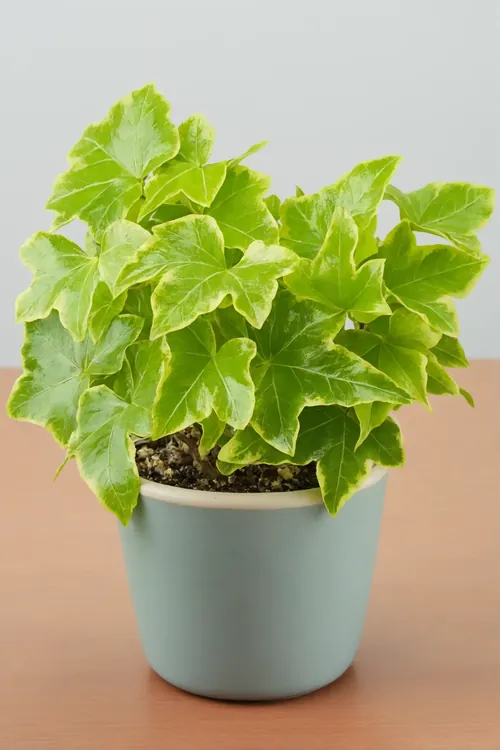
English Ivy is a climbing or trailing vine with glossy, lobed leaves. Cultivars offer many leaf shapes and combinations of green, white, gray, or yellow. Its flexible stems can spill from baskets or climb a support. It suits growers who can provide cool conditions, bright filtered light, and regular pruning. Its toxic foliage makes careful placement important in homes with children or pets.
Care data checked 25 September 2026 · Dany · A-Z Plants
Light requirements
English Ivy prefers medium to bright indirect light at 150 to 200 μmol·m⁻²·s⁻¹. Use a PAR meter or PAR meter app to check this PPFD range.
Position it about 6 ft / 1.8 m from a south, west, or east-facing window.
The leaves should not have a direct view of the sky. Use a sheer curtain when direct sunlight is unavoidable.
Too much sun can scorch the foliage, especially on variegated forms.
Too little light causes sparse growth and weaker variegation. Rotate hanging pots so all stems receive similar exposure.
Watering
Water English Ivy when the topsoil feels dry to the touch. Check the soil before each watering because hanging pots and small containers may dry faster than expected.
Use room temperature rainwater, distilled water, or reverse osmosis water.
Water thoroughly until runoff exits the drainage holes. Let the excess drain completely before placing the pot back on a saucer or inside a decorative planter.
Water considerably less in winter when active growth slows.
Waterlogged soil can cause root rot. Prolonged dryness may result in wilted foliage and crispy edges. Always use a pot with drainage holes.
Soil
English Ivy grows well in an organic all-purpose potting mix. The soil should retain light moisture but drain before roots remain saturated. For a DIY blend, combine 3 parts Coir with 1 part Pumice, then top dress with Worm Castings. Avoid compacted mixes that restrict air around the roots.
Feeding
Feed English Ivy with an organic all-purpose fertilizer every 2 to 4 weeks from March to October. Apply the labeled strength to moist soil. Do not increase the dose to speed climbing growth, and pause routine feeding during winter when growth is slower.
Temperature & humidity
English Ivy prefers cool indoor conditions of 50 to 70 °F / 10 to 21 °C. Keep it away from strong heaters and hot, dry drafts. Its ideal humidity is 40 to 60%. Moderate humidity helps prevent crispy foliage without leaving leaves constantly wet.
What to expect
English Ivy reaches maturity in about 3 to 5 years. Supported or trailing stems can extend to 10 ft / 3 m, depending on the structure provided. The eventual spread may reach 8 ft / 2.5 meters. Growth can be vigorous, so regular pruning is often useful.
Varieties & cultivars
Hedera helix ‘Glacier’: Green, white, and gray leaves grow on a compact, bushy vine suited to pots or hanging baskets.
Hedera helix ‘Sagittifolia’: Deeply lobed, arrowhead-like leaves cover vigorous trailing stems that can climb a trellis or pole.
Hedera helix ‘Goldchild’: Green leaves have yellow edges. Its moderate climbing growth can brighten a shaded location.
Hedera helix ‘Needlepoint’: Narrow, pointed leaves create a lacy look. Slow trailing growth suits small containers and limited spaces.
Hedera helix ‘Wonder’: Dark green leaves show strong white veins. Its fast climbing habit creates dense foliage.
English Ivy: questions
Is English Ivy toxic to cats and dogs?
English Ivy is toxic to people, cats, and dogs. Its leaves and berries should not be eaten, and plant sap may be irritating. Keep the vine beyond the reach of children and pets…
How much light does English Ivy need?
English Ivy prefers medium to bright indirect light at 150 to 200 μmol·m⁻²·s⁻¹. Use a PAR meter or PAR meter app to check this PPFD range. - Position it about 6 ft / 1.8 m from a south, west, or east-facing window. - The leaves should not have a direct view of the sky. Use a sheer curtain when…
How often should I water English Ivy?
Water English Ivy when the topsoil feels dry to the touch. Check the soil before each watering because hanging pots and small containers may dry faster than expected. - Use room temperature rainwater, distilled water, or reverse osmosis water. - Water thoroughly until runoff exits the drainage…