LightEcheveria needs bright direct light at 250 to 1000…
WaterAllow Echeveria soil to dry completely before watering…
ToxicitySafe for cats & dogs
Mature sizeMost indoor plants grow 6 to 12 in / 15…
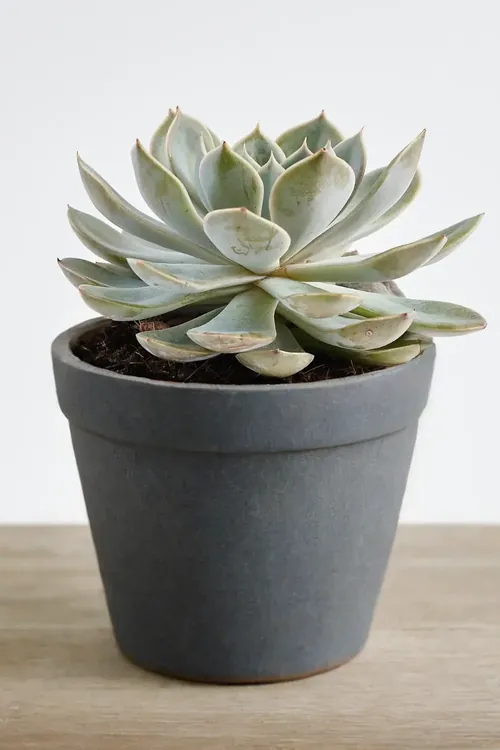
Echeveria is a group of compact succulents that form neat leaf rosettes. Their fleshy, spoon-shaped leaves store water and may appear green, blue, gray, or red-edged. The geometric form suits sunny windowsills and small containers. It is an easy choice for growers who can provide strong light, sparse watering, and a gritty mix that dries quickly.
Care data checked 25 September 2026 · Dany · A-Z Plants
Light requirements
Echeveria needs bright direct light at 250 to 1000 μmol·m⁻²·s⁻¹. Use a PAR meter or PAR meter app to measure this PPFD range.
Provide 6+ hours of direct sunlight each day.
Keep the plant within 2 ft / 60 cm of a south or southwest-facing window, with an unobstructed view of the sky.
Too much intense light without gradual adjustment may scorch the leaves.
Too little light causes stretched, loose rosettes. Grow lights can supplement short winter days when natural daylight hours are reduced.
Watering
Allow Echeveria soil to dry completely before watering. Test moisture at several depths with a knitting needle or chopstick, since the surface may feel dry while the lower mix remains damp.
Use room temperature rainwater, distilled water, or reverse osmosis water.
Water thoroughly until excess flows through the drainage holes. Let the container drain fully before returning it to a saucer or decorative planter.
Water considerably less during winter when growth slows.
Damp soil can quickly cause root rot. Extreme drought may shrivel the leaves or leave dry, crispy edges. A pot with drainage holes is essential.
Soil
Use a specialty organic potting mix formulated for succulents. Echeveria needs a gritty blend that drains quickly and does not remain damp around the roots. For a DIY recipe, combine 2 parts Coir, 2 parts Coarse Sand, and 1 part Pumice. A shallow container with drainage holes works well.
Feeding
Apply an organic fertilizer made for succulents every 2 to 4 weeks from March to October. Use the recommended strength and feed only damp soil. Do not overfertilize, since lush, weak growth can distort the rosette. Stop regular applications during winter.
Temperature & humidity
Echeveria prefers 65 to 80 °F / 18 to 27 °C. Keep it away from cold drafts and very humid, stagnant areas. An ideal humidity level is 40 to 50%. Moderate or dry indoor air suits its succulent leaves better than prolonged dampness.
What to expect
Echeveria reaches maturity in about 2 to 3 years. Most indoor plants grow 6 to 12 in / 15 to 30 cm tall and spread 6 to 12 in / 15 to 30 cm. Growth is compact and moderate when strong light keeps the rosette dense.
Varieties & cultivars
Echeveria agavoides (Fox Tail Echeveria): Narrow, pointed blue-green leaves form rosettes and develop reddish tips.
Echeveria imbricata (Imbricated Echeveria): Thick green leaves overlap closely and show reddish edges.
Echeveria: questions
Is Echeveria toxic to cats and dogs?
Echeveria is considered non-toxic to people, cats, and dogs. However, the supplied facts do not confirm an ASPCA safety ruling for the whole genus, so it cannot be called pet safe…
How much light does Echeveria need?
Echeveria needs bright direct light at 250 to 1000 μmol·m⁻²·s⁻¹. Use a PAR meter or PAR meter app to measure this PPFD range. - Provide 6+ hours of direct sunlight each day. - Keep the plant within 2 ft / 60 cm of a south or southwest-facing window, with an unobstructed view of the sky. - Too much…
How often should I water Echeveria?
Allow Echeveria soil to dry completely before watering. Test moisture at several depths with a knitting needle or chopstick, since the surface may feel dry while the lower mix remains damp. - Use room temperature rainwater, distilled water, or reverse osmosis water. - Water thoroughly until excess…
How big does Echeveria get?
Mature size indoors: Most indoor plants grow 6 to 12 in / 15….