LightElephant Bush prefers bright indirect light at 150 to 250…
WaterLet the soil dry completely before watering Elephant Bush…
ToxicitySafe for cats & dogs
Mature sizeIndoors, it may reach 2 to 4 ft / 0
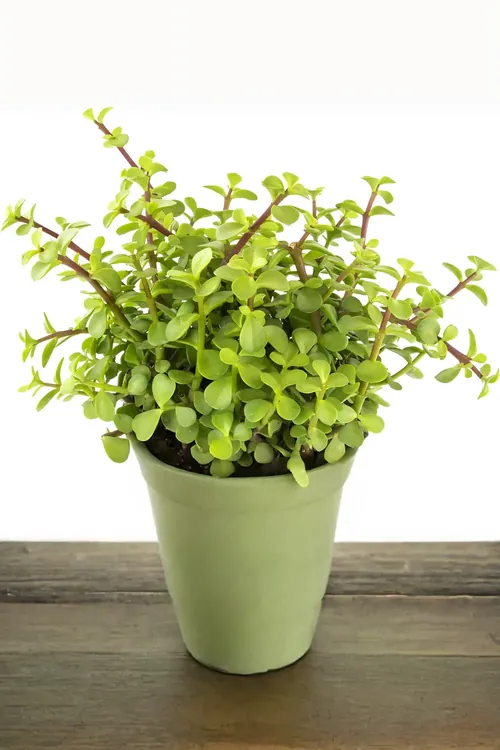
Elephant Bush is a succulent shrub with small, fleshy oval leaves on reddish woody stems. Its flexible branches may trail from a basket or be pruned into a compact, tree-like form. The fine foliage also makes it useful for bonsai. It suits growers who want a forgiving plant but can still provide bright filtered light and let the soil dry fully between waterings.
Care data checked 25 September 2026 · Dany · A-Z Plants
Light requirements
Elephant Bush prefers bright indirect light at 150 to 250 μmol·m⁻²·s⁻¹. A PAR meter or PAR meter app can measure this PPFD level.
Place it around 5 ft / 1.5 m from a south, west, or east-facing window.
The plant should not have a direct view of the sky. Use a sheer curtain to soften unavoidable direct sun.
Too much intense sun without adjustment can scorch or discolor the leaves.
Too little light leads to long, weak stems and sparse foliage. Rotate the container to promote balanced branching.
Watering
Let the soil dry completely before watering Elephant Bush. Check moisture at different depths with a knitting needle or chopstick, because the lower mix may remain damp after the surface dries.
Use room temperature rainwater, distilled water, or reverse osmosis water.
Water deeply until excess runs through the drainage holes. Allow complete drainage before returning the pot to a saucer or decorative planter.
Water considerably less in winter when active growth slows.
Wet soil can cause root rot and stem decline. Severe drought may wrinkle the leaves or make their edges crispy. A container with drainage holes is essential.
Soil
Elephant Bush needs a fast-draining organic potting mix made for succulents. The roots should never remain in a dense, wet blend. For a DIY mix, combine 2 parts Coir, 2 parts Coarse Sand, and 1 part Pumice. Choose a container with open drainage holes and empty any collected runoff.
Feeding
Feed Elephant Bush with an organic succulent fertilizer every 2 to 4 weeks from March to October. Apply the product at its recommended strength to moist soil. Do not use extra fertilizer to force growth, and pause regular feeding during the winter rest period.
Temperature & humidity
Elephant Bush prefers 65 to 80 °F / 18 to 27 °C. Protect it from cold drafts and sudden temperature changes. Its ideal humidity is 40 to 50%. Average indoor air usually works well, while prolonged high humidity can slow soil drying.
What to expect
Elephant Bush takes about 3 to 5 years to mature. Indoors, it may reach 2 to 4 ft / 0.6 to 1.2 m tall and spread 1 to 2 ft / 0.3 to 0.6 m. Growth is moderate, though pruning can keep it smaller and bushier.
Varieties & cultivars
Portulacaria afra ‘Variegata’: Cream and green leaves grow on red stems. It has a more compact, bushy habit than the species.
Portulacaria afra ‘Minima’: Smaller leaves and stems make this dwarf form useful for bonsai or hanging baskets.
Portulacaria afra ‘Decumbent’: Long, thin stems trail across the ground or cascade over walls and containers.
Portulacaria afra ‘Mediopicta’: This rare cultivar has yellow and green leaves on red stems. It grows more slowly than the species.
Elephant Bush: questions
Is Elephant Bush toxic to cats and dogs?
Elephant Bush is considered non-toxic to people, cats, and dogs. However, the supplied facts do not confirm an ASPCA safety ruling, so it cannot be called pet safe on that basis…
How much light does Elephant Bush need?
Elephant Bush prefers bright indirect light at 150 to 250 μmol·m⁻²·s⁻¹. A PAR meter or PAR meter app can measure this PPFD level. - Place it around 5 ft / 1.5 m from a south, west, or east-facing window. - The plant should not have a direct view of the sky. Use a sheer curtain to soften unavoidable…
How often should I water Elephant Bush?
Let the soil dry completely before watering Elephant Bush. Check moisture at different depths with a knitting needle or chopstick, because the lower mix may remain damp after the surface dries. - Use room temperature rainwater, distilled water, or reverse osmosis water. - Water deeply until excess…
How big does Elephant Bush get?
Mature size indoors: Indoors, it may reach 2 to 4 ft / 0.