LightEarth Star shows its strongest color in bright indirect…
WaterWater Earth Star when the topsoil feels dry. Apply water to…
ToxicitySafe for cats & dogs
Mature sizeIt remains only 3 to 6 in / 8 to 15 cm…
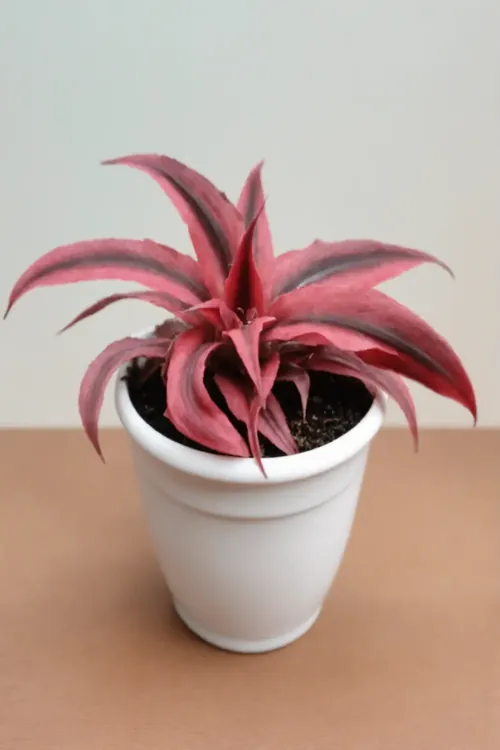
Earth Star is a compact bromeliad that forms a low, spreading rosette. Its strap-shaped leaves have toothed, wavy edges and may show pale green or pink stripes. Unlike tank bromeliads, it grows in soil and should not hold water in its center. Its small size, vivid patterns, and easy care make it useful for shelves, terrariums, and shallow containers.
Care data checked 25 September 2026 · Dany · A-Z Plants
Light requirements
Earth Star shows its strongest color in bright indirect light at 150 to 250 μmol·m⁻²·s⁻¹. A PAR meter or PAR meter app can check the PPFD level.
Position it about 5 ft / 1.5 m from a south, west, or east-facing window.
Avoid giving the rosette a direct view of the sky. Filter direct rays with a sheer curtain.
Too much sunlight can bleach the stripes or scorch the thin leaf edges.
Too little light causes dull color and slower growth. Turn the container so the rosette receives even exposure.
Watering
Water Earth Star when the topsoil feels dry. Apply water to the potting mix rather than filling the central cup formed by the leaves.
Never leave water standing in the central cup or tank.
Use room temperature rainwater, distilled water, or reverse osmosis water.
Water until excess leaves through the drainage holes. Let the pot drain fully before returning it to a saucer or decorative planter.
Water considerably less in winter. Soggy soil can cause root rot, while prolonged dryness may create curled or crispy leaf edges. A pot with drainage holes is essential.
Soil
Earth Star prefers a specialty organic potting mix made for bromeliads. The mix should be coarse, airy, and quick to drain while holding light moisture around the roots. For a DIY recipe, combine 2 parts Bark, 1 part Pumice, and 1 part Biochar. Do not use dense soil that remains waterlogged.
Feeding
Apply an organic fertilizer formulated for bromeliads every 2 to 4 weeks from March to October. Use it at the labeled strength and apply it to moist soil. Do not pour concentrated fertilizer into the rosette. Stop routine feeding when winter growth slows.
Earth Star grows best at 65 to 80 °F / 18 to 27 °C. Protect the low rosette from cold drafts and drying heat. It prefers 50 to 70% humidity. Moderate to high humidity supports healthy leaves, but air movement should remain gentle and steady.
What to expect
Earth Star reaches maturity in about 2 to 3 years. It remains only 3 to 6 in / 8 to 15 cm tall and spreads 6 to 12 in / 15 to 30 cm. Growth is compact, with the rosette widening gradually and producing a low profile.
Varieties & cultivars
Cryptanthus bivittatus ‘Bronze Star’: The leaves carry alternating bronze and green stripes.
Cryptanthus bivittatus ‘Pink Star’: Bright pink bands contrast with green areas on the foliage.
Cryptanthus bivittatus ‘Tricolor’: Green, yellow, and red stripes create a multicolored rosette.
Cryptanthus bivittatus ‘Minimus’: This miniature form has smaller leaves with vivid green coloring.
Cryptanthus bivittatus ‘Zonatus’: Distinct bands of silver and green cross the leaves.
Earth Star: questions
Is Earth Star toxic to cats and dogs?
Earth Star is considered non-toxic to people, cats, and dogs. However, the supplied facts do not confirm an ASPCA safety ruling, so it cannot be called pet safe on that basis…
How much light does Earth Star need?
Earth Star shows its strongest color in bright indirect light at 150 to 250 μmol·m⁻²·s⁻¹. A PAR meter or PAR meter app can check the PPFD level. - Position it about 5 ft / 1.5 m from a south, west, or east-facing window. - Avoid giving the rosette a direct view of the sky. Filter direct rays with a…
How often should I water Earth Star?
Water Earth Star when the topsoil feels dry. Apply water to the potting mix rather than filling the central cup formed by the leaves. - Never leave water standing in the central cup or tank. - Use room temperature rainwater, distilled water, or reverse osmosis water. - Water until excess leaves…
How big does Earth Star get?
Mature size indoors: It remains only 3 to 6 in / 8 to 15 cm….