LightBoston Fern needs bright indirect light at 150 to 250…
WaterKeep Boston Fern soil consistently moist without leaving it…
ToxicitySafe for cats & dogs
Mature sizeIts fronds can stand or trail 1 to 3 ft…
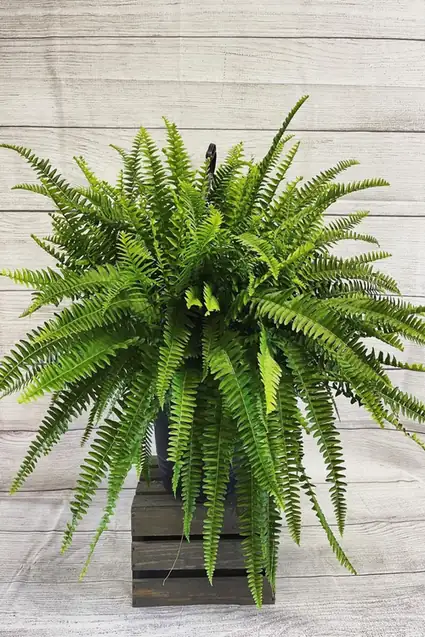
Boston Fern forms a lush fountain of arching fronds covered with many fine leaflets. Mature foliage spills over the pot, making this fern useful on plant stands or in hanging planters. Its soft green texture adds volume without a rigid outline. It suits growers who enjoy full, cascading foliage and can maintain consistent moisture, filtered light, and moderate to high humidity throughout the year.
Care data checked 25 September 2026 · Dany · A-Z Plants
Light requirements
Boston Fern needs bright indirect light at 150 to 250 μmol·m⁻²·s⁻¹ PPFD. Keep direct rays off its fine, sensitive fronds.
Placement: position it about 5 ft / 1.5 m from a south, west or east-facing window. It should not see open sky directly.
Filtering: use a sheer curtain where sunlight would otherwise fall on the leaves.
Measurement: a PAR meter or PAR meter app can measure photosynthetically active radiation.
Too much light causes bleaching and crisp patches. Too little light slows growth, thins the plant, and increases frond loss.
Watering
Keep Boston Fern soil consistently moist without leaving it soggy. Check moisture at several depths with a knitting needle or chopstick. Use room temperature rainwater, distilled water, or reverse osmosis water.
Water the whole root ball until excess runs through the drainage holes. Let it escape fully before returning the pot to a saucer or decorative planter.
Drainage holes are essential. Waterlogged soil restricts air and encourages root rot.
Reduce watering considerably during winter, when active growth is slower, but never allow a long dry spell.
Dry soil and low humidity can create crispy leaflets and shedding fronds. Yellowing or a sour-smelling mix may indicate too much water.
Soil
An organic all-purpose potting mix holds the moisture Boston Fern needs. It should remain loose enough to drain and admit air after each watering. Never place it in a sealed container without drainage.
DIY recipe: combine 3 parts coir with 1 part pumice.
Apply worm castings as a light top dressing.
Feeding
Apply an organic all-purpose fertilizer every 2 to 4 weeks from March to October. Feed Boston Fern after watering or while the soil is already moist. Avoid strong or excessive applications, which may burn fine roots and fronds. Pause routine feeding during winter.
Temperature & humidity
Boston Fern grows best at 65 to 80°F / 18 to 27°C. Keep it away from cold drafts and hot, dry vents. Aim for 50 to 70% humidity. Adequate humidity helps prevent brown tips and leaflet drop, but it does not replace proper soil moisture.
What to expect
Boston Fern usually reaches maturity in 2 to 3 years. Its fronds can stand or trail 1 to 3 ft / 30 to 90 cm. The eventual spread is also 1 to 3 ft / 30 to 90 cm. Growth forms a widening, cascading clump.
Varieties & cultivars
Nephrolepis exaltata ‘Compacta’: This is a smaller, denser form of the standard Boston Fern.
Nephrolepis exaltata ‘Fluffy Ruffle’: Closely curled fronds give the plant a full, ruffled texture.
Nephrolepis exaltata ‘Dallasii’: Its finer fronds create a light, graceful outline.
Nephrolepis exaltata ‘Kimberly Queen’: Fronds grow more upright, and the cultivar is noted for air-purifying qualities.
Nephrolepis exaltata ‘Golden Boston’: Golden-green fronds distinguish this selection from darker forms.
Boston Fern: questions
Is Boston Fern toxic to cats and dogs?
The ASPCA lists Boston Fern as non-toxic to cats and dogs. It is also considered non-toxic to people. A pet may still develop minor stomach upset after eating a large amount, and…
How much light does Boston Fern need?
Boston Fern needs bright indirect light at 150 to 250 μmol·m⁻²·s⁻¹ PPFD. Keep direct rays off its fine, sensitive fronds. - Placement: position it about 5 ft / 1.5 m from a south, west or east-facing window. It should not see open sky directly. - Filtering: use a sheer curtain where sunlight would…
How often should I water Boston Fern?
Keep Boston Fern soil consistently moist without leaving it soggy. Check moisture at several depths with a knitting needle or chopstick. Use room temperature rainwater, distilled water, or reverse osmosis water. - Water the whole root ball until excess runs through the drainage holes. Let it escape…
How big does Boston Fern get?
Mature size indoors: Its fronds can stand or trail 1 to 3 ft….