WaterKeep Baby’s Tears consistently moist, but not soggy. Check…
ToxicitySafe for cats & dogs
Mature sizesee care guide
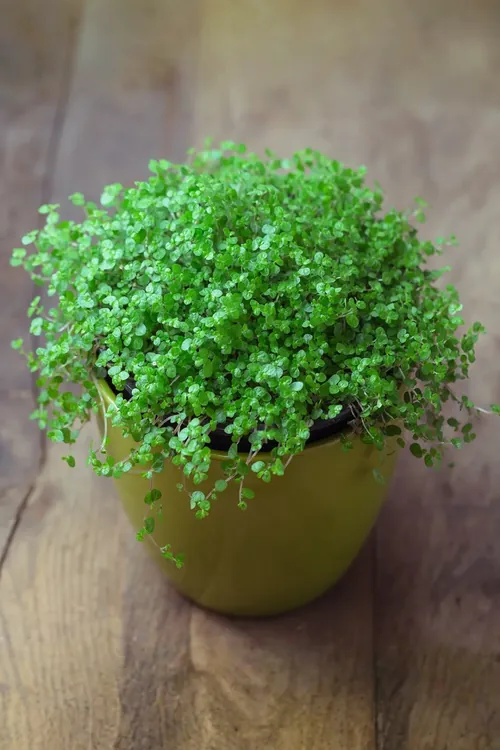
Baby’s Tears is a mat-forming tropical perennial with countless small leaves. Each round or bean-shaped leaf grows on a short, fleshy stem, creating a dense carpet. The plant spills gently over pot edges and also suits humid terrariums. It is easy to grow when moisture never swings too far. Dry soil can damage the fine growth quickly, while poor drainage may cause stems and roots to rot.
Set it 5 ft / 1.5 m from a south, west, or east-facing window, without a direct view of the sky.
Use a sheer curtain if sunlight reaches the foliage. Strong direct rays can scorch and dry the tiny leaves.
Too little light produces loose, thin growth and may weaken variegated coloring.
A PAR meter or PAR meter app can measure photosynthetically active radiation as PPFD (μmol·m⁻²·s⁻¹).
Watering
Keep Baby’s Tears consistently moist, but not soggy. Check several soil depths with a knitting needle or chopstick before watering. Its fine stems can wilt quickly when the root zone becomes dry.
Use room temperature rainwater, distilled water, or reverse osmosis water.
Water thoroughly until excess exits the drainage holes. Let the pot drain completely before placing it back in a saucer or decorative planter.
Water considerably less in winter, when growth slows, but do not let the soil dry fully.
Constant saturation can cause root rot and stem collapse. Drought leads to wilting and crisp, brown patches. A container with drainage holes is essential.
Soil
Use an organic all-purpose potting mix that holds even moisture while draining excess water. For a DIY blend, mix 3 parts coir with 1 part pumice. Add a top dressing of worm castings. Baby’s Tears has fine roots, so avoid dense, compacted soil and ensure the pot's drainage holes remain open.
Feeding
Apply an organic all-purpose fertilizer every 2 to 4 weeks from March to October. Feed Baby’s Tears during active growth and use it only on moist soil. Reduce feeding in winter. Too much fertilizer may burn the fine roots or produce soft, weak stems.
Temperature & humidity
Baby’s Tears prefers 65 to 75°F / 18 to 24°C and humidity of 50% or higher. Keep the plant away from cold drafts, heaters, and air-conditioning vents. Higher humidity supports its delicate leaves, but airflow and drainage still matter because constantly wet stems may rot.
What to expect
Baby’s Tears grows continuously rather than reaching a fixed maturity point. It stays low at about 4 in / 10 cm tall but may spread as far as 3 ft / 90 cm. Growth is fast under warm, humid conditions, creating a dense mat that spills over containers.
Varieties & cultivars
Soleirolia soleirolii ‘Aurea’: Gold and green leaves create a brighter look. This cultivar is more compact than the standard form.
Soleirolia soleirolii ‘Alba’: Silvery-green foliage grows quickly and contrasts well with greener cultivars.
Soleirolia soleirolii ‘Golden Queen’: Yellowish margins outline the small leaves.
Soleirolia soleirolii ‘Silver Queen’: Silver-gray foliage gives this cultivar a cool-toned appearance.
Soleirolia soleirolii ‘Variegata’: Silverish leaves carry fine white stippling. It was formerly called ‘Argentea’.
Baby’s Tears: questions
Is Baby’s Tears toxic to cats and dogs?
Baby’s Tears is considered non-toxic to people. The ASPCA lists Soleirolia soleirolii as non-toxic to cats and dogs. This makes it a lower-risk plant for homes with pets. However…
How much light does Baby’s Tears need?
Baby’s Tears prefers bright, indirect light measuring 150 to 250 μmol·m⁻²·s⁻¹. - Set it 5 ft / 1.5 m from a south, west, or east-facing window, without a direct view of the sky. - Use a sheer curtain if sunlight reaches the foliage. Strong direct rays can scorch and dry the tiny leaves. - Too…
How often should I water Baby’s Tears?
Keep Baby’s Tears consistently moist, but not soggy. Check several soil depths with a knitting needle or chopstick before watering. Its fine stems can wilt quickly when the root zone becomes dry. - Use room temperature rainwater, distilled water, or reverse osmosis water. - Water thoroughly until…