WaterWater Baby Rubber Plant when the topsoil feels dry. Check…
ToxicitySafe for cats & dogs
Mature sizesee care guide
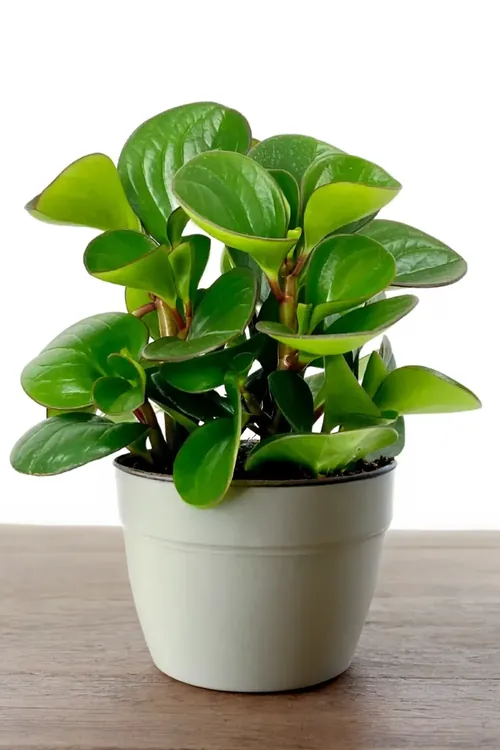
Baby Rubber Plant is a compact houseplant with thick, glossy leaves shaped like rounded spoons. The fleshy foliage stores some moisture, helping the plant handle an occasional missed watering. Its tidy, upright form fits shelves, desks, and small rooms. It is easy to maintain under bright filtered light and normal indoor conditions. Several cultivars add white, yellow, or lime markings to the leaves.
Water Baby Rubber Plant when the topsoil feels dry. Check the mix beneath the surface first, since its thick leaves hold moisture and the roots dislike constant dampness. Let some air return to the soil between waterings.
Use room temperature rainwater, distilled water, or reverse osmosis water.
Water deeply until excess exits the drainage holes. Let the container drain fully before returning it to a saucer or decorative planter.
Water considerably less in winter, when the plant is not actively growing.
Waterlogged soil can cause root rot, yellow leaves, and soft stems. Long dry spells may wrinkle leaves or cause crispy edges. A pot with drainage holes is essential.
Soil
Use an organic all-purpose potting mix that drains freely and does not pack around the roots. For a simple DIY mix, combine 3 parts coir with 1 part pumice. Add worm castings as a top dressing. Baby Rubber Plant tolerates brief dryness better than heavy soil, so open drainage holes are important.
Apply an organic all-purpose fertilizer every 2 to 4 weeks from March to October. Feed Baby Rubber Plant during active growth and apply fertilizer only to moist soil. Stop or reduce feeding in winter. Overfeeding can burn roots, build up salts, or produce weak, stretched stems.
Baby Rubber Plant prefers 65 to 75°F / 18 to 24°C and humidity between 40 to 50%. Average household humidity is usually adequate. Keep it away from cold drafts and direct airflow from heaters or air conditioners. Stable warmth supports steady, compact growth.
What to expect
Baby Rubber Plant may take 2 to 5 years to mature. It generally reaches 1 ft / 30 cm tall and spreads about 1 ft / 30 cm. Growth is slow to moderate. Pinching the stem tips can encourage a denser, more branched shape.
Varieties & cultivars
Peperomia obtusifolia ‘Variegata’: White and green marble-like patterns cover the glossy leaves.
Peperomia obtusifolia ‘Green’: This form has classic, solid dark green foliage.
Peperomia obtusifolia ‘Golden Gate’: Yellow margins frame each leaf.
Peperomia obtusifolia ‘Albo-marginata’: Clear white edges contrast with the green leaf centers.
Peperomia obtusifolia ‘Lemon Lime’: Bright green and yellow coloring gives the foliage a fresh appearance.
Baby Rubber Plant: questions
Is Baby Rubber Plant toxic to cats and dogs?
Baby Rubber Plant is considered non-toxic to people. The ASPCA lists Peperomia obtusifolia as non-toxic to cats and dogs. It is a lower-risk choice for pet-owning homes, but no…
How much light does Baby Rubber Plant need?
Baby Rubber Plant prefers bright, indirect light between 150 to 250 μmol·m⁻²·s⁻¹. - Place it 5 ft / 1.5 m from a south, west, or east-facing window, without a direct view of the sky. - Filter unavoidable sun with a sheer curtain. Harsh direct rays can bleach or scorch the thick leaves. - Too little…
How often should I water Baby Rubber Plant?
Water Baby Rubber Plant when the topsoil feels dry. Check the mix beneath the surface first, since its thick leaves hold moisture and the roots dislike constant dampness. Let some air return to the soil between waterings. - Use room temperature rainwater, distilled water, or reverse osmosis water…