LightBlue Star Fern prefers bright indirect light at 150 to 250…
WaterKeep the soil consistently moist for Blue Star Fern, but do…
ToxicityNot ASPCA-listed
Mature sizeIt can eventually reach 2 to 3 feet /…
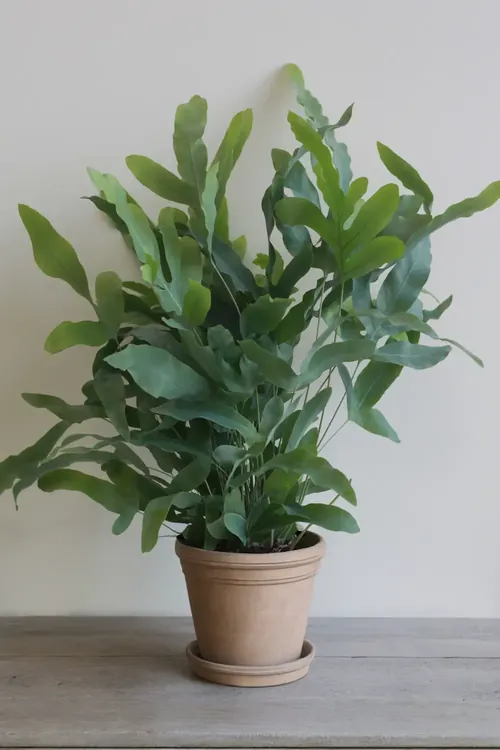
Blue Star Fern is an evergreen fern that spreads from creeping rhizomes and forms a broad clump. Its arching fronds have an unusual blue-green cast and softly divided outlines. The foliage looks less delicate than many traditional ferns. This easy indoor plant suits shelves, stands, or wide pots. It works well for growers who can maintain light moisture while keeping the rhizomes above dense, soggy soil.
Care data checked 25 September 2026 · Dany · A-Z Plants
Light requirements
Blue Star Fern prefers bright indirect light at 150 to 250 μmol·m⁻²·s⁻¹ PPFD. Its blue-green fronds should be shielded from direct sun.
Placement: keep it about 5 ft / 1.5 m from a south, west or east-facing window, without a direct view of the sky.
Filtering: a sheer curtain can soften any unavoidable direct sunlight.
Measurement: check photosynthetically active radiation with a PAR meter or PAR meter app.
Too much light can bleach or crisp the fronds. Too little light reduces growth and may create a thin, open clump.
Watering
Keep the soil consistently moist for Blue Star Fern, but do not make it soggy. Test several depths with a knitting needle or chopstick before adding more water. Use room temperature rainwater, distilled water, or reverse osmosis water.
Water across the mix until liquid drains from the bottom. Let the pot empty completely before setting it in a saucer or decorative planter.
A pot with drainage holes is essential. Stagnant moisture can rot roots and creeping rhizomes.
Water considerably less in winter because the fern is not growing as actively. Avoid letting the whole pot become bone dry.
Crispy frond edges suggest extended dryness or low humidity. Yellowing near the base can indicate excess moisture.
Soil
Use an organic all-purpose potting mix with enough air space for the fern’s roots and rhizomes. The mix should remain lightly moist yet drain promptly after watering. A pot with drainage holes is required.
DIY mix: combine 3 parts coir with 1 part pumice.
Top dress sparingly with worm castings.
Feeding
Feed Blue Star Fern with an organic all-purpose fertilizer every 2 to 4 weeks from March to October. Apply it to moist soil and follow the recommended dose. Do not overfeed the rhizomes. Stop regular applications when cooler, darker conditions slow growth.
Temperature & humidity
Blue Star Fern prefers 65 to 80°F / 18 to 27°C. Keep it away from cold windows, drafts, and drying vents. Humidity between 50 and 70% supports flexible fronds and cleaner edges. Lower humidity may cause tips or margins to become brown and crisp.
What to expect
Blue Star Fern takes about 2 to 5 years to mature. It can eventually reach 2 to 3 feet / 60 to 90 cm in height. Its spread is also 2 to 3 feet / 60 to 90 cm. Rhizomes expand sideways, gradually creating a broad clump.
Varieties & cultivars
Phlebodium aureum ‘Crispum’: Deeply ruffled and crested fronds give this form a strongly textured appearance.
Phlebodium aureum ‘Denta’: Sharply toothed margins give the fronds a more traditionally fern-like look.
Phlebodium aureum ‘Blue Moon’: This cultivar is valued for especially vivid blue fronds.
Phlebodium aureum ‘Midas Touch’: Its foliage stands out with a golden-yellow color.
Blue Star Fern: questions
Is Blue Star Fern toxic to cats and dogs?
Blue Star Fern is not listed by the ASPCA, so it has no official safety ruling for cats or dogs. It cannot be called pet safe from that evidence alone. The plant is generally…
How much light does Blue Star Fern need?
Blue Star Fern prefers bright indirect light at 150 to 250 μmol·m⁻²·s⁻¹ PPFD. Its blue-green fronds should be shielded from direct sun. - Placement: keep it about 5 ft / 1.5 m from a south, west or east-facing window, without a direct view of the sky. - Filtering: a sheer curtain can soften any…
How often should I water Blue Star Fern?
Keep the soil consistently moist for Blue Star Fern, but do not make it soggy. Test several depths with a knitting needle or chopstick before adding more water. Use room temperature rainwater, distilled water, or reverse osmosis water. - Water across the mix until liquid drains from the bottom. Let…
How big does Blue Star Fern get?
Mature size indoors: It can eventually reach 2 to 3 feet /….