LightBleeding Heart Vine performs best in bright indirect light…
WaterKeep Bleeding Heart Vine evenly moist, but never leave its…
ToxicityNot ASPCA-listed
Mature sizeIts stems may reach 6 to 10 ft / 1
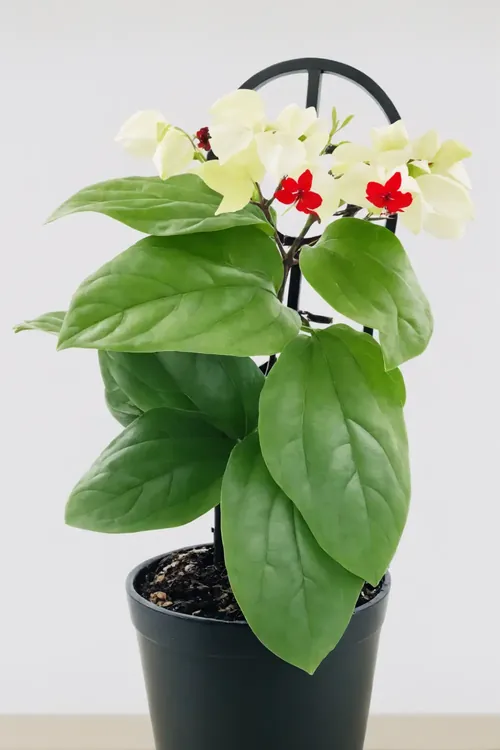
Bleeding Heart Vine is an evergreen climber with glossy green leaves and showy, heart-shaped flowers. Its contrasting blooms appear in clusters and stand out clearly against the foliage. Flexible stems can climb a support or be trained around a frame. This plant suits growers who want a flowering indoor vine and can provide filtered light, steady moisture, and regular shaping as the stems lengthen.
Care data checked 25 September 2026 · Dany · A-Z Plants
Light requirements
Bleeding Heart Vine performs best in bright indirect light at 150 to 250 μmol·m⁻²·s⁻¹ PPFD. Filter intense sun to protect the leaves and flowers.
Placement: set it about 5 ft / 1.5 m from a south, west or east-facing window. Avoid an unobstructed view of the sky.
Filtering: hang a sheer curtain if direct rays would otherwise touch the plant.
Measurement: use a PAR meter or PAR meter app to check photosynthetically active radiation.
Too much light may scorch foliage. Too little light leads to weak vines and fewer flowers.
Watering
Keep Bleeding Heart Vine evenly moist, but never leave its potting mix sodden. Test moisture at several depths with a knitting needle or chopstick. Use room temperature rainwater, distilled water, or reverse osmosis water.
Water thoroughly until liquid runs from the drainage holes. Wait for all excess to escape before replacing the saucer or decorative planter.
Drainage holes are essential. Constantly saturated soil can cause root rot and yellow leaves.
Use considerably less water in winter, when active growth slows, while preventing complete dryness.
Crispy edges and wilted leaves can develop if the root ball remains dry for too long. Do not respond to every wilt by watering without checking the soil first.
Soil
An organic all-purpose potting mix gives Bleeding Heart Vine a balance of moisture retention and drainage. The roots need air, so avoid tightly packed or waterlogged soil. Use a container with open drainage holes.
DIY recipe: mix 3 parts coir with 1 part pumice.
Add a light top dressing of worm castings.
Feeding
Apply an organic all-purpose fertilizer every 2 to 4 weeks from March to October. Feed Bleeding Heart Vine while growth and flowering are active. Apply fertilizer to damp soil and avoid exceeding the label rate. Pause routine feeding during the slower winter period.
Temperature & humidity
Bleeding Heart Vine prefers 55 to 75°F / 13 to 24°C. Shield it from cold drafts and major temperature swings. Aim for humidity near 50%. This moderate level helps preserve healthy leaves and flowers without requiring constantly saturated soil.
What to expect
Bleeding Heart Vine matures in about 2 to 3 years. Its stems may reach 6 to 10 ft / 1.8 to 3 m, while the plant can spread 3 to 5 ft / 0.9 to 1.5 m. Its climbing growth needs support and occasional guidance indoors.
Varieties & cultivars
Clerodendrum thomsoniae ‘Variegatum’: Cream-colored edges brighten the leaves. The flowers remain white and red.
Clerodendrum thomsoniae ‘Delectum’: Larger flower clusters appear in a lighter shade of red.
Clerodendrum thomsoniae ‘Rosea’: This cultivar produces pink and white flowers.
Clerodendrum thomsoniae ‘Alba’: Its flowers are pure white.
Clerodendrum thomsoniae ‘White Wings’: Clusters of pure white blooms carry a subtle fragrance.
Bleeding Heart Vine: questions
Is Bleeding Heart Vine toxic to cats and dogs?
Bleeding Heart Vine is not listed by the ASPCA, so there is no official safety ruling for cats or dogs. It cannot be described as pet safe on that basis. Although it is generally…
How much light does Bleeding Heart Vine need?
Bleeding Heart Vine performs best in bright indirect light at 150 to 250 μmol·m⁻²·s⁻¹ PPFD. Filter intense sun to protect the leaves and flowers. - Placement: set it about 5 ft / 1.5 m from a south, west or east-facing window. Avoid an unobstructed view of the sky. - Filtering: hang a sheer curtain…
How often should I water Bleeding Heart Vine?
Keep Bleeding Heart Vine evenly moist, but never leave its potting mix sodden. Test moisture at several depths with a knitting needle or chopstick. Use room temperature rainwater, distilled water, or reverse osmosis water. - Water thoroughly until liquid runs from the drainage holes. Wait for all…
How big does Bleeding Heart Vine get?
Mature size indoors: Its stems may reach 6 to 10 ft / 1.